
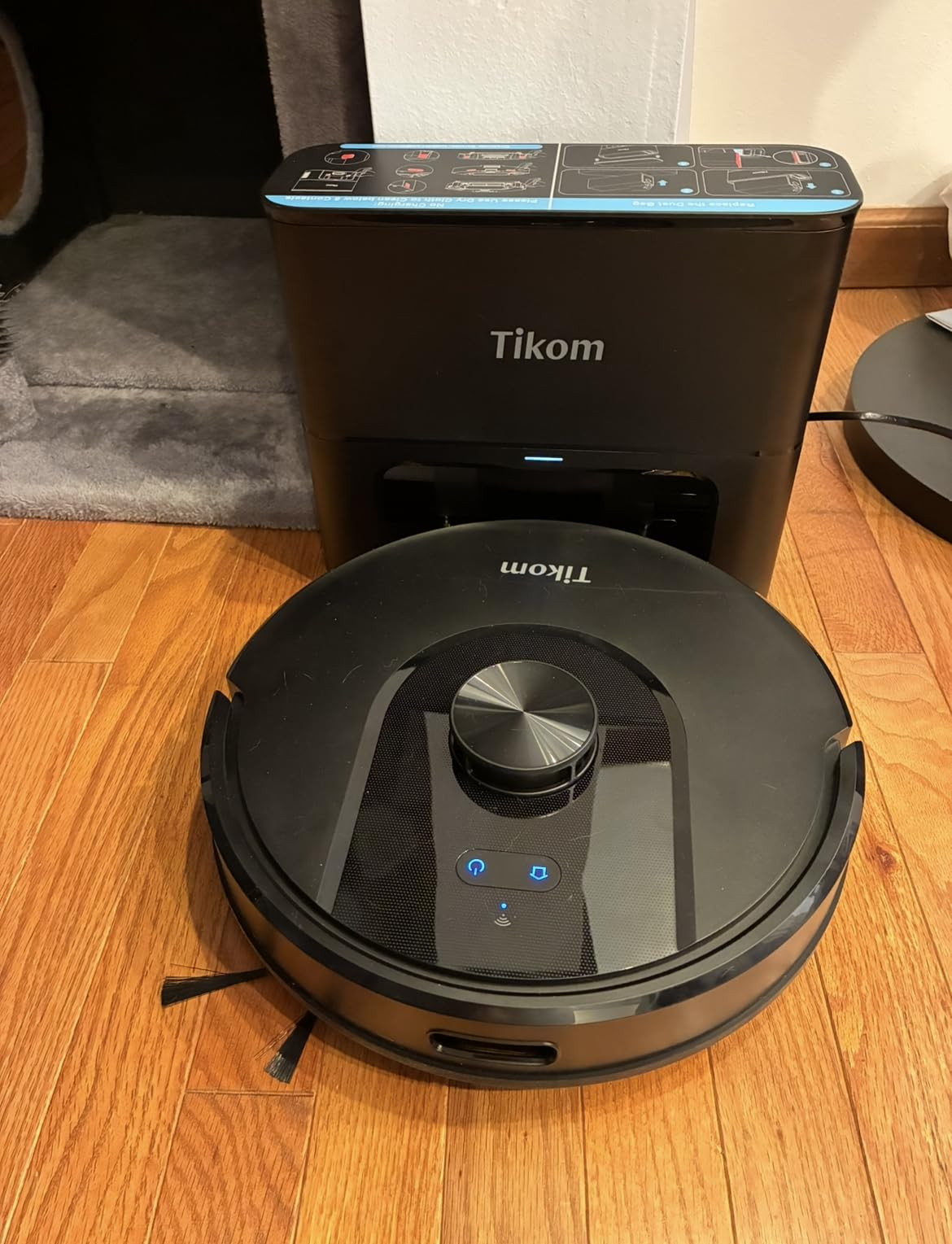
tikom robot vacuum and mop combo review
The feature sheet is where many robot vacuum comparisons become misleading. A high Pa number may look impressive, but a useful robotic cleaner depends on the combination of suction, airflow, brush design, navigation, battery management, filtration, and how effectively the machine converts those specifications into actual floor coverage.
For this reason, our assessment treats each specification as part of a larger cleaning system. The L8000 Plus, for example, is officially positioned with 6,000Pa maximum suction, up to 150 minutes of battery runtime, LiDAR-based navigation, and a self-emptying system. Independent testing found approximately 1.08 kPa suction and 15 CFM airflow on that model, illustrating why advertised Pa and measured airflow should not be treated as interchangeable metrics.
Suction Power and Cleaning Performance
Suction power is one of the first specifications shoppers notice. Tikom’s higher-end models advertise substantial maximum suction figures, but maximum laboratory-style suction does not tell the entire story about how much dirt reaches the dustbin.
Pa suction represents pressure generated by the vacuum system. Water Lift (inches) is another way of describing suction pressure, while CFM airflow describes how much air the system can move. In practical cleaning, both pressure and airflow can influence how effectively particles are transported through the brush and intake.
The brush roll matters as well. A robot needs to agitate debris from carpet fibers while its airflow carries the particles toward the dustbin. This is why two machines with similar advertised suction can produce different results on rugs, pet hair, and embedded debris.
Independent testing of the L8000 Plus demonstrates this distinction. Vacuum Wars measured 1.08 kPa suction and 15 CFM airflow, with the model performing close to average overall in those bench measurements. It also removed 79% of embedded sand in its carpet deep-clean test.
Bottom Line: Don’t buy a Tikom robot simply because the Pa number looks high. Consider suction, airflow, brush design, floor type, and real-world pickup together.
Dustbin and Water Tank Capacity
The onboard dustbin determines how much debris the robotic vacuum can collect before requiring attention. A smaller bin can become inconvenient in homes with pets or high traffic because hair and debris accumulate quickly.
The L8000 Plus combines a 450ml onboard dustbin with a self-emptying dock using a 3-liter disposable dust bag. That changes the maintenance equation because the robot can transfer collected debris to the larger base rather than requiring manual emptying after every cleaning cycle.
The mopping system adds another capacity consideration. Water capacity affects how much floor can be damp-cleaned before refilling. However, a larger water tank does not automatically mean better mopping. Water delivery, pad pressure, pad movement, and stain-removal ability are equally important.
For mixed-floor homes, also consider whether the robot can identify areas that should remain dry. A fixed mop pad can create problems when the robot travels onto carpet while the mopping attachment is installed.
Bottom Line: Look at the complete cleaning workflow—dust capacity, self-emptying, water capacity, and mop behavior—not just individual tank sizes.
Battery Runtime and Recharge-and-Resume
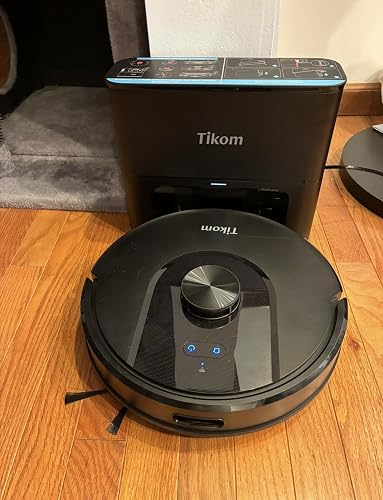
Battery runtime determines how much floor the robot can cover before it needs to return to the charging station. Tikom’s L8000 Plus is officially rated for up to 150 minutes, although actual coverage depends on suction mode, flooring, navigation, obstacles, and the number of times the robot has to maneuver around furniture.
Higher suction settings normally consume more energy than gentler modes. Carpet cleaning can also require more power because the robot may increase suction automatically. A complicated home with many rooms can therefore produce considerably different results from a large open-plan space.
Recharge-and-resume is especially useful in larger houses. Instead of stopping permanently when the battery becomes low, a supported robot can return to its dock, recharge, and continue the unfinished cleaning route.
Independent testing found the L8000 Plus less efficient than the comparison average in battery coverage, estimating approximately 881 square feet per charge in that test environment. The machine nevertheless supports recharge-and-resume, which reduces the practical impact for users willing to let it complete a job in multiple stages.
Bottom Line: Advertised runtime is useful for comparison, but coverage per charge is a more meaningful real-world consideration.
Design, Height, Wheels, and Threshold Handling
Robot vacuum design directly affects where the machine can clean. A low-profile body can travel beneath beds, sofas, cabinets, and other furniture that a conventional upright vacuum may struggle to reach.
Wheel design is equally important. The robot needs enough traction to cross common transitions between rooms without becoming trapped against thresholds or rug edges.
In a real home, furniture legs create another challenge. Even when a robot has accurate mapping, narrow spaces can force repeated turning and repositioning. This increases cleaning time and can reduce battery efficiency.
Field Note: One of the easiest things to overlook when evaluating an autonomous cleaner is the difference between mapped space and usable cleaning space. A robot may successfully map a room but still spend significant time maneuvering around chair legs, rug edges, and tight furniture gaps.
Bottom Line: A robot’s physical design is just as important as its software. Check furniture clearance, rug transitions, and thresholds before expecting completely hands-off cleaning.
Tikom Robot Vacuum Technology — Navigation, Mapping & Smart Cleaning
Navigation is one of the biggest differences between inexpensive and premium robotic cleaners. The best systems do more than randomly move around until the battery becomes low; they create a map, understand room positions, calculate routes, and return to unfinished areas.
Tikom’s lineup is particularly important to examine model by model because navigation technology is not identical across every machine. The L8000 Plus uses spinning LiDAR, while other Tikom products may use different navigation systems.
LiDAR Navigation vs Gyroscope Navigation
LiDAR navigation uses laser-based distance measurements to understand the surrounding environment. A spinning sensor can detect walls, furniture, and room boundaries while the robot calculates its position.
This is different from simply driving forward and reacting when the robot hits something. With structured mapping, a robot can create a more coherent floor plan and plan more systematic cleaning routes.
SLAM mapping—simultaneous localization and mapping—is a useful technical concept here. It describes the broader process of building a map while determining the robot’s position within that environment. LiDAR is one sensor technology that can support this type of mapping.
However, shoppers should not assume that every Tikom model includes LiDAR. The exact navigation technology must be verified against the individual model being purchased.
Independent testing of the L8000 Plus found its LiDAR navigation efficient, with the robot achieving 0.89 square meters per minute in the cited navigation test compared with a 0.72 square meters per minute average.
Bottom Line: LiDAR can make a budget robot considerably more systematic, but navigation technology should always be checked by model rather than assumed across the Tikom brand.
Smart Mapping and Multi-Floor Cleaning
Smart mapping transforms a robotic vacuum from a simple automated cleaner into a more configurable floor-cleaning system.
On supported models, users can identify rooms, select specific areas, establish virtual barriers, and create no-go or no-mop zones. This is particularly useful in homes where some areas contain delicate rugs, pet bowls, cables, or spaces that should not receive water.
The L8000 Plus supports multi-level maps, virtual barriers, and no-go zones. That makes it more useful for multi-story homes than basic random-navigation robots.
Multi-floor mapping is especially useful when the robot is carried between floors. Instead of treating every floor as an entirely new environment, supported systems can retain separate maps and apply the appropriate cleaning configuration.
However, mapping is only valuable when the robot can maintain an accurate understanding of the environment. Major furniture changes, moved charging docks, or repeated navigation interruptions can sometimes require map correction.
Bottom Line: Smart mapping is one of Tikom’s more valuable features on supported models because it gives users control over where and how the robot cleans.
Obstacle Avoidance and Cliff Sensors
Obstacle avoidance should not be confused with basic collision detection. A conventional robot can use bump sensors to recognize that it has contacted an object, while a more sophisticated system may identify an object before physical contact.
Advanced AI obstacle avoidance can potentially recognize objects such as cables, shoes, socks, toys, and pet-related clutter. That is a major convenience in busy households.
The L8000 Plus demonstrates why this distinction matters. Despite its LiDAR mapping, independent testing found no dedicated obstacle-avoidance system and reported that the robot could bump into objects or become stuck on smaller obstacles.
Cliff sensors serve a different purpose. They help detect drop-offs such as stairs, reducing the risk of the robot driving over an edge.
Bottom Line: LiDAR mapping does not automatically mean AI obstacle avoidance. A robot can map a room accurately while still requiring you to remove cables and small objects from its path.
App, Remote Control and Voice Commands
Smart controls can significantly improve everyday convenience. Instead of allowing the robot to clean the entire home every time, users can often schedule runs, select rooms, adjust suction, configure water flow, or create restricted zones.
The L8000 Plus uses the Tuya platform and supports functions such as room customization, no-go zones, scheduling, and voice-assistant integration.
This is where smart home integration becomes useful. Compatibility with voice assistants can allow a user to start or stop cleaning without opening the application.
For households that clean at consistent times, scheduling can be even more valuable than voice commands. A robot can be programmed to clean when residents are away or during a preferred daily window.
Bottom Line: The app turns the robot from a simple automatic vacuum into a configurable cleaning appliance, but software features still vary by model.
Tikom Vacuum and Mopping Performance — Real-World Cleaning Analysis
A 2-in-1 robot should be evaluated as two machines in one: a vacuum and a mop. Combining both functions is convenient, but it does not guarantee that both functions perform equally well.
Our assessment therefore separates dry debris pickup from wet cleaning. This is important because a robot can be a competent vacuum while offering only basic mopping.
Performance on Hardwood and Tile Floors
Hard floors are generally the easiest environment for a robotic vacuum because dust and debris remain exposed rather than becoming deeply embedded in fibers.
Fine dust, crumbs, cereal-sized particles, and everyday debris can be collected through the main brush and suction path. Side brushes help pull debris from edges toward the robot’s intake.
The real benefit is frequency. A robot that runs every day can prevent small amounts of dirt from accumulating into a larger cleaning problem.
The mopping function can then provide a light damp pass over compatible hard floors. This is useful for surface dust and light marks, but it should not be confused with intensive scrubbing.
Bottom Line: Tikom’s vacuum-plus-mop concept makes the most sense on hard floors where frequent light maintenance is more valuable than aggressive stain removal.
Performance on Carpets and Rugs
Carpet cleaning places greater demands on a robot because debris can become trapped between fibers.
Carpet boost is useful because the robot can increase suction when it identifies carpeted flooring. This can improve pickup of embedded particles without forcing the robot to operate at maximum power across the entire house.
Independent testing of the L8000 Plus found 79% embedded sand pickup in a medium-pile carpet test, slightly above the reported 77% comparison average.
The robot also performed strongly in a flattened pet-hair test, collecting 89.5% of the tested hair compared with an 81% average in that test set.
However, thick high-pile rugs, long fringes, and uneven transitions can still present problems for budget robotic cleaners.
Bottom Line: The L8000 Plus has evidence supporting respectable carpet vacuuming, but buyers with very thick rugs should not assume that every Tikom model will perform identically.
Pet Hair and Long-Hair Performance
Pet owners benefit from frequent automated cleaning because loose hair can accumulate rapidly.
Short pet hair and flattened hair can be collected effectively when suction and brush agitation work together. The L8000 Plus’s independent pet-hair result is one of its more encouraging performance areas.
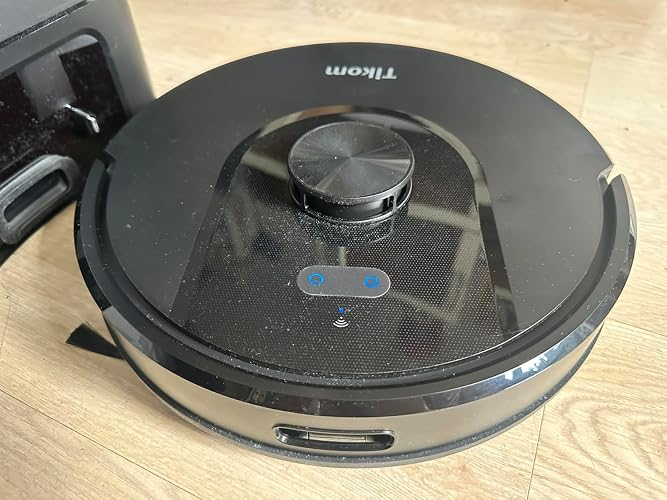
Long human hair creates a different problem. Hair can wrap around a traditional bristle roller and gradually restrict its movement. This can reduce cleaning performance and increase maintenance requirements.
Vacuum Wars reported that 56% of seven-inch hair tangled around the L8000 Plus’s brush during its test, compared with a 21% average in its comparison set.
That means pet owners should inspect the brush regularly, particularly if they have long-haired pets or household members with long hair.
Bottom Line: Tikom can be useful for routine pet-hair pickup, but long-hair households should budget more time for brush maintenance.
How Good Is the Mopping Function?
This is where expectations need to be controlled.
A simple robot mop typically uses a water reservoir and a flat pad that stays in contact with the floor. It can distribute moisture and wipe away light surface residue, but it does not necessarily apply enough mechanical force to remove dried stains.
The L8000 Plus uses a fixed flat mop pad with adjustable water flow. Independent testing found its mopping performance to be a significant weakness, including very poor results in dried-on and coffee-stain testing.
The robot also does not automatically lift the mop pad over carpet. Users therefore need to configure no-mop zones or remove the mopping attachment when appropriate.
This makes the system better understood as a vacuum-first robotic cleaner with light mopping support rather than a floor-washing replacement.
Bottom Line: If mopping is your primary reason for buying a robot, look beyond the “2-in-1” label and examine the actual mop mechanism.
Tikom Robot Vacuum Model Comparisons
Tikom’s lineup makes direct model comparison particularly important because features can change substantially between products.
A buyer choosing primarily for LiDAR mapping, another choosing for low maintenance, and a third choosing for carpet performance may not need the same Tikom model.
Tikom G8000 vs G8000 Max
The G8000 family is positioned toward buyers who want straightforward automated vacuuming and mopping without necessarily paying for the most advanced navigation architecture.
The G8000 Max is marketed with 5,000Pa suction, while the L8000 Plus moves higher in the lineup with 6,000Pa maximum suction and LiDAR-based navigation. Because suction and navigation are not the only factors determining cleaning quality, the cheaper model may still make sense for a smaller, less complicated home.
For buyers who mainly want scheduled maintenance on accessible floors, simpler navigation may be sufficient. For larger homes with multiple rooms, structured mapping becomes more valuable.
Bottom Line: Choose the G8000 family when simplicity and value are more important than advanced mapping; move upward when navigation and automation become priorities.
Tikom L8000 vs L8000 Plus
The L8000 Plus is particularly interesting because it combines LiDAR navigation with a self-emptying station.
Its advertised specifications include 6,000Pa suction, up to 150 minutes runtime, 450ml onboard dustbin, and a 3-liter disposable dust bag in the self-empty configuration.
The self-emptying system is a meaningful convenience upgrade. Instead of manually emptying the robot after every run, collected debris can be transferred to the larger dock.
For buyers who clean frequently or have pets, this can matter more than a modest increase in suction power.
Bottom Line: The L8000 Plus makes the most sense when LiDAR mapping and reduced dustbin maintenance are worth paying extra for.
Tikom L8000 Plus vs G8000 Max
The better choice depends on the home.
For larger or multi-floor properties, the L8000 Plus has an advantage because of its LiDAR mapping and multi-level mapping capabilities. For users who primarily need basic daily cleaning and do not require advanced maps, a simpler model may be adequate.
Hard-floor households can benefit from either vacuum-and-mop configuration, although buyers should remember that the L8000 Plus’s mopping performance was weak in independent testing.
Pet owners may appreciate the self-emptying dock, but long-hair maintenance remains a concern because the main brush showed significant tangling in testing.
Bottom Line: The L8000 Plus is the more compelling choice for mapping and convenience; the G8000 Max can make sense when basic automated cleaning is the priority.
Tikom vs Roborock, Dreame and Ecovacs
The broader comparison is less about brand names and more about what you expect the robot to accomplish.
Tikom can be attractive when price-to-feature ratio is the main objective. LiDAR mapping and self-emptying technology appearing in a lower-cost product demonstrates how advanced features have moved downward into budget categories.
Premium competitors typically place more emphasis on advanced obstacle recognition, sophisticated mop mechanisms, dock automation, and software ecosystems.
For a buyer who primarily needs daily dust removal, Tikom can be sufficient. For someone who wants a robot to identify cables, avoid clutter, wash its mop, dry the pads, and manage more of the cleaning process automatically, a premium system may justify its higher price.
Bottom Line: Tikom competes most strongly on value. Premium brands generally become more attractive as your expectations for obstacle avoidance, mopping, and hands-free maintenance increase.
Tikom Robot Vacuum Maintenance and Long-Term Ownership
Robot vacuums reduce floor-cleaning labor, but they do not eliminate appliance maintenance.
The best way to protect performance is to treat brushes, filters, dustbins, wheels, sensors, and mop components as routine consumables rather than waiting for a noticeable decline.
How Often Should You Empty and Clean the Dustbin?
If the model includes automatic emptying, the onboard dustbin may require less frequent manual attention.
The L8000 Plus’s self-empty dock uses a 3-liter dust bag, and Tikom’s advertised capacity can support extended intervals between bag replacements depending on household conditions.
However, homes with multiple pets can fill bags much faster than small apartments. Dust, hair, litter, and other debris all influence the actual interval.
Even with self-emptying, periodically inspect the robot’s intake path. A blockage can reduce airflow and cleaning performance.
Bottom Line: Self-emptying reduces daily maintenance, but it does not make the dust system maintenance-free.
Filter, Brush Roll and Side Brush Maintenance
The filter protects the motor and helps trap fine particles. Over time, accumulated dust can restrict airflow.
A dirty filter can therefore make the robot appear weaker even when the motor itself is functioning correctly.
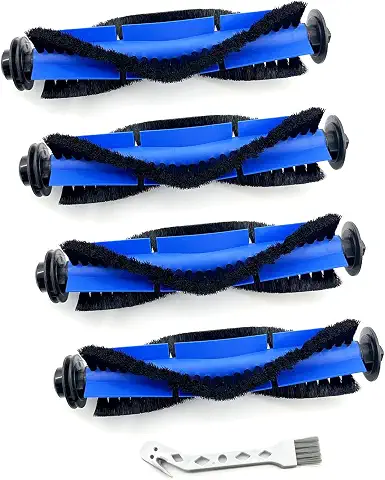
The main brush deserves particular attention in homes with long hair and pets. Remove wrapped hair before it becomes tightly wound around the roller ends.
Side brushes can also accumulate hair and dust. If they become bent or damaged, edge-cleaning performance can decline.
Bottom Line: A few minutes of weekly brush and filter care can prevent many of the cleaning problems that users mistakenly attribute to weak suction.
Mop Pad and Water Tank Maintenance
Mop pads should be cleaned regularly rather than repeatedly reused while dirty.
A contaminated pad can spread residue instead of removing it. This is especially noticeable in kitchens where grease and food particles are common.
Empty unused water after cleaning when the manufacturer’s instructions call for it. Stagnant moisture can contribute to odors and unwanted residue.
Water outlets should also be inspected if the mop suddenly stops becoming wet.
Bottom Line: The mop attachment needs almost as much attention as the vacuum components if you want consistent wet-cleaning results.
Long-Term Maintenance Cost
The purchase price is only part of the ownership equation.
Potential consumables include:
- Filters
- Main brushes
- Side brushes
- Mop pads
- Disposable dust bags on self-empty models
- Batteries over the long term
The self-empty dock reduces daily labor but introduces disposable bag costs. That’s a worthwhile trade-off for some users, particularly pet owners who dislike handling dust.
Before purchasing, confirm that replacement parts are readily available for the exact model. A robot vacuum is much more useful over several years when brushes, filters, pads, and other service components can be replaced easily.
Bottom Line: Evaluate total cost of ownership—not just the initial robot price—before deciding whether Tikom represents better value.
Tikom Robot Vacuum Troubleshooting Guide
Most robot vacuum problems fall into a relatively small number of categories: obstruction, maintenance, navigation, charging, connectivity, or incorrect cleaning settings.
Understanding the likely cause can prevent unnecessary replacement.
Why Is My Tikom Robot Vacuum Getting Stuck?
Start by checking the physical environment.
Loose cables, socks, pet toys, rug fringes, and narrow furniture gaps can trap robotic cleaners. A robot without advanced AI obstacle avoidance is especially dependent on a relatively clear floor.
Thresholds can also cause trouble. If the robot repeatedly approaches a transition and turns around, inspect whether the height or angle is beyond what its wheels can comfortably cross.
Clean the wheels if they have accumulated hair or debris.
Bottom Line: Before blaming navigation software, remove common physical obstacles and inspect the wheels and brush system.
Why Is the Tikom Robot Vacuum Not Picking Up Dirt?
First check the dustbin and filter.
A full bin can restrict airflow, while a clogged filter can reduce the amount of air moving through the cleaning system.
Next inspect the main brush. Hair and string can wrap around the roller and prevent it from rotating properly.
Finally, verify the cleaning mode. If the robot is operating in a lower-power mode, its performance may be noticeably different from maximum suction.
Bottom Line: Empty the bin, clean the filter, inspect the brush, and verify suction settings before assuming the motor has failed.
Why Is the Robot Not Mopping Properly?
Check whether the water tank contains sufficient water and whether the mop pad is correctly attached.
A dirty or saturated pad can also produce poor results. If the water outlet is restricted, the pad may remain too dry.
The selected water-flow setting matters too. A low setting may be suitable for light maintenance but inadequate for heavier residue.
Remember that the L8000 Plus’s independent mopping results were weak even when functioning correctly, so poor stain removal is not necessarily evidence of a defective machine.
Bottom Line: Troubleshoot the water system first, but maintain realistic expectations about what a fixed-pad mop can accomplish.
Wi-Fi, Charging and Navigation Problems
If the robot will not connect, begin by checking the app requirements and home Wi-Fi configuration.
For mapping issues, make sure the charging dock remains in a consistent location. Moving the dock can confuse an established map or cause the robot to behave differently.
If the robot cannot return to the dock, check whether the path is blocked and whether the charging station has been moved.
For repeated navigation errors, cleaning the robot’s sensors can help because dust accumulation may interfere with environmental detection.
Bottom Line: Stable Wi-Fi, a consistent dock location, clean sensors, and an uncluttered path solve many common robotic-vacuum problems.
Buyer’s Intent — Is the Tikom Robot Vacuum and Mop Combo Worth Buying?
The buying decision ultimately depends on what you want the robot to automate.
If your main goal is daily dust and debris pickup, Tikom becomes much easier to recommend. If your main goal is replacing manual mopping, the decision becomes more complicated.
Best For
Tikom is a strong candidate for:
- Budget-conscious buyers
- Small and medium homes
- Hard-floor households
- Pet owners who need frequent vacuuming
- First-time robot-vacuum buyers
- Busy households wanting scheduled cleaning
- Buyers who value LiDAR mapping on supported models
- Users who want a self-emptying option without entering the premium price category
The L8000 Plus is particularly interesting for users who value structured navigation and reduced dustbin maintenance. Independent testing confirmed efficient LiDAR navigation and solid vacuuming performance for its category.
Bottom Line: Tikom makes the most sense for buyers who want affordable automation and primarily care about vacuuming.
Not Ideal For
Be cautious if your home contains heavy clutter and you expect the robot to intelligently identify every small object.
A LiDAR system can map a room without necessarily recognizing a sock or cable before driving toward it. Advanced AI obstacle avoidance is a separate feature.
Mopping-focused buyers should also be careful. A basic flat pad can handle light damp cleaning, but it is not equivalent to an active scrubbing system.
Finally, long-hair households should be prepared for brush maintenance because independent testing found significant hair wrapping on the L8000 Plus’s main roller.
Bottom Line: Tikom is less convincing when advanced object recognition, deep mopping, or minimal brush maintenance are your top priorities.
Best Tikom Model by Buyer Type
| Buyer Type | Recommended Direction |
|---|---|
| Lowest-cost automation | Entry-level Tikom |
| Pet owners | Higher-suction model with frequent brush maintenance |
| Multi-floor home | LiDAR/multi-map model |
| Less manual emptying | Self-emptying model |
| Mostly hard floors | Vacuum + mop configuration |
| Carpet-heavy home | Higher-suction model with carpet boost |
| Smart-home user | App and voice-compatible model |
| Mapping priority | LiDAR-equipped model |
The exact model should always be verified before purchase because Tikom’s specifications differ across the lineup.
Bottom Line: There is no universally “best” Tikom. The right choice depends on whether your priority is navigation, suction, mopping, battery coverage, or maintenance convenience.
Is Tikom a Good Value in 2026?
For value-focused shoppers, the answer can be yes—but only when expectations match the product.
The L8000 Plus is an especially strong example of how budget robotic cleaners now offer features that were previously associated with more expensive machines, including LiDAR navigation and self-emptying.
Independent testing, however, demonstrates the trade-off: vacuuming and navigation were respectable, while mopping and long-hair management were much weaker.
That makes the product easier to recommend as an automated vacuum with light mopping than as a fully automated floor-washing appliance.
Bottom Line: Tikom can offer excellent feature value when vacuuming and navigation matter more than premium mopping and obstacle avoidance.
Tikom Robot Vacuum Alternatives Worth Considering
Tikom is not automatically the best choice for every household. The right alternative depends on which limitation you want to overcome.
Best Alternative for Advanced Navigation
Look for a competitor with both LiDAR mapping and dedicated object-recognition technology.
This combination is more appropriate for cluttered homes where the robot must navigate around cables, shoes, toys, and other small objects.
The important distinction is that mapping tells the robot where it is, while advanced obstacle recognition helps it determine what is in front of it.
Bottom Line: If clutter avoidance is your biggest concern, prioritize object recognition rather than simply choosing another LiDAR robot.
Best Alternative for Better Mopping
If wet cleaning is your primary goal, consider a system with:
- Rotating mop pads
- Mop lifting
- Active water management
- Automated mop washing
- Mop drying
- Higher downward cleaning pressure
These systems are generally better suited to households where the robot is expected to perform more than light surface wiping.
Bottom Line: If mopping is the main reason you’re buying, spend more on mop technology rather than paying extra simply for higher suction.
Best Alternative for Pet Hair
Pet-focused buyers should look at the entire brush system.
Important features include anti-tangle technology, brush design, strong airflow, easy roller removal, and a self-emptying dock.
A robot that picks up large quantities of hair but requires difficult brush cleaning every few days may not actually provide the convenience a pet owner wants.
Bottom Line: For pet homes, anti-tangle design can be more valuable than chasing the highest advertised Pa number.
Best Alternative for Maximum Automation
Premium robot systems increasingly combine:
- Self-emptying
- Self-washing
- Self-drying
- Automatic water management
- Detergent handling
- Advanced obstacle avoidance
- Automatic mop lifting
- More sophisticated room recognition
These features substantially reduce human involvement.
Tikom’s self-emptying option already addresses one major maintenance chore, but it does not eliminate every manual task.
Bottom Line: Choose premium automation when your goal is to minimize interaction with the robot, not simply to automate vacuuming.
Frequently Asked Questions — Tikom Robot Vacuum and Mop Combo
Is Tikom a Good Brand for Robot Vacuums?
Tikom is most compelling for shoppers looking for a budget-oriented robot with useful automation features. Some models offer technologies such as LiDAR mapping and self-emptying at relatively accessible price points.
The important qualification is that the brand’s lineup varies. A buyer should evaluate the exact model rather than assuming every Tikom robot provides the same navigation, suction, mopping, or obstacle-avoidance technology.
Bottom Line: Tikom can be a good value brand when the specific model matches your cleaning needs.
Is Tikom Robot Vacuum Worth Buying?
Yes, for the right buyer.
If you mainly want automated vacuuming, scheduled cleaning, mapping, and reasonable value, a suitable Tikom model can make sense.
If you expect aggressive mopping, advanced AI obstacle avoidance, and almost completely maintenance-free operation, a premium alternative may be a better fit.
Bottom Line: Tikom is strongest as an affordable automated vacuum rather than a premium all-in-one floor-cleaning replacement.
Does Tikom Have LiDAR Navigation?
Some Tikom models do.
The L8000 Plus, for example, uses spinning LiDAR navigation and supports structured mapping features. Independent testing found its navigation efficiency to be a strength for its price category.
However, not every Tikom model should be assumed to use LiDAR.
Bottom Line: Check the exact model’s navigation specification before purchasing.
Can Tikom Vacuum and Mop at the Same Time?
Compatible Tikom 2-in-1 models can vacuum and mop as part of the same cleaning workflow.
However, the exact mopping mechanism differs by model. Some configurations use a simple fixed mop pad rather than an actively scrubbing system.
Bottom Line: Yes, but “vacuum and mop” describes functionality, not necessarily premium mopping performance.
How Long Does a Tikom Robot Vacuum Battery Last?
Runtime depends on the model and cleaning mode.
The L8000 Plus is officially rated for up to 150 minutes in its lower-power cleaning mode. Actual coverage varies with suction, floor type, navigation, obstacles, and battery condition.
Bottom Line: Use advertised runtime as a comparison point, not as a guarantee of whole-home coverage.
Is Tikom Good for Pet Hair?
It can be.
Independent testing of the L8000 Plus found 89.5% pickup of flattened pet hair, which was above the reported comparison average. However, the same testing found significant long-hair tangling around the main brush.
Bottom Line: Good routine pet-hair pickup is possible, but regular brush maintenance remains important.
Does Tikom Work With Alexa?
Supported models can offer voice-assistant integration. The L8000 Plus, for example, supports voice control through compatible smart-home platforms.
Because connectivity features can differ by model and app platform, verify compatibility before purchasing.
Bottom Line: Smart-home integration is available on supported Tikom models, but it should not be assumed across the entire lineup.
How Do I Clean a Tikom Robot Vacuum?
Start by emptying the dustbin or checking the self-empty station.
Then inspect the main brush, side brushes, wheels, filter, sensors, and mop components. Remove hair from the roller and wash or replace components according to the manufacturer’s instructions.
For mopping models, clean the mop pad after use and maintain the water system to prevent buildup and odors.
Bottom Line: Regular preventative maintenance is easier and cheaper than waiting until the robot loses cleaning performance.
Why Does My Tikom Robot Vacuum Keep Getting Stuck?
The most common causes are clutter, cables, rug edges, thresholds, low furniture, and objects that the robot cannot recognize.
LiDAR mapping does not automatically provide AI obstacle avoidance. A robot can understand the shape of a room while still physically contacting smaller objects.
Bottom Line: Keep the floor reasonably clear and use no-go zones where necessary.
How Often Should I Replace Tikom Filters and Brushes?
There is no universal interval because replacement depends on usage, pets, dust levels, floor type, and the specific model.
Inspect filters and brushes regularly rather than relying only on a calendar schedule. Replace components when they become damaged, excessively worn, clogged, or difficult to clean.
Bottom Line: Maintenance intervals should follow component condition and manufacturer guidance rather than a one-size-fits-all number.
Final Verdict — Should You Buy the Tikom Robot Vacuum and Mop Combo?
A Tikom robot vacuum and mop combo review ultimately leads to a fairly clear conclusion: Tikom’s strongest argument is not that it completely replaces premium robotic floor cleaners, but that it can deliver meaningful automation at a more accessible price.
The L8000 Plus is a good example. It combines 6,000Pa maximum suction, LiDAR navigation, multi-level mapping, a self-emptying station, and app-based controls. Independent testing found respectable vacuuming performance and efficient navigation, but substantially weaker mopping, significant long-hair tangling, and below-average battery efficiency.
That combination creates a product with a very specific buyer profile. Someone who wants daily dust removal, pet-hair pickup, structured navigation, and less frequent dustbin emptying may find the feature package compelling.
A shopper primarily interested in deep wet cleaning should look elsewhere. The fixed-pad mopping approach is better viewed as light maintenance wiping than as a replacement for manual scrubbing.
Overall Performance Score
| Category | Rating | Verdict |
|---|---|---|
| Vacuuming | 8/10 | Strong value for routine cleaning |
| Mopping | 4/10 | Basic surface wiping rather than deep scrubbing |
| Navigation | 8/10 | LiDAR is a major advantage on supported models |
| Pet Hair | 7/10 | Good pickup, but brush tangling needs attention |
| Battery | 6/10 | Adequate, but efficiency can be a limitation |
| App & Controls | 8/10 | Useful scheduling and room-control functions |
| Maintenance | 7/10 | Self-emptying helps, but manual care remains necessary |
| Value | 9/10 | Strong feature-to-price proposition |
The Biggest Strength
The biggest strength is the amount of automation available for the money.
Features such as LiDAR mapping, room-level controls, virtual barriers, multi-floor mapping, and self-emptying can make a budget robot feel considerably more sophisticated than a basic random-navigation cleaner.
The Biggest Weakness
The biggest weakness is mopping performance.
A 2-in-1 label can create the impression that the machine is equally capable at vacuuming and washing floors. The available independent evidence suggests that this is not the case for the L8000 Plus.
Its vacuuming performance is the stronger side of the product, while the mop should be treated as a light-maintenance feature.
Final Recommendation
Choose Tikom if your priority is affordable automated vacuuming with useful smart features. It is particularly attractive for hard-floor households, apartments, busy users, and buyers who want mapping and reduced dustbin maintenance without immediately moving into a premium price category.
Choose a more advanced robot if your priorities are deep mopping, sophisticated AI obstacle avoidance, anti-tangle performance, or maximum hands-free maintenance.
The most important buying rule is simple: choose the Tikom model based on the technology you actually need rather than assuming the entire brand offers the same experience.
Bottom Line: Tikom is best understood as a value-focused robot vacuum ecosystem. Its strongest models can provide impressive navigation and automation for the price, but buyers should keep expectations realistic about mopping, obstacle avoidance, and long-term brush maintenance.