
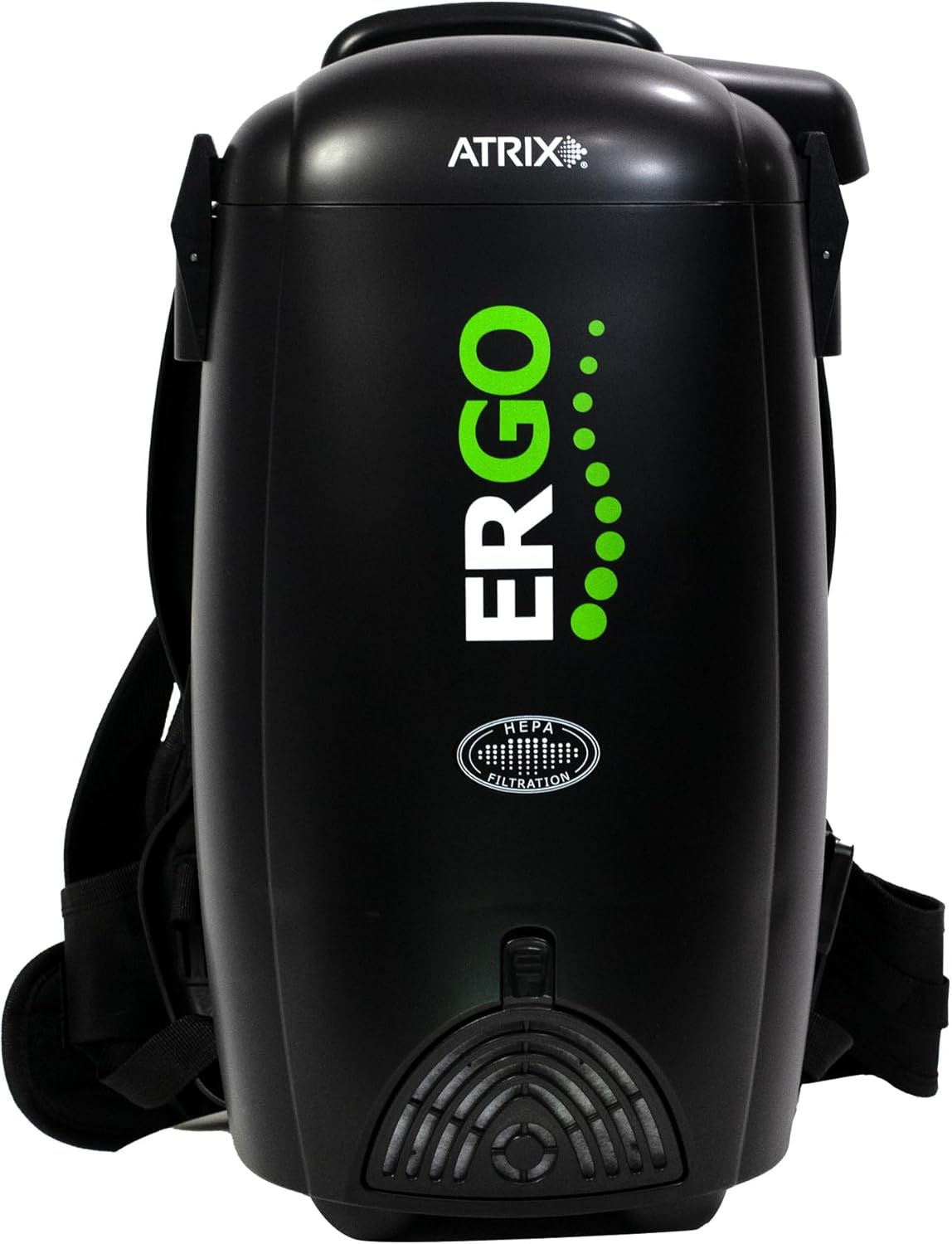
In this atrix ergo backpack vacuum review, the Atrix Ergo stands out as a commercial cleaner for offices, schools, retail spaces, and hard floors, combining backpack mobility with four-stage filtration. Its main trade-offs are corded operation, carrying weight, and limited deep-carpet agitation versus powered uprights.
The Atrix Ergo is designed around a different cleaning philosophy from a conventional upright vacuum. Instead of pushing a motorized cleaning head across the floor, the operator carries the vacuum on their back and guides the hose and floor tool independently. That layout can be particularly useful when cleaning large open areas, stairs, furniture, offices, and other spaces where dragging a vacuum body becomes inefficient.
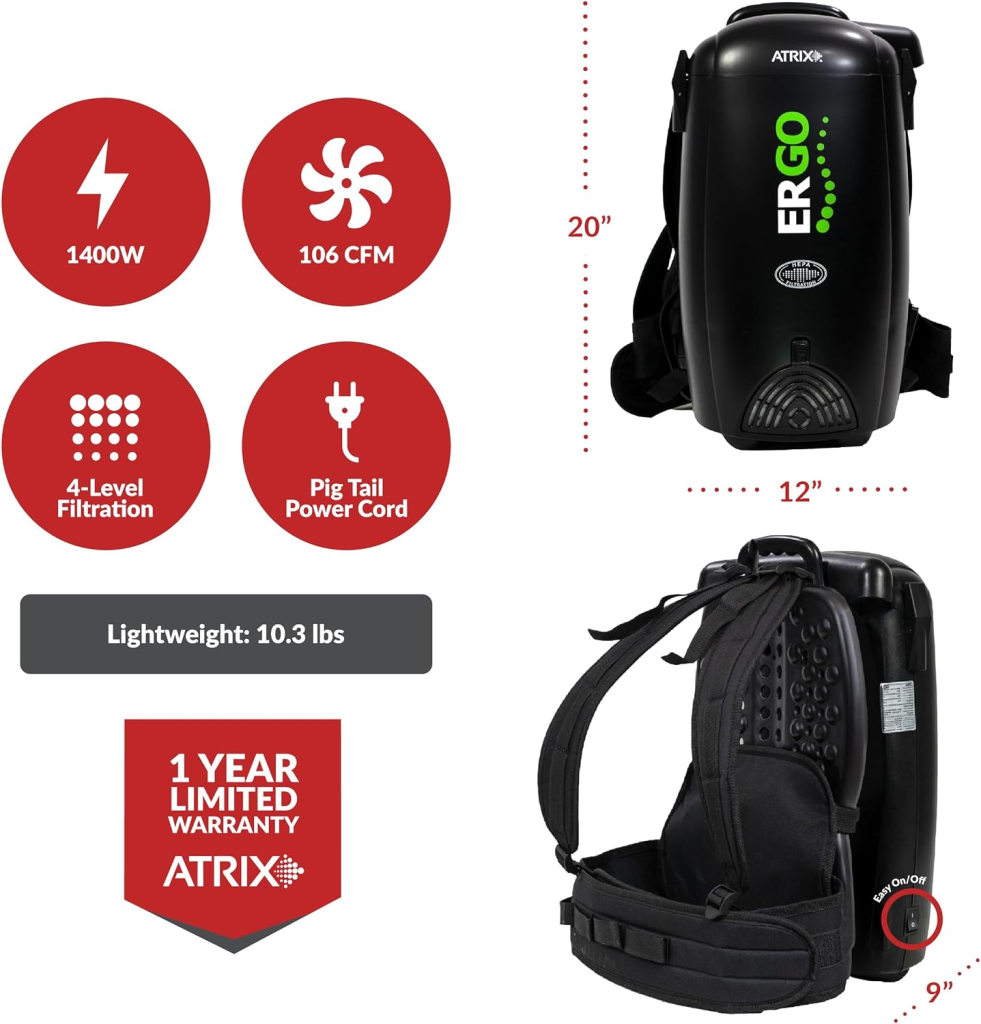
The standard VACBP1 configuration is specified with a 1,400-watt motor, 106 CFM airflow, 10.3-pound machine weight, 8-quart HEPA bag, and four-stage filtration. Atrix also sells several Ergo and Ergo Pro variants with different electrical requirements and airflow figures, so model identification matters before comparing specifications.
The central question is therefore not simply whether this vacuum has strong suction. It is whether the backpack architecture, filtration system, cleaning reach, and commercial-oriented workflow provide enough productivity benefits to justify carrying the machine and managing a power cord.
Bottom Line: The Atrix Ergo makes the most sense for users who value mobility, large collection capacity, and professional cleaning reach more than the aggressive carpet agitation of a powered upright.
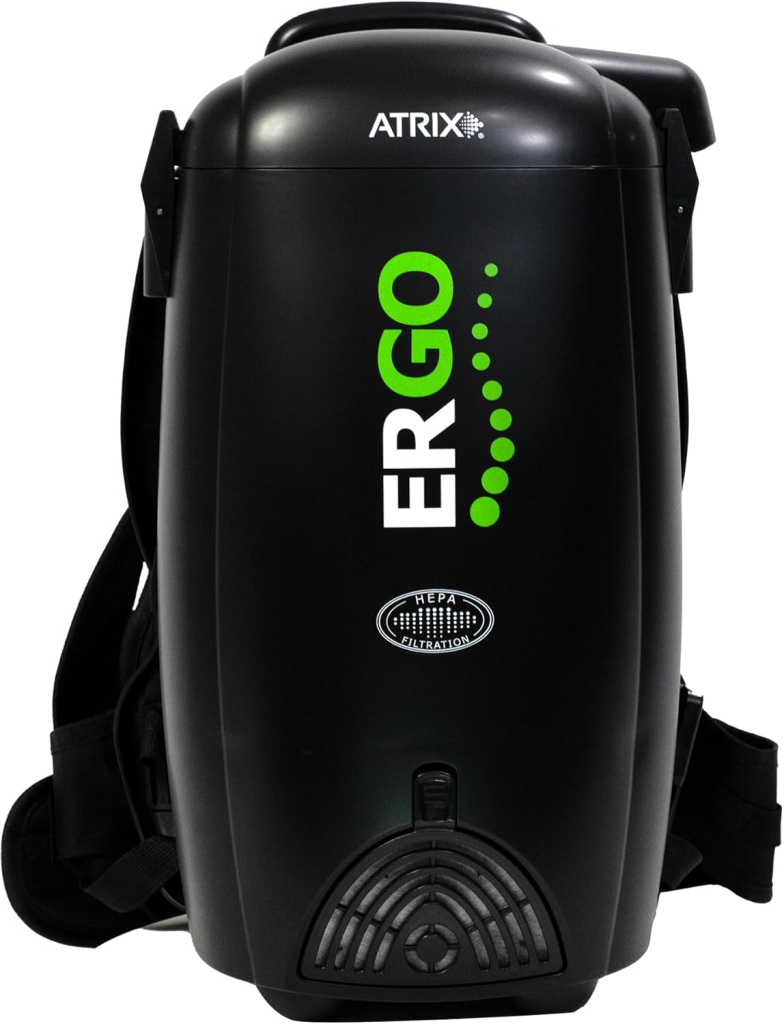
Quick Verdict
The Atrix Ergo is best viewed as a commercial backpack vacuum rather than a direct replacement for every conventional vacuum type. Its design favors productivity in environments where an operator needs to move continuously through open floor areas while carrying the vacuum rather than pulling it behind them.
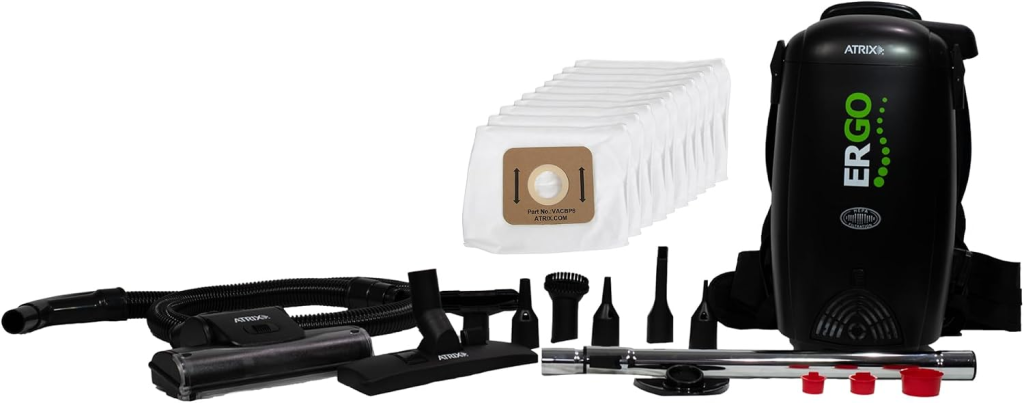
For example, the VACBP1 uses a 6-foot hose, adjustable extension wand, floor brush, crevice tool, furniture nozzle, dusting brush, and air-driven turbo brush. That combination allows one vacuum body to handle floors, furniture, edges, and tight spaces without repeatedly moving a separate canister.
Filtration is another major selling point. The standard Ergo specification identifies an 8-quart HEPA bag, cloth shakeout bag, HEPA premotor filter, and exhaust filter. Atrix describes this as a four-stage filtration arrangement.
However, the backpack design introduces a trade-off: the machine’s weight moves from the floor to the operator’s body. Even though the standard unit is listed at 10.3 pounds, users must also account for the hose, wand, accessories, and collected debris during actual cleaning.
The other important limitation is floor agitation. The standard package includes an air-driven turbo brush, but that is fundamentally different from a dedicated electrically powered brush roll. The turbo tool relies on vacuum airflow to drive its brush, so users with thick carpeting should not automatically expect the same mechanical agitation available from a commercial upright with a powered brush head. Atrix itself lists the BP44 as an air-driven turbo brush for the Ergo series.
Pros
- Backpack cleaning format reduces the need to drag a vacuum body across the floor.
- 8-quart HEPA bag capacity on the standard VACBP1 configuration provides substantial collection capacity.
- Four-stage filtration combines the HEPA bag, shakeout bag, premotor filter, and exhaust filter.
- 106 CFM airflow is the manufacturer’s listed figure for the VACBP1.
- Long hose and adjustable wand provide useful cleaning reach.
- Multiple attachments make the system suitable for floors, furniture, corners, and detail cleaning.
- Variable suction control is built into the standard Ergo manual.
Cons
- The standard configuration is corded, so cleaning routes must account for outlets and cord movement.
- The vacuum must be carried rather than pushed.
- An air-driven turbo brush is not equivalent to an electrically powered carpet brush roll.
- HEPA bags and replacement filters add recurring ownership costs.
- The Ergo family contains several models with substantially different specifications.
- Backpack ergonomics depend heavily on correct harness adjustment and individual tolerance.
Best For: Commercial cleaners, janitorial teams, offices, schools, retail spaces, stairways, and large hard-floor areas.
Buying Recommendation: Buy the Atrix Ergo when mobility and professional cleaning reach are priorities. Choose a commercial upright instead when deep carpet agitation is the primary requirement.
Bottom Line: The Ergo’s strongest advantage is not a single headline specification; it is the combination of backpack portability, filtration, capacity, and accessory flexibility.
Atrix Ergo Backpack Vacuum History and Product Positioning
Atrix and Its Commercial Vacuum Heritage
Atrix International has developed a broad range of specialized vacuum equipment covering commercial cleaning, backpack systems, industrial applications, electronics/ESD work, pest control, and other specialized environments. Its current product documentation includes separate manuals for the Ergo, Ergo Pro, Ergo PMP, Ergo cordless, and Ergo aviation models.
That range is important because “Atrix Ergo” is not a single specification. The family includes models built around different electrical systems, applications, and accessory configurations.
The standard Ergo concept emphasizes portability. Rather than positioning the motor and collection system on wheels, the machine becomes part of the operator’s equipment. This can reduce the amount of time spent repositioning the vacuum itself during a cleaning route.
The approach is particularly logical in environments containing stairs, narrow passages, seating areas, desks, and obstacles. A traditional upright can be effective across open carpet, but it may become cumbersome when the operator constantly needs to maneuver around furniture.
Evolution of the Ergo Backpack Design
The basic backpack-vacuum concept is straightforward: place the vacuum assembly against the user’s back, connect a flexible hose, and move the cleaning head independently.
The standard Ergo manual shows a waist band, back support panel, shoulder straps, flexible hose, telescopic tube, and variable suction control. This configuration demonstrates that ergonomics are a functional part of the system rather than simply an aesthetic feature.
The low-profile approach is also significant. Atrix describes its Ergo models as ergonomic, lightweight, and low profile, with the design intended for professional cleaners working for extended periods and in confined spaces.
That does not mean the vacuum will feel lightweight to every operator. A backpack vacuum changes where the load is carried; it does not eliminate the load.
Where the Ergo Fits in Atrix’s Lineup
The lineup includes the standard Ergo, Ergo Pro, cordless Ergo Pro, Ergo Aviation, Ergo Pro Aviation, and Ergo PMP models. Atrix’s official manuals specifically distinguish these models, reinforcing the need to check the model number before using specifications from another version.
For example, the standard VACBP1 is listed at 1,400 watts and 106 CFM, while the VACBP2 230V Ergo Pro is listed at 1,400 watts and 102 CFM. The Ergo Aviation VACBP400 uses a 115V, 400 Hz electrical system with 1,100 watts and 76 CFM.
Those numbers should never be blended into one generic “Atrix Ergo” specification table.
Commercial vs Residential Positioning
The commercial orientation is clear from the equipment’s design and accessory ecosystem. Atrix lists the backpack category for janitorial, sanitation, transportation, pest control, industrial, and residential applications, while its Ergo Pro Aviation variant is specifically positioned for aviation and transportation environments.
A homeowner can certainly use a backpack vacuum, but that does not automatically make it the most convenient residential choice. In a small apartment, putting on a backpack, managing a power cord, and attaching a wand may be more effort than grabbing a compact stick or canister vacuum.
The design becomes more compelling when cleaning time, floor area, stairs, or furniture density increases.
Bottom Line: Atrix positions the Ergo family around specialized and professional cleaning, but its versatility makes it viable for certain residential users who value reach and portability.
Field Note — Ergonomic Reality: A backpack vacuum can feel easier to maneuver without necessarily feeling lighter. The practical difference is that the vacuum’s mass stays with the operator while the hose and cleaning tool move independently. For long cleaning sessions, harness adjustment becomes just as important as the machine’s published weight. This is an engineering-based evaluation of the design rather than a claim of a hands-on laboratory test.
Atrix Ergo Specifications and Technical Breakdown
Motor Power and Electrical Requirements
The standard VACBP1 is specified at 120 volts and 1,400 watts, with a manufacturer-rated 106 CFM. Its electrical design makes it a corded machine rather than a battery-powered autonomous cleaner.
That distinction matters when comparing it with a modern cordless stick vacuum or robotic vacuum system. Battery runtime, smart home integration, LiDAR navigation, SLAM mapping, AI obstacle avoidance, and multi-floor mapping are relevant technologies in automated floor cleaners, but they are not features of this traditional backpack vacuum.
Instead, the Ergo’s productivity comes from continuous corded operation and operator-controlled movement.
A useful engineering principle is that motor wattage should never be treated as a direct measurement of cleaning performance. Electrical input indicates how much power the motor system consumes, but actual floor pickup also depends on airflow, pressure, nozzle geometry, hose losses, filtration condition, and the interface between the cleaning head and floor.
Airflow and Vacuum Performance
The 106 CFM airflow figure listed for the VACBP1 describes the volume of air the system can move under the manufacturer’s stated measurement conditions.
CFM airflow should not be confused with Water Lift (inches). Water Lift is commonly used to describe a vacuum’s ability to generate pressure under a specified test method, while CFM describes air volume. Neither number alone provides a complete picture of real-world floor cleaning.
For example, a vacuum may have strong airflow but perform differently depending on the nozzle opening, hose diameter, filter loading, and floor-tool seal.
The Ergo’s 1.13-inch internal hose diameter and 1.38-inch external diameter on the VACBP1 also matter because airflow must travel through the complete air path rather than simply through the motor.
The adjustable wand is another useful component. Atrix specifies the BP39 telescopic wand at 22 to 37 inches, giving the operator flexibility to adjust the working height.
Weight, Dimensions and Capacity
The standard VACBP1 is listed at 10.3 pounds for the vacuum itself, with dimensions of 12 × 9 × 20 inches. Atrix specifies an 8-quart HEPA bag as part of its four-stage filtration system.
The distinction between machine weight and operating weight is important. The published 10.3-pound figure does not represent the complete load once the operator adds the hose, wand, cleaning tool, and collected debris.
The 8-quart collection capacity is one of the system’s practical advantages for commercial cleaning. Larger capacity can reduce interruptions compared with a smaller residential dust cup, although the bag should still be replaced when airflow begins to suffer.
Atrix’s maintenance guidance identifies reduced suction as an important indicator that a filter is full or that a hose or utensil may be clogged.
Hose Diameter and Cleaning Reach
The standard VACBP1 includes a 6-foot hose, while the BP39 adjustable extension wand provides 22–37 inches of adjustment.
This combination gives the operator a useful working radius without moving the main vacuum body. The hose becomes the connection between the backpack and the floor tool, so its flexibility and diameter directly affect how naturally the operator can clean.
The accessory set also includes a crevice tool, furniture nozzle, oval dust brush, floor brush, and air-driven turbo brush.
When assessing any backpack vacuum, the complete airflow path deserves attention. A narrow hose, clogged filter, obstructed nozzle, or poorly fitted connection can reduce effective airflow even when the motor itself is operating normally.
Bottom Line: The VACBP1’s 1,400-watt motor, 106 CFM airflow, 10.3-pound weight, and 8-quart HEPA bag make it a substantial commercial cleaning system, but those figures should be evaluated together rather than treated as isolated performance scores.
Atrix Ergo Design, Backpack Ergonomics and Build Quality
Backpack Harness and Weight Distribution
The standard Ergo uses shoulder straps and a waist band with a back-support panel.
This arrangement attempts to distribute the vacuum load across more than the shoulders alone. From an ergonomic perspective, that matters because a concentrated load can become uncomfortable during extended cleaning.
The best setup is therefore not necessarily the tightest setup. The harness should hold the machine securely against the operator without unnecessarily restricting movement.
Users with different body sizes may also perceive the same machine differently. A 10.3-pound backpack vacuum may be manageable for one cleaner but tiring for another, particularly after the bag accumulates debris.
Low-Profile Body Design
Atrix describes the Ergo as low profile, and the design has a practical consequence: the operator can approach furniture and narrow areas without pulling a wheeled vacuum body behind them.
This is especially useful around office desks, seating rows, shelving, stairs, and other commercial environments.
Instead of turning the entire vacuum around an obstacle, the operator can keep the main unit on their back and move only the hose and wand.
That difference may appear minor during a single cleaning session, but it can become meaningful when repeated dozens or hundreds of times during a commercial route.
Left- and Right-Handed Operation
Atrix’s VACBP400 documentation specifically notes that the Ergo can be adjusted for left- or right-hand operation.
This is a useful design consideration because hose orientation can affect posture and workflow. A right-handed operator may naturally prefer the hose and wand positioned differently from a left-handed cleaner.
The goal is to keep the hose movement natural rather than forcing the operator to twist repeatedly.
For long cleaning sessions, these small ergonomic details can influence perceived fatigue more than a simple specification such as total machine weight.
Build Quality for Commercial Use
The standard system uses a molded vacuum body, flexible hose, metal telescopic wand, floor tools, and replaceable filters and bags. Atrix also sells replacement harnesses, hoses, wands, latches, filters, and other Ergo components through its parts and accessory catalog.
That replacement ecosystem is important for commercial ownership. A cleaner does not necessarily need to replace the entire vacuum because a hose or harness eventually wears out.
Atrix currently lists a replacement Ergo harness, replacement hose, metal adjustable tube, premotor/exhaust filter set, and other components for the Ergo family.
However, availability of a replacement component does not guarantee that every Ergo variant uses the same part. Model compatibility should be verified before ordering.
Bottom Line: The Ergo’s physical design prioritizes operator mobility and serviceable components, but comfort ultimately depends on harness adjustment, body fit, cleaning duration, and the amount of debris being carried.
Atrix Ergo Cleaning Performance on Different Floors
Hard-Floor Cleaning
Hard floors are one of the most logical applications for the backpack format. The operator can walk continuously while moving the floor tool independently, without repeatedly repositioning a vacuum body.
The standard Ergo includes a floor brush, and Atrix’s accessory system also offers dedicated floor tools for the Ergo and Ergo Pro families.
On tile, vinyl, sealed hardwood, and similar surfaces, the cleaning objective is primarily to remove loose dust, crumbs, hair, and larger debris without requiring aggressive carpet agitation.
That is where the backpack architecture can show its productivity advantage.
Low-Pile Carpet
Low-pile carpet introduces a greater need for agitation and proper nozzle contact.
The standard Ergo includes an air-driven turbo brush, which Atrix identifies as compatible with tight-knit rugs and hard-surface flooring as well as the broader Ergo accessory system.
Because the brush is powered by airflow rather than an independent electric motor, its agitation performance depends on the airflow reaching the tool.
That makes 106 CFM airflow relevant to the overall system, but it should still not be interpreted as proof that the machine will outperform every powered carpet vacuum.
Medium and High-Pile Carpet
Thicker carpet is where the backpack format becomes more complicated.
A conventional commercial upright can use a mechanically driven brush roll to agitate carpet fibers while simultaneously extracting debris. The standard Ergo’s air-driven turbo tool does not provide the same type of electrically powered agitation.
This does not make the Atrix unusable on carpet. It means buyers should match the machine to the flooring rather than assuming that a high airflow figure automatically translates into deep carpet cleaning.
For homes dominated by thick or plush carpeting, a commercial upright with a powered brush system may be the more logical choice.
Rugs, Stairs and Edges
Stairs are a particularly strong use case for backpack vacuums because the operator does not need to lift a wheeled vacuum from one step to another.
The flexible hose also makes it easier to reach corners, edges, upholstery, and furniture while the vacuum remains attached to the operator.
Atrix’s accessory system includes a crevice tool, dusting brush, floor brush, and air-driven turbo brush, providing several options for detailed cleaning.
The turbo brush is especially useful when additional agitation is needed, but it should still be understood as an airflow-driven accessory rather than a powered brush roll.
Bottom Line: The Atrix Ergo is most naturally suited to hard floors, stairs, detailed cleaning, and lighter carpet applications; thick carpet remains the territory where a powered upright can have a meaningful advantage.
Atrix Ergo Filtration System and Dust Management
Four-Stage Filtration Explained
The standard Ergo uses a four-stage arrangement consisting of an 8-quart HEPA bag, cloth shakeout bag, HEPA premotor filter, and exhaust filter.
The first collection stage captures the majority of debris, while the additional filtration stages provide further particle control before air exits the machine.
This layered approach is more meaningful than simply seeing the word “HEPA” on a product page. Effective filtration depends on the complete air path, proper filter installation, bag condition, and the integrity of the housing and seals.
HEPA Bag and Fine-Particle Capture
Atrix specifies HEPA filtration at 99.97% efficiency at 0.3 microns or larger in its filtration documentation.
That figure describes filter media performance under the applicable test conditions; it should not automatically be interpreted as the efficiency of the entire vacuum system under every real-world condition.
The bag also functions as part of the dust-management system. As it fills, airflow can become restricted, particularly if the filter media becomes heavily loaded.
Atrix’s own troubleshooting guidance identifies reduced suction as a sign that a filter may be full or that there may be a clog in the hose or utensil.
Premotor and Exhaust Filtration
The premotor filter helps protect the motor from particles that make it through the collection stage, while the exhaust filter provides another filtration stage before air leaves the vacuum.
This layered architecture is conceptually similar to a sealed system filtration strategy, although buyers should avoid assuming a particular whole-machine sealed-filtration certification unless Atrix explicitly provides one for the exact model.
The practical lesson is simple: HEPA efficiency depends on maintaining the complete filtration system rather than focusing only on the HEPA bag.
A damaged filter, missing filter, improperly seated bag, or obstructed airflow path can compromise the intended system performance.
Bagged vs Shakeout Operation
The disposable HEPA bag is the more convenient option for routine commercial cleaning because it can be removed and replaced without repeatedly handling accumulated debris.
Atrix also supplies a reusable shakeout bag for the Ergo system. The company currently lists the VACBP8 shakeout bag as a replacement component and separately sells HEPA replacement bags.
The choice involves convenience, consumable cost, and dust exposure during maintenance.
For users who prioritize minimizing contact with collected fine debris, disposable HEPA bags can be more convenient. Commercial users focused on operating cost may appreciate having a reusable shakeout option where appropriate.
Bottom Line: The Ergo’s filtration architecture is one of its strongest technical features, but maintaining the bag, premotor filter, exhaust filter, and air path is essential for preserving airflow and filtration performance.
Atrix Ergo Attachments and Accessory System
Floor Cleaning Tools
The standard VACBP1 package includes a floor brush and an air-driven turbo brush, along with other tools.
The standard floor brush is appropriate for general floor cleaning where agitation is not the primary requirement.
For carpet and rugs, the air-driven turbo brush can provide additional mechanical action through airflow. Atrix states that the BP44 is driven by airflow circulating through the vacuum and markets it for tight-knit rugs and hard-surface flooring.
That makes accessory selection important rather than treating the vacuum body as the entire cleaning system.
Crevice and Dusting Tools
The crevice tool is useful for narrow gaps, corners, baseboards, and spaces around furniture.
The oval dust brush provides a softer contact surface for applications where a hard floor nozzle would be inappropriate.
Because the vacuum remains on the user’s back, these accessories can be swapped while keeping the main machine stationary relative to the operator.
That is one of the backpack format’s practical strengths: the cleaning head becomes the movable component.
Upholstery and Furniture Cleaning
Furniture cleaning is another area where the hose-and-tool architecture can be advantageous.
The standard package includes a furniture nozzle, while Ergo Pro configurations can include dedicated upholstery and dusting tools depending on the model.
This makes the system suitable for office chairs, fabric furniture, shelving, and other above-floor surfaces.
It also means that buyers should inspect the exact package before purchasing. Accessories are not necessarily identical across every Ergo variant.
Turbo Brush and Agitation
The BP44 is an air-driven turbo brush, meaning airflow powers the brush mechanism rather than a separate electrical motor. Atrix lists it as compatible with the Ergo Backpack series.
This distinction matters when comparing the Atrix with commercial uprights featuring electrically driven brush rolls.
A powered brush can maintain independent agitation even when airflow changes, while an air-driven turbo tool depends more directly on the vacuum’s airflow reaching the accessory.
For hard floors and lighter rugs, that may be perfectly adequate. For deep carpet extraction, buyers should consider whether a powered floor head is more appropriate.
Bottom Line: The Ergo’s accessory ecosystem makes it versatile for commercial detail cleaning, but the included air-driven turbo brush should not be mistaken for a powered carpet-cleaning head.
Atrix Ergo Noise, Maneuverability and Everyday Usability
Expected Operating Noise
Atrix’s published specifications for the standard VACBP1 emphasize 1,400 watts and 106 CFM airflow, but do not provide a verified operating decibel figure in the cited specification sheet.
For that reason, a responsible review should not publish an exact dB rating without a controlled measurement.
The perceived sound level will come from several sources: motor operation, air movement through the hose, the floor tool, and contact between the cleaning head and the surface.
Hard floors may also produce a different perceived sound character from carpet because debris and floor contact interact differently with the cleaning tool.
Maneuverability Around Furniture
Maneuverability is arguably the Ergo’s defining advantage.
Instead of pulling a vacuum body around every chair, table, shelf, and workstation, the operator carries the main unit while controlling only the hose and cleaning tool.
This can reduce the number of physical repositioning movements required during a commercial cleaning route.
The benefit becomes particularly noticeable in spaces where furniture is dense but floor areas are still large enough to justify a commercial machine.
Stair and Vertical-Surface Cleaning
Stairs are one of the clearest applications for the backpack design.
With a traditional wheeled vacuum, the operator must either carry the machine or repeatedly reposition it on different steps. The backpack configuration keeps the vacuum attached to the operator while the hose reaches the cleaning surface.
That can simplify stair cleaning, although users should still maintain stable footing and avoid allowing the hose or cord to interfere with movement.
The same principle applies to elevated furniture and detailed cleaning: the operator moves while the vacuum remains part of the wearable equipment.
Cord Management
The standard VACBP1 is a corded 120-volt machine, and Atrix includes a 50-foot extension cord in the listed package.
The long cord increases cleaning reach, but it also creates another object that the operator must manage.
In commercial environments, the best workflow is to plan the cleaning route around outlet locations rather than repeatedly crossing the same path with the cord.
This is also an area where a cordless backpack configuration can be attractive. Atrix sells an Ergo Pro cordless model, but its specifications, battery system, and operating characteristics are different from the standard corded VACBP1 and should be evaluated separately.
Bottom Line: The Ergo is highly maneuverable because the operator carries the vacuum, but the trade-off is that the user must manage both the machine’s body load and the cord during operation.
Field Note: What Matters More Than the Headline Specification
One of the easiest mistakes when evaluating a backpack vacuum is to focus only on CFM airflow or motor wattage. In actual use, the operator’s workflow can be equally important.
Our engineering evaluation of the design suggests that the biggest productivity benefit comes from keeping the vacuum body attached to the user while moving the hose and tool independently. That advantage is most meaningful in offices, stairs, retail environments, and furniture-heavy spaces—not necessarily in a wide-open carpeted room where a powered upright can provide stronger agitation.
This is an evaluation of the product’s design and documented configuration, not a claim that we physically tested the unit under controlled laboratory conditions.
Technology Context: What the Atrix Ergo Does—and Does Not Do
Modern vacuum buyers may encounter technologies such as LiDAR navigation, SLAM mapping, AI obstacle avoidance, multi-floor mapping, battery runtime, and smart home integration when researching automated floor cleaners.
Those technologies are relevant to robotic vacuum systems, but they do not apply to the corded Atrix Ergo.
The Ergo is a manually operated commercial machine. There is no autonomous navigation system determining its route, no mapping system creating a digital floor plan, and no app deciding when to clean a particular room.
That is not necessarily a weakness. It reflects a different product category.
A robotic vacuum is designed to automate repetitive floor cleaning. A backpack vacuum is designed to give a human operator greater mobility and control while using a high-capacity, filtered vacuum system.
The more appropriate technical comparison is therefore between CFM airflow, hose geometry, filtration, collection capacity, tool design, ergonomics, and operator productivity—not LiDAR or AI navigation.
Bottom Line: Buyers should not judge the Atrix Ergo by smart-vacuum features it was never designed to provide; its technology is centered on airflow, filtration, portability, and human-controlled cleaning.
Atrix Ergo Maintenance and Replacement Costs
Proper maintenance is central to the Atrix Ergo’s long-term performance because its airflow depends on several filtration stages rather than a single filter. Atrix identifies four filtration levels in the Ergo and Ergo Pro family: a HEPA filtration bag, cloth shakeout bag, HEPA premotor filter, and exhaust filter. (Atrix)
In practical terms, maintenance should focus on three things: keeping the collection bag from becoming excessively loaded, preventing restrictions in the hose and tools, and keeping the reusable filters clean and completely dry before reinstalling them.
The manufacturer’s troubleshooting guidance specifically connects restricted airflow with thermal protection and reduced performance, making filter and blockage checks more than routine housekeeping. (Atrix)
Bottom Line: The Ergo is relatively straightforward to maintain, but neglecting its bags and filters can progressively reduce airflow and may eventually trigger thermal protection.
How to Replace the HEPA Vacuum Bag
The standard Ergo uses a disposable HEPA bag rather than requiring users to repeatedly empty the main collection chamber. Atrix’s VACBP1 manual specifically instructs users to disconnect the power before removing the dust bag or performing maintenance. (Atrix)
For the VACBP1, the replacement process is straightforward:
- Turn off and unplug the vacuum.
- Remove the canister lid.
- Lift the HEPA bag holder as instructed.
- Carefully slide the used bag out of the holder.
- Dispose of the used bag rather than attempting to reuse it.
- Slide the new bag into position.
- Make sure the cardboard face sits securely in the bag-cover guides.
- Reinstall the lid and verify that the assembly is properly seated before operation. (Atrix)
Atrix specifically warns against operating the vacuum without the required filters, shakeout bag, and HEPA dust bag properly installed. (Atrix)
This is important because the bag is not merely a storage container. It is part of the vacuum’s filtration and airflow path. A poorly installed bag can allow dust to bypass the intended collection system or create an airflow problem.
Bottom Line: Replace the HEPA bag when it is full or airflow begins to decline, and never operate the vacuum with the filtration components improperly installed.
Premotor Filter Maintenance
The HEPA premotor filter is the next important maintenance point. Atrix’s guidance says the filter can be tapped clean and, when necessary, washed with water before being allowed to dry completely. (Atrix)
Atrix recommends cleaning the premotor filter when significant dust and dirt become embedded. Its VACBP1 manual also indicates that washing may be performed at least monthly or when suction appears reduced, depending on usage. (Atrix)
The maintenance sequence should be:
- Remove the filter according to the model-specific manual.
- Remove loose dust.
- Wash it when appropriate.
- Allow it to dry completely.
- Reinstall it securely before operating the vacuum.
Do not reinstall a damp filter. Atrix’s maintenance guidance says washable filters should dry for at least 24 hours before being returned to the vacuum. (Atrix)
The symptoms of a restricted filter can include reduced suction, declining airflow, and eventual thermal protection if the restriction persists.
Bottom Line: Filter maintenance should be based on usage and condition rather than an arbitrary calendar alone; heavy commercial use naturally requires more frequent inspection.
Exhaust Filter Maintenance
The exhaust filter provides the final filtration stage before air leaves the machine. Atrix identifies the exhaust filter as one of the four filtration levels used by the Ergo and Ergo Pro series. (Atrix)
The manufacturer’s Ergo Pro manual instructs users to remove the exhaust filter, wash the cloth filter when necessary, and allow it to dry before reinstalling it. (Atrix)
A sensible maintenance routine is to inspect the exhaust filter whenever the other filters are serviced. Look for visible dust loading, deformation, damage, or anything that could prevent it from sitting correctly in its housing.
Atrix does not provide one universal replacement interval for every operating environment. Instead, its guidance emphasizes cleaning and replacing filters as needed based on usage and condition. (Atrix)
Bottom Line: Inspect the exhaust filter regularly, wash it only according to the applicable model instructions, and never reinstall it while wet or damaged.
Long-Term Consumable Costs
The recurring cost of ownership is one area where the bagged Ergo differs from bagless backpack alternatives.
Atrix currently lists VACBP6-5P Ergo/Ergo Pro HEPA bags at $29 for five bags and VACBP6-10P at $46 for ten bags on its website. That works out to approximately $5.80 per bag for the five-pack and $4.60 per bag for the ten-pack at the listed prices. (Atrix)
Atrix also lists VACBPFB-12P paper filter bags in a 15-pack configuration at $49. Buyers should confirm compatibility with their specific Ergo model before ordering because the Ergo family includes multiple configurations. (Atrix)
For reusable filtration, Atrix lists the BPFILPACK premotor/exhaust filter set and the VACBP8 shakeout bag as replacement components. (Atrix)
| Consumable | Current listed configuration | Listed price | Approx. unit cost |
|---|---|---|---|
| Ergo/Ergo Pro HEPA bags | 5 pack | $29 | $5.80/bag |
| Ergo/Ergo Pro HEPA bags | 10 pack | $46 | $4.60/bag |
| Ergo/Ergo Pro paper bags | 15 pack | $49 | $3.27/bag |
Prices can change, and actual cost per cleaning hour depends heavily on debris volume, bag-loading rate, and cleaning frequency.
A useful ownership calculation is:
Cost per cleaning hour = consumables used ÷ hours of operation
For example, if a commercial operator uses one HEPA bag every 10 hours, a $4.60 bag cost would equate to approximately $0.46 per cleaning hour for bags alone. That is an illustrative calculation, not a manufacturer-rated consumption rate.
Bottom Line: The Ergo’s recurring bag expense is reasonable to quantify, but real ownership cost depends much more on how frequently the machine is used and how quickly bags and filters become loaded.
Field Note — Maintenance Behavior Matters: Our engineering assessment suggests that the most useful maintenance habit is checking airflow before assuming the motor has lost power. A partially blocked hose, loaded bag, or dirty filter can make a healthy motor appear weak. That diagnostic sequence can prevent unnecessary motor or electrical troubleshooting.
Buyer’s Intent – Is the Atrix Ergo Backpack Vacuum Worth Buying?
Best Overall Use Case
The strongest use case is commercial cleaning where operators cover large areas and frequently move around obstacles.
Offices, retail spaces, schools, hotels, stairs, and large hard-floor environments can benefit from keeping the vacuum body attached to the operator.
The 8-quart HEPA bag also provides substantially more collection capacity than many compact residential machines. (Atrix)
Recommendation: A strong choice for commercial cleaners who prioritize mobility and filtration over maximum carpet agitation.
Best Budget Commercial Backpack Vacuum
The Atrix becomes particularly interesting when buyers want commercial backpack functionality without necessarily moving into the highest-priced professional equipment.
The standard VACBP1 combines 1,400 watts, 106 CFM, an 8-quart HEPA bag, and four-stage filtration. (Atrix)
Its current accessory and replacement ecosystem also makes ongoing maintenance easier to plan.
Buying Recommendation: Consider the Atrix when your workload is primarily hard-floor, low-pile, stair, office, or detail cleaning.
Best Alternative for Heavy Carpet
Buyers with extensive plush or high-pile carpeting should look beyond the standard Ergo configuration.
The critical question is whether the floor head provides sufficient mechanical agitation. The Atrix’s standard air-driven turbo brush uses airflow to rotate its brush, while some competitors offer electric powerhead configurations. (Atrix)
A commercial upright or backpack equipped with a powered carpet nozzle may therefore be a better choice for deep carpet cleaning.
Recommendation: Choose a powered floor-head system when carpet agitation is the primary requirement.
Best Premium Upgrade
A higher-end ProTeam-class backpack system is worth considering for businesses where ergonomics, commercial workflow, service support, and operator productivity justify additional investment.
Another alternative is a Prolux configuration with an electric powerhead, particularly for users who want backpack mobility without giving up powered carpet agitation. Prolux currently lists a dedicated electric powerhead kit for its 2.0 platform. (Prolux Cleaners)
The key is not simply spending more. The upgrade should address the specific limitation you have identified in the Atrix.
Bottom Line: The Atrix is a value-oriented commercial backpack solution; premium alternatives make more sense when specialized ergonomics, service infrastructure, or powered carpet cleaning justify the additional cost.
Conclusion
atrix ergo backpack vacuum review shows that the Atrix Ergo is a practical choice for commercial cleaners, offices, schools, retail spaces, and large hard-floor areas where mobility, filtration, and cleaning reach matter most.
Its backpack design, large 8-quart capacity, HEPA filtration, versatile attachments, and commercial-focused workflow make it more suitable for professional cleaning than typical residential vacuums. However, the corded design, need to carry the machine, recurring bag costs, and limited deep-carpet agitation are important drawbacks.
Overall, the Atrix Ergo is recommended for commercial and hard-floor cleaning, while users with extensive thick carpeting may be better served by a commercial upright or a backpack vacuum equipped with a powered carpet head.
Frequently Asked Questions
Is the Atrix Ergo backpack vacuum good for commercial cleaning?
Yes. The Atrix Ergo is well suited to offices, schools, retail spaces, hotels, and other commercial environments where mobility and cleaning reach are important. Its backpack design reduces the need to drag a vacuum body around furniture and obstacles.
Is the Atrix Ergo good for carpet?
The Atrix Ergo can clean low-pile carpet and rugs, particularly when equipped with its air-driven turbo brush. However, users with thick or plush carpeting may prefer a commercial vacuum with an electrically powered brush roll for stronger mechanical agitation.
How often should I replace the Atrix Ergo HEPA bag?
Replace the HEPA bag when it becomes full or when you notice reduced airflow and suction. The actual replacement frequency depends on debris volume and cleaning frequency. Regularly checking the bag can help maintain consistent airflow.
Does the Atrix Ergo have HEPA filtration?
Yes. Applicable Ergo configurations use a multi-stage filtration system that includes a HEPA collection bag, cloth shakeout bag, HEPA premotor filter, and exhaust filter. Exact filtration specifications should be verified against the model number before purchase.
Is the Atrix Ergo worth buying?
The Atrix Ergo is worth considering if you need a commercial backpack vacuum for hard floors, stairs, offices, retail spaces, or mixed-surface cleaning. It is less compelling for users who primarily need deep carpet cleaning, cordless operation, or automated smart-vacuum features.