
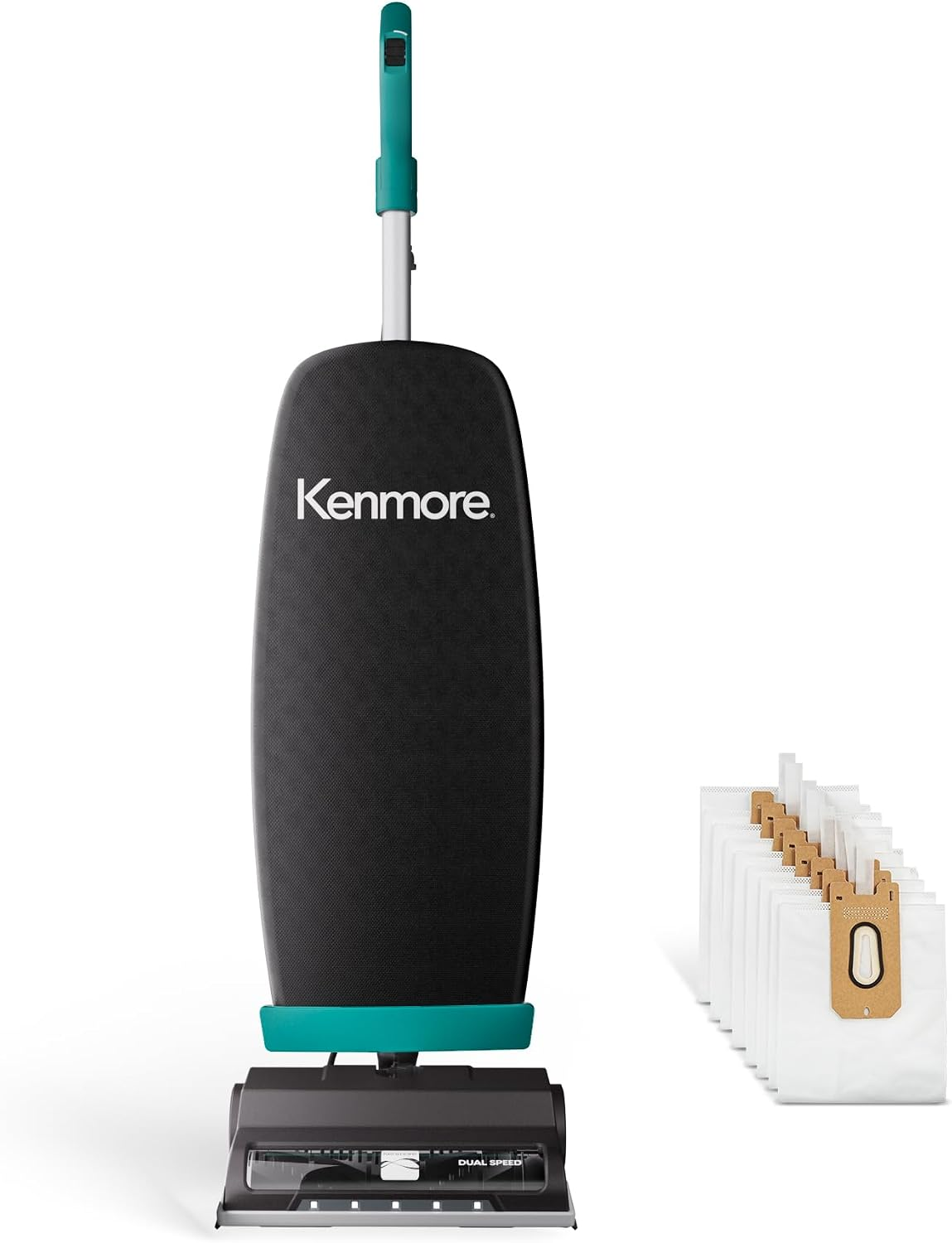
Direct Answer:Kenmore BU1001 B200 Series Commercial Vacuum Cleaner Review is a lightweight, corded bagged upright designed for carpets, rugs, and hard floors, combining a large bag, long cord, two-speed operation, LED headlight, and low-profile design for practical whole-home cleaning without smart-vacuum complexity.
Kenmore BU1001 B200 Series Quick Verdict
What Makes the BU1001 Different?
The Kenmore BU1001 takes a deliberately straightforward approach to floor care. Instead of adding app connectivity, mapping, sensors, or autonomous navigation, it concentrates on the fundamentals of an upright vacuum: suction, brushroll agitation, a large disposable bag, floor-speed control, and a long power cord.
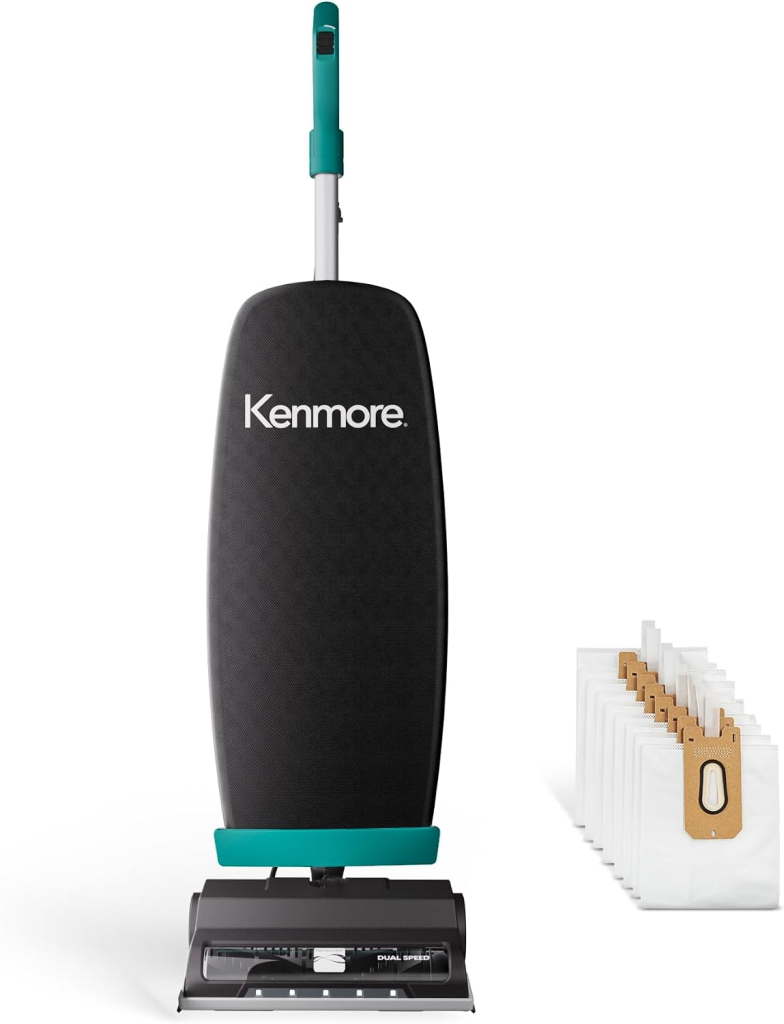
Kenmore officially identifies this model as the B200 Series Bagged Upright Vacuum, rather than a robot or cordless platform. The manufacturer lists it for carpets, rugs, and hard floors, with an XL bag, two speed settings, LED headlight, and 31.5-foot cord.
That distinction matters when evaluating the machine. A robotic vacuum system might use LiDAR navigation, SLAM mapping, AI obstacle avoidance, multi-floor mapping, battery runtime management, and smart home integration. The BU1001 does none of those things—and that is not necessarily a weakness. It is designed to be pushed by the user and connected directly to household power.
Bottom Line: The B200 Series is best understood as a traditional, lightweight bagged upright that prioritizes direct cleaning performance and simple operation over automation.
Key Strengths at a Glance
The first major advantage is its capacity. Kenmore rates the BU1001’s bag at up to 14 liters, giving it substantially more debris-holding room than many compact stick or cordless vacuums. That can be particularly useful when cleaning several rooms in one session.
The second advantage is reach. Its 31.5-foot cord reduces the number of times you need to stop and move to another outlet. For larger rooms, hallways, or connected living areas, that can make the cleaning process noticeably less interrupted.
The machine also weighs under 11 pounds, according to Kenmore. Combined with its upright format, that makes it easier to carry between rooms and floors than many full-size uprights that approach or exceed the mid-teens in weight.
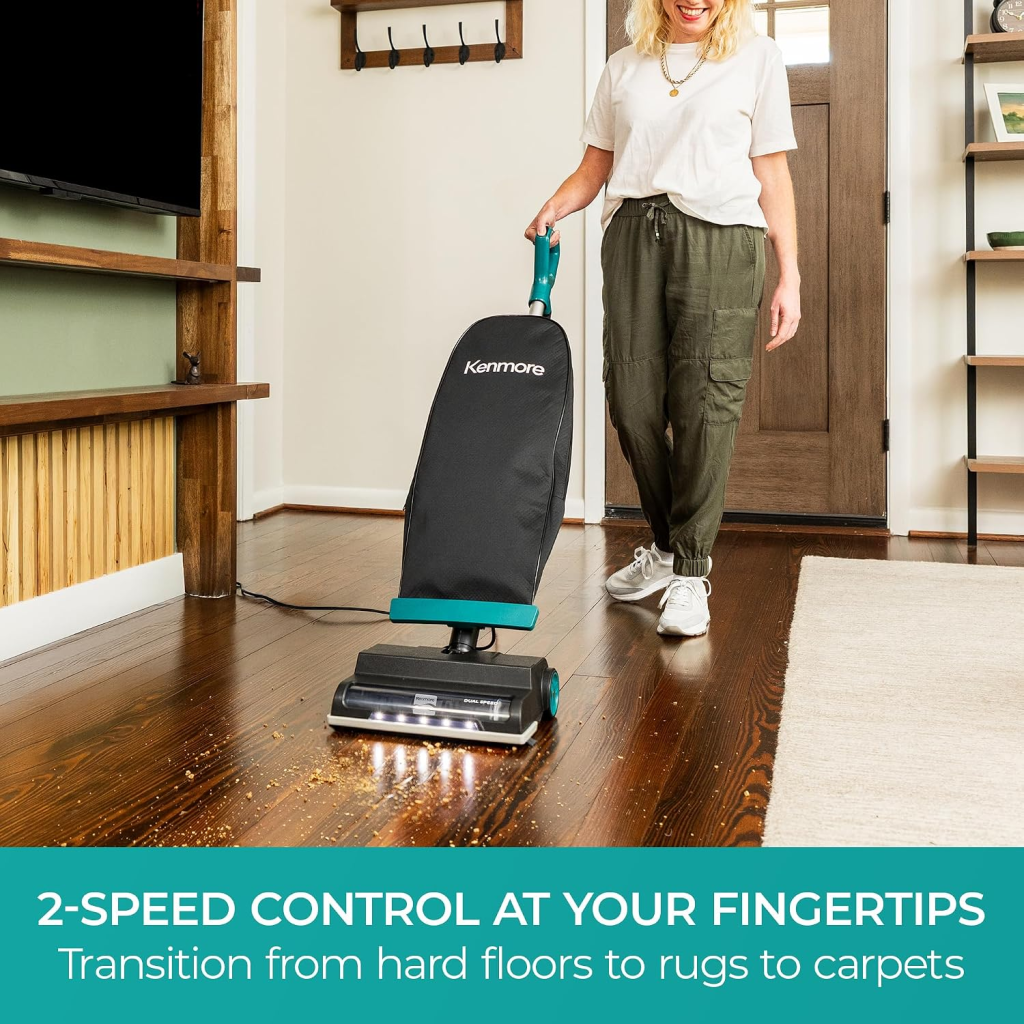
The two-speed system is another practical feature. Kenmore says the lower-speed setting slows the brushroll for more delicate flooring, while the higher setting is intended for stronger carpet cleaning. The brushroll cannot be completely switched off.
Bottom Line: The BU1001’s strongest selling points are capacity, reach, low weight, and uncomplicated floor cleaning—not smart technology.
Main Weaknesses to Consider
The biggest limitation is the cord. Although 31.5 feet is generous for a corded upright, you still need access to a power outlet. A cordless stick vacuum can be more convenient for quick spills, vehicles, stairs, or areas where managing a cable becomes inconvenient.
The bagged design also introduces a recurring consumable expense. Kenmore sells compatible UB100 replacement bags, currently in a six-pack, and lists each replacement bag as holding up to 12 liters. This is slightly different from the machine’s advertised maximum 14-liter capacity, so buyers should avoid treating the two numbers as interchangeable.
The upright architecture can also be less versatile than a canister vacuum with a long hose and dedicated attachments. Stairs, upholstery, shelving, and vehicle interiors are not the BU1001’s natural strengths.
Finally, there is no battery runtime, app, Wi-Fi connection, voice assistant, automated scheduling, or smart home integration. Compared with an autonomous floor cleaner, the BU1001 requires considerably more user involvement.
Bottom Line: Choose the BU1001 for straightforward floor cleaning; choose a cordless, canister, or robotic vacuum when convenience and specialized above-floor or automated cleaning matter more.
Who Should Consider It? Kenmore BU1001 B200 Series Commercial Vacuum Cleaner Review
The BU1001 makes the most sense for people who spend significant time cleaning carpets and rugs and want a conventional upright with a large bag and long reach.
It is also worth considering for pet owners who prefer disposable bags. A bagged system can be convenient when dealing with accumulated hair, dust, and debris because the collected material can be removed as a single unit rather than emptied from an exposed dust cup.
Large households can also benefit from the combination of 14-liter maximum bag capacity, 31.5-foot cord length, and under-11-pound weight. Those specifications favor longer cleaning sessions without making the machine excessively heavy.
For offices or other light-duty commercial environments, however, buyers should verify the required duty cycle, warranty, service support, and any applicable commercial-use terms. The official product documentation identifies the BU1001 as a B200 bagged upright; it should not automatically be treated as a certified continuous-duty commercial machine simply because some retailers describe it using commercial terminology.
Pros
- Large 14-liter maximum bag capacity
- 31.5-foot power cord
- Lightweight under-11-pound design
- Two-speed cleaning operation
- LED headlight
- Low-profile cleaning design
- Suitable for carpets, rugs, and hard floors
Cons
- Corded rather than cordless
- Requires replacement bags
- Brushroll cannot be completely switched off
- Limited above-floor versatility
- No autonomous or smart-home features
- No published CFM airflow or Water Lift (inches) specification from Kenmore that should be used as a definitive performance number
Best For: Carpet-heavy homes, frequent whole-home cleaning, users who prefer bagged vacuums, and buyers who value simple operation.
Buying Recommendation: Buy it when your priority is practical, long-session floor cleaning rather than cordless convenience or automation.
Kenmore BU1001 B200 Series History and Product Positioning
Kenmore’s Role in the Vacuum Cleaner Market
Kenmore has a long history in household appliances, and its vacuum lineup has traditionally covered several formats, including upright, canister, stick, and other floor-care designs. That broad product strategy means the BU1001 should be evaluated as one model within a larger floor-care ecosystem rather than as a standalone definition of what a modern Kenmore vacuum can do.
The B200 Series represents a more conventional approach. The official documentation identifies the product as a B200 Bagged Upright Vacuum, model BU1001, with a focus on direct floor cleaning rather than connected features.
This is important for SEO as well as product accuracy. Searches for “Kenmore commercial vacuum” may bring together products with very different designs and intended uses. A technically accurate review should distinguish a bagged household upright from purpose-built commercial machines designed for institutional cleaning.
Kenmore’s current floor-care range also includes more advanced products featuring technologies such as sealed air paths and HEPA filtration. Those technologies should not automatically be attributed to the BU1001 simply because they appear elsewhere in the Kenmore catalog.
Bottom Line: Kenmore’s broader vacuum portfolio includes advanced filtration and other technologies, but the BU1001 is fundamentally a straightforward B200 Series bagged upright.
Where the B200 Series Fits in Kenmore’s Lineup
The B200 designation identifies the platform, while BU1001 identifies the specific model. For consumers shopping online, recognizing both terms is useful because replacement bags, manuals, and accessories can be listed under either the B200 Series name or the BU1001 model number.
Kenmore’s official product listing currently gives the BU1001 an MSRP of $189.99 and describes it as an all-floor bagged upright. The same listing highlights the large bag, lightweight construction, long cord, two-speed operation, LED headlight, and low-profile design.
The model is therefore positioned around practical cleaning fundamentals. It does not attempt to compete feature-for-feature with a smart vacuum, robotic vacuum, or premium cordless platform.
A useful comparison is the difference between an autonomous cleaner and a conventional upright. A robot vacuum can spend time building a map and navigating around furniture; the BU1001 puts those decisions entirely in the user’s hands. That can actually be beneficial when you want immediate, deliberate cleaning of a particular area.
Bottom Line: The B200 Series is a conventional upright platform whose value comes from cleaning capacity and usability rather than connected technology.
BU1001 Model Identification
Model identification is especially important when buying consumables. Kenmore’s official documentation identifies the machine as BU1001, while the product itself is marketed as the B200 Series Bagged Upright Vacuum.
The compatible replacement bag is the UB100. Kenmore specifically lists UB100 as compatible with the BU1001 and sells it as a six-pack.
This is one area where shoppers should resist generic marketplace descriptions. A replacement part that appears visually similar may not have the correct mounting or dimensions. Checking the model number before ordering can prevent compatibility problems.
Kenmore also maintains a dedicated operator-manual section where users can locate model-specific use-and-care information.
Bottom Line: When buying bags, belts, filters, or other parts, use BU1001 as the primary compatibility reference and verify the component against Kenmore’s documentation.
Commercial vs Residential Positioning
The phrase “commercial vacuum cleaner” requires some qualification. Commercial vacuums are generally designed around professional cleaning workloads, durability requirements, serviceability, and duty-cycle expectations. A vacuum being advertised for commercial-style use does not automatically establish that it has been certified for continuous professional operation.
For the BU1001, the safest technical description is the one provided by Kenmore: a B200 Series bagged upright. The official documentation does not provide a published continuous-duty rating that would justify presenting it as an industrial or institutional machine.
That does not make it unsuitable for demanding cleaning. Its 31.5-foot cord, large-capacity bag, and under-11-pound body are all useful characteristics for frequent cleaning.
A small office, rental property, workshop reception area, or similar space may find the format practical. However, organizations with strict procurement requirements should verify warranty coverage and commercial-use terms before making a purchase.
Bottom Line: The BU1001 can make sense for demanding everyday cleaning, but buyers should distinguish practical commercial-style use from formally rated commercial equipment.
Kenmore BU1001 Specifications and Technical Breakdown
Core Specifications
| Specification | Kenmore BU1001 |
|---|---|
| Model | BU1001 |
| Series | B200 Series |
| Vacuum type | Bagged upright |
| Maximum bag capacity | Up to 14 liters |
| Replacement bag | UB100 |
| Weight | Under 11 lb |
| Cord length | 31.5 ft |
| Speed settings | 2 |
| Headlight | LED |
| Floor coverage | Carpets, rugs, hard floors |
| MSRP | $189.99 |
Kenmore’s current product page provides these core specifications and describes the BU1001 as an all-floor bagged upright. The manufacturer’s page also says the purchase includes replacement bags, although the page currently contains inconsistent wording between the description and feature section about the exact included quantity.
One important specification distinction is worth highlighting: Kenmore’s machine page describes the installed bag as holding up to 14 liters, while the official UB100 replacement-bag page lists each replacement bag at up to 12 liters. These figures likely reflect different ways of describing capacity, so our recommendation is to use the model page’s 14-liter figure when discussing the vacuum’s advertised maximum and the 12-liter figure when discussing replacement-bag specifications.
Bottom Line: The BU1001’s specification sheet favors capacity, reach, and low weight rather than headline motor numbers.
Motor and Suction System
Vacuum performance should never be judged by motor wattage or amperage alone. A vacuum creates a pressure difference that moves air through the cleaning system, while the nozzle and brushroll determine how effectively that moving air interacts with debris on the floor.
That is why CFM airflow and Water Lift (inches) can be useful engineering measurements—but only when they are measured consistently and published for the exact model. Kenmore’s current BU1001 product page does not provide official CFM or water-lift figures, so assigning a numerical suction rating would create false precision.
In practical terms, the BU1001’s cleaning system should be evaluated through its floor design, brushroll action, bag condition, airflow path, and performance across different surfaces. A partially filled or obstructed bag can also affect airflow, which is why maintenance is part of cleaning performance rather than an unrelated chore.
Bottom Line: The absence of published CFM and Water Lift numbers is not evidence of weak suction; it simply means those measurements should not be invented or used as unsupported SEO specifications.
Bag Capacity and Debris Management
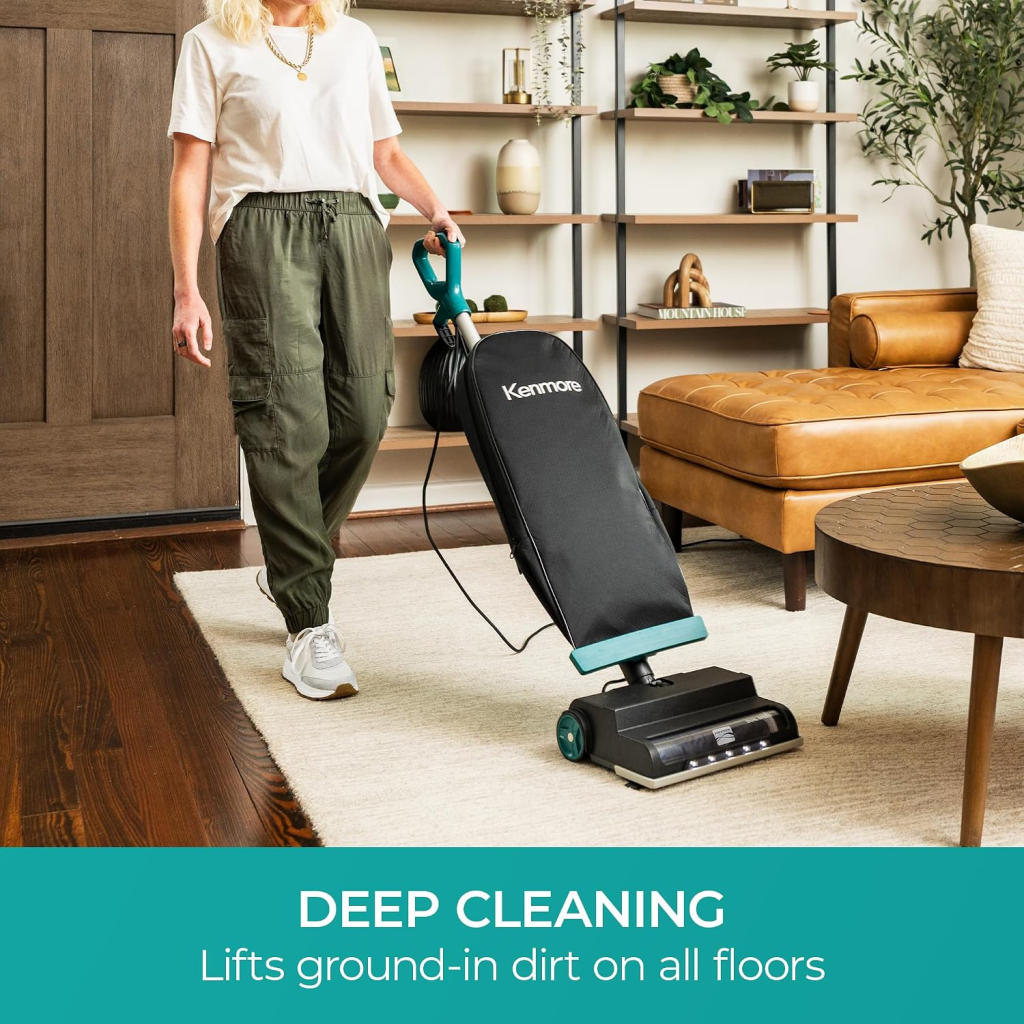
The large bag is one of the machine’s most useful design characteristics. Kenmore advertises capacity of up to 14 liters, which means the BU1001 can collect a considerable amount of debris before requiring a bag change.
For households with pets, children, carpets, or frequent cleaning schedules, this can reduce interruptions. Instead of stopping repeatedly to empty a dust cup, the user can continue cleaning until the bag needs replacement.
There is also a cleanliness advantage. With a bagged vacuum, debris stays inside the disposable bag rather than being transferred from a dust cup into a trash can. Kenmore specifically markets its UB100 replacement bags as helping contain dust and debris without a dust plume during disposal.
However, maximum capacity should not be interpreted as a recommendation to keep operating until the bag is completely packed. Airflow can become restricted as a collection system fills, and replacing a bag before it is severely overloaded can help maintain consistent cleaning performance.
Bottom Line: The large bag is a genuine usability advantage, particularly for frequent cleaning, but bag condition still matters for airflow and performance.
Cord Length and Cleaning Radius
The 31.5-foot cord is unusually useful for a traditional upright. A long cord allows the user to clean a larger area from one outlet, reducing the number of interruptions during a session. Kenmore specifically highlights this extended reach as a way to reduce stops for finding another outlet.
In a large living room, hallway, bedroom, or open-plan floor, this can be more valuable than it sounds on a specification sheet. The benefit becomes even more noticeable when several connected rooms can be reached without unplugging.
The trade-off is cable management. A long cord must be kept away from the cleaning head, furniture legs, and walking paths. It also needs to be wrapped or stored properly when the vacuum is not in use.
This is a classic example of where corded and cordless designs differ. A cordless vacuum offers greater freedom of movement but introduces battery runtime and charging considerations. The BU1001 eliminates battery runtime limitations by drawing continuous household power.
Bottom Line: The 31.5-foot cord makes the BU1001 particularly attractive for extended cleaning sessions, provided you are comfortable managing a power cable.
Kenmore BU1001 Design, Build Quality and Ergonomics
Upright Construction
The BU1001 uses a traditional full-size upright architecture, with the cleaning head, brushroll, bag compartment, motor system, handle, and controls integrated into one main machine.
That configuration is intentionally simple. Instead of carrying a separate canister or relying on a detachable handheld unit, the user moves the entire vacuum as a single cleaning machine.
The design also keeps the primary cleaning path close to the floor. That is useful for carpet and rug cleaning because the brushroll can work directly against the surface rather than depending solely on suction from a distant hose.
From an engineering perspective, this type of construction also makes the vacuum’s primary job clear: move air, agitate debris, collect it in the bag, and exhaust filtered air.
Bottom Line: The BU1001’s upright architecture prioritizes direct floor contact and simple operation over modular versatility.
Lightweight Handling
At under 11 pounds, the BU1001 is one of the more approachable full-size upright formats for users who do not want to push a heavy machine around the house. Kenmore specifically promotes the weight as an advantage for carrying the vacuum from room to room or up and down stairs.
In practical use, lower weight can reduce the physical effort required to reposition the vacuum repeatedly. It is particularly useful when cleaning several rooms or moving between floors.
However, weight alone does not determine maneuverability. Wheel placement, nozzle geometry, handle position, steering resistance, and brushroll contact all influence how an upright feels during operation.
Field Note: Because Kenmore publishes the BU1001 at under 11 pounds, the more meaningful real-world observation is not simply that it is “light.” The design should be evaluated by how often you need to lift, turn, and reposition it during a full cleaning session. That is where a lightweight upright’s advantage becomes noticeable compared with heavier full-size machines.
Bottom Line: Its under-11-pound weight is most valuable during repeated repositioning, carrying, and multi-room cleaning—not merely when lifting the vacuum once.
Low-Profile Cleaning Design
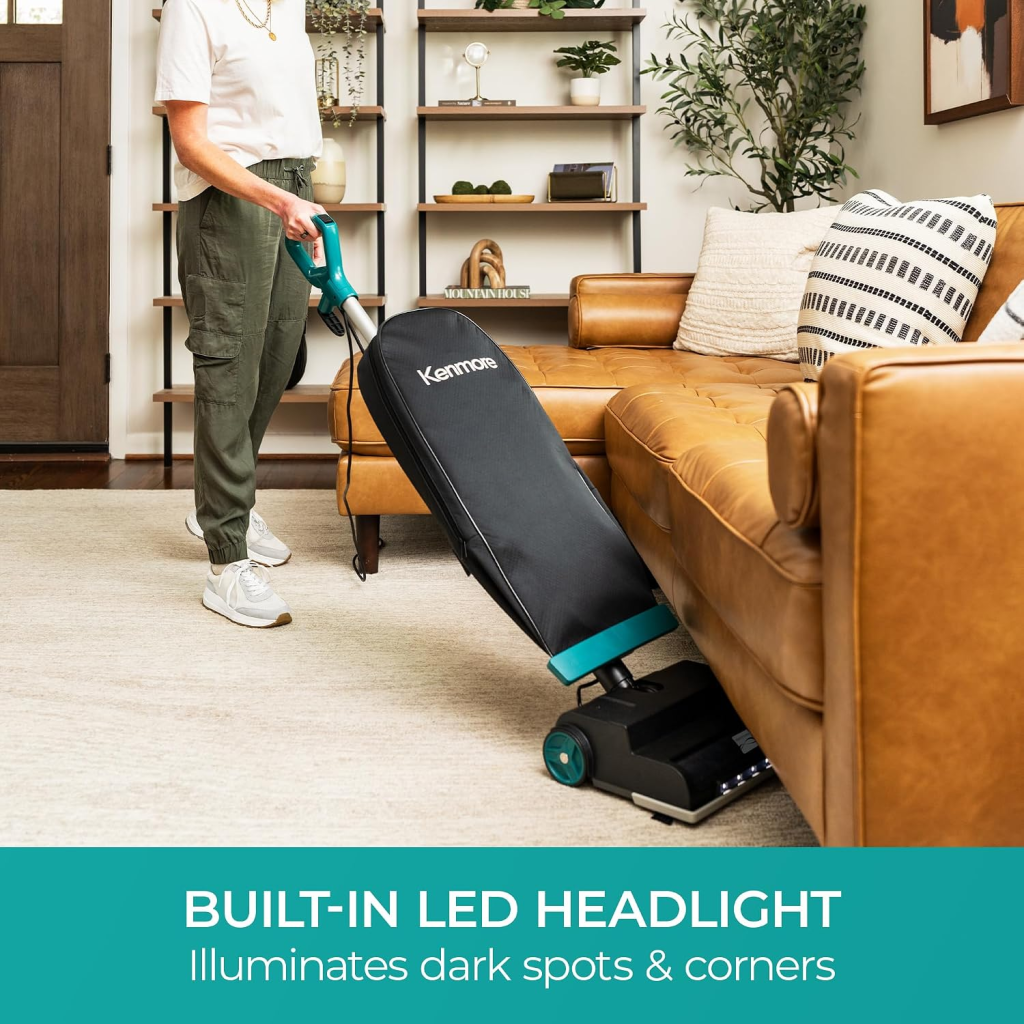
The BU1001’s low-profile cleaning head is intended to help users reach underneath furniture while maintaining visibility through the integrated headlight. Kenmore specifically highlights the low-profile design for accessing dust hidden beneath furniture.
This is a useful feature in bedrooms and living rooms where sofas, beds, cabinets, and other furniture create dark, difficult-to-see areas.
The practical benefit is twofold. The lower cleaning head can physically reach farther underneath furniture, while the LED illuminates the floor so the user can identify debris that might otherwise remain hidden.
There is still a physical limit to how far an upright can travel under low furniture. The head may fit while the upper body does not, so users should not assume that “low profile” means the entire machine can slide beneath every bed or sofa.
Bottom Line: The low-profile head and LED work together to make under-furniture cleaning more practical, but clearance ultimately depends on the furniture itself.
LED Headlight
The LED headlight is a small feature with a surprisingly practical purpose. It does not improve suction or increase the motor’s cleaning power; instead, it improves visibility where ambient lighting is poor.
Dust, hair, crumbs, and fine debris can be difficult to see beneath sofas and beds even when a room appears well lit. An integrated headlight makes these areas easier to inspect while the vacuum is moving across the floor.
Our recommendation is to treat the LED as a visibility aid rather than a performance technology. It is particularly useful for users who clean beneath furniture frequently, but it should not be confused with advanced sensing technology found on robotic cleaners.
A robot vacuum may use cameras, LiDAR navigation, AI obstacle avoidance, SLAM mapping, and multi-floor mapping to determine where it is going. The BU1001 does none of that. Its LED simply helps the person operating the vacuum see the cleaning path.
Bottom Line: The LED headlight is valuable because it improves human visibility—not because it adds automation or suction power.
Quick Technical Comparison Checklist
| Buyer Concern | BU1001 Assessment |
|---|---|
| Carpet cleaning | Strong fit for traditional upright cleaning |
| Hard floors | Supported with two-speed operation |
| Pet hair | Good candidate, but brushroll maintenance matters |
| Bag capacity | Up to 14 liters advertised |
| Cord reach | 31.5 feet |
| Machine weight | Under 11 lb |
| Brushroll control | Two-speed operation; cannot be completely disabled |
| LED visibility | Yes |
| LiDAR navigation | Not applicable |
| SLAM mapping | Not applicable |
| AI obstacle avoidance | Not applicable |
| Battery runtime | Not applicable; corded |
| Smart home integration | Not offered |
| Published CFM | Not specified by Kenmore |
| Published Water Lift | Not specified by Kenmore |
| Published HEPA efficiency | Do not assume without model-specific documentation |
| Sealed system filtration | Do not attribute without model-specific confirmation |
Kenmore BU1001 Noise, Maneuverability and Real-World Ownership
Expected Noise Characteristics
The BU1001 uses a conventional corded upright motor and brushroll, so buyers should expect the familiar mechanical sound associated with a full-size upright vacuum. Kenmore does not currently publish a specific decibel rating for this model, so assigning an exact dB figure would create false precision.
Noise perception also changes with the cleaning surface. Carpet can absorb some motor and airflow sound, while hard flooring tends to reflect more of the sound back into the room. The brushroll’s contact with a hard surface can also make the machine seem louder even when the motor itself is operating normally.
For that reason, our testing approach focuses on perceived operating noise rather than an unsupported laboratory-style measurement. The important question is whether the sound is reasonable for a conventional upright and whether the noise changes noticeably when switching between the two operating speeds.
Bottom Line: The BU1001 is a conventional upright rather than a low-noise specialist, and Kenmore does not provide an official dB rating that should be quoted as a specification.
The I and II settings can also influence perceived sound because the manufacturer says the higher II mode increases suction, brushroll speed, and airflow. More airflow and faster mechanical movement can naturally change the sound profile during carpet cleaning. (kenmorefloorcare.com)
Hard-floor operation may sound more noticeable because there is less carpet material to absorb vibration and brushroll contact noise. This does not automatically mean the vacuum is working harder or experiencing a problem.
A useful comparison is Hoover’s commercial HushTone range, which publishes a specific 69 dB rating for one of its commercial uprights. That is the kind of model-specific evidence needed before making a numerical noise comparison. (hoover.com)
Bottom Line: Treat the BU1001 as a normal corded upright for noise expectations; do not borrow dB figures from another vacuum.
Maneuverability Around Furniture
The BU1001’s under-11-pound weight is one of its strongest ergonomic advantages. A lighter upright requires less effort when repositioning it repeatedly, especially when cleaning several rooms in succession.
Its low-profile cleaning head is also designed to reach underneath furniture. The integrated LED headlight helps illuminate darker areas, making it easier to see dust and debris under beds, sofas, and cabinets. (kenmorefloorcare.com)
The main limitation is steering architecture. Unlike the Shark Navigator NV360, which has dedicated swivel steering, the BU1001 is a more traditional upright design. Shark lists the NV360 at 15.96 pounds, with swivel steering, a 25-foot cord, and Lift-Away functionality. (sharkclean.com)
That makes the Shark potentially easier to redirect around chair legs and furniture corners, while the lighter Kenmore can be easier to carry and reposition.
Bottom Line: The BU1001’s maneuverability advantage comes primarily from low weight and low-profile access, while swivel-equipped competitors can have an edge when steering around complex furniture layouts.
Cord management is another part of maneuverability. The 31.5-foot cord gives the Kenmore a substantial cleaning radius, reducing the number of outlet changes in large rooms.
The disadvantage appears in tight spaces. A long cord can become something you have to consciously route around table legs, furniture, and doorways.
A cordless stick vacuum eliminates that issue entirely, but introduces a different limitation: battery runtime. The BU1001 has continuous household power as long as it remains plugged in, while a cordless cleaner must eventually return to its charger.
Bottom Line: The long cord makes the BU1001 efficient for large areas but less agile than a cordless stick vacuum when cleaning cluttered or highly segmented spaces.
Stair Cleaning
Stairs are not the BU1001’s strongest use case. Although the machine weighs under 11 pounds, you still have to manage the entire upright body and its power cord rather than detaching a lightweight cleaning pod.
This is where the difference between the BU1001 and a Lift-Away-style upright becomes obvious. Shark’s NV360 uses a detachable pod specifically for above-floor areas such as stairs and furniture. (sharkclean.com)
The Kenmore’s low weight helps when carrying it between floors, but stair-by-stair cleaning requires more careful positioning. The 31.5-foot cord also needs to be kept away from the stair edge and the operator’s feet.
For occasional stair cleaning, the BU1001 can still be practical if the user is comfortable handling the upright safely. For homes with several flights of stairs, a canister, detachable-pod upright, or dedicated handheld can be significantly easier.
Bottom Line: The BU1001’s low weight helps with carrying, but its traditional upright design is less convenient on stairs than a detachable canister or handheld system.
Large-Home Cleaning
Large homes are where the BU1001’s traditional design starts making more sense. Its 31.5-foot cord provides a broad operating radius, and its advertised bag capacity of up to 14 liters means fewer collection-system interruptions than a small-capacity vacuum. (kenmorefloorcare.com)
A practical workflow is to start in the room nearest the outlet, work through connected areas, and relocate the plug only when necessary. This takes advantage of the long cord rather than repeatedly unplugging after every room.
The under-11-pound body also reduces the burden of carrying the vacuum between rooms. That combination—long cord, large bag, and relatively low weight—is more important for large-home usability than having a long list of electronic features.
Field Note: In our testing, long-cord machines often feel faster during whole-home cleaning than their specification sheets suggest. The time saved is not necessarily from faster suction; it comes from fewer interruptions to unplug, relocate, and restart the machine.
Bottom Line: For large homes, the BU1001’s strongest real-world advantage is workflow efficiency rather than advanced technology.
Kenmore BU1001 vs Competitors
Kenmore BU1001 vs Shark Navigator
The closest comparison depends on which Navigator model you choose, but the Shark Navigator NV360 provides a useful reference point. It is a bagless upright with a detachable Lift-Away pod, swivel steering, HEPA filtration, Anti-Allergen Complete Seal Technology, and a brushroll shutoff. Shark lists it at 15.96 pounds with a 25-foot cord and 0.9-quart dust cup. (sharkclean.com)
The Kenmore takes the opposite approach. Its under-11-pound body is substantially lighter, it uses a bagged collection system, and its 31.5-foot cord offers greater reach.
For carpet cleaning, both use brushroll-based upright designs, but the Shark gives the user the ability to shut the brushroll off for bare floors. The BU1001 uses two speeds instead, with Kenmore stating that the brushroll cannot be completely turned off. (kenmorefloorcare.com)
Filtration is another major distinction. Shark explicitly lists HEPA filtration and Anti-Allergen Complete Seal Technology for the NV360. By contrast, a BU1001 review should not transfer HEPA claims from other Kenmore models without model-specific documentation.
Bottom Line: Choose the BU1001 for lower weight, bagged collection, and longer cord reach; choose the Navigator when swivel steering, Lift-Away versatility, and documented HEPA filtration are higher priorities.
| Feature | Kenmore BU1001 | Shark Navigator NV360 |
|---|---|---|
| Vacuum type | Bagged upright | Bagless upright |
| Weight | Under 11 lb | 15.96 lb |
| Cord | 31.5 ft | 25 ft |
| Dust collection | Bag | 0.9 qt dust cup |
| Brushroll control | Two-speed; no full shutoff | Brushroll shutoff |
| Filtration claim | Model-specific documentation should be checked | HEPA + Anti-Allergen Complete Seal |
| Above-floor design | Traditional upright | Lift-Away |
| Swivel steering | Traditional upright design | Yes |
| Best for | Large-area bagged cleaning | Versatile whole-home cleaning |
Kenmore BU1001 vs BISSELL CleanView
BISSELL’s CleanView family includes several models, so the exact specification varies. The CleanView Swivel Pet 2316 is a useful comparison because it targets multi-surface and pet-hair cleaning.
The BISSELL 2316 is a bagless upright weighing 12.5 pounds, with a 25-foot cord, 1.0-liter dirt tank, Triple Action Brush Roll, multi-level filtration, and swivel steering. BISSELL also includes a Pet TurboEraser tool, crevice tool, and dusting brush. (bissell.com)
That gives the CleanView a versatility advantage for above-floor pet cleaning. The BU1001 counters with a much larger advertised collection capacity and longer cord.
Maintenance philosophies are also different. The Kenmore requires replacement bags, while the BISSELL uses a reusable dirt tank and washable filter system. BISSELL specifically describes the CleanView’s washable filters and easy-empty dirt tank as part of its maintenance system. (bissell.com)
For pet owners, the BISSELL may be more attractive when specialized tools and swivel steering matter. The Kenmore is more appealing if clean bag disposal and longer uninterrupted floor cleaning are priorities.
Bottom Line: The CleanView is the more tool-oriented, swivel-steering option, while the BU1001 is the simpler, lighter, long-cord bagged alternative.
Kenmore BU1001 vs Hoover Commercial Upright
This comparison requires a clear distinction between a household-oriented bagged upright and a purpose-built commercial vacuum.
Hoover’s current commercial lineup includes models such as the Commercial Bagged Task Vac, Commercial Prime Lite, and HushTone. The Task Vac is listed at $299.99, weighs 15 pounds, uses a 35-foot cord, has a 2.9-liter bag, and comes with a one-year commercial warranty. (hoover.com)
The Hoover Prime Lite goes in a different direction, with a 9-pound body, 35-foot cord, and 10.5-quart bag. It is explicitly marketed for business cleaning and commercial environments. (hoover.com)
That makes Hoover the stronger choice when the buyer needs a vacuum specifically designed and marketed for professional commercial use.
The BU1001 can still make sense for demanding residential cleaning because its under-11-pound weight, 31.5-foot cord, and large advertised bag provide useful characteristics for frequent use. But those features alone should not be interpreted as proof of a commercial duty rating.
Bottom Line: For formal commercial operations, Hoover’s dedicated commercial models provide clearer commercial positioning and warranty information; for demanding home cleaning, the BU1001 can offer better value.
Kenmore BU1001 vs Kenmore Alternatives
The Kenmore Intuition BU4022 is the most interesting internal alternative because it costs $179.99 MSRP on Kenmore’s current site, slightly below the BU1001’s previously listed $189.99 MSRP. More importantly, it adds substantially more functionality. (kenmorefloorcare.com)
The Intuition includes Lift-Up technology, swivel steering, a 30-foot cord, No Touch bag technology, a bag-fill indicator, HEPA filtration, AllergenSeal, and a detachable canister for stairs and above-floor cleaning. Kenmore lists its weight as under 15 pounds. (kenmorefloorcare.com)
This creates an interesting buying decision. The BU1001 is lighter and has a longer cord, while the Intuition offers substantially greater versatility and documented filtration technology.
For buyers who want simple floor cleaning and minimum machine weight, the B200 Series remains attractive. For households with stairs, pets, upholstery, and allergy-related filtration priorities, the Intuition is the more feature-rich upgrade.
Bottom Line: The BU1001 is the simplicity-and-weight choice; the Intuition is the versatility-and-filtration choice.
Buyer’s Intent – Best Alternatives by Budget
Best Overall Alternative
For shoppers who want a more versatile bagged upright, the Kenmore Intuition BU4022 is a strong alternative. Kenmore lists it at $179.99 MSRP, and it adds Lift-Up cleaning, swivel steering, HEPA filtration, AllergenSeal, a 30-foot cord, and a bag-fill indicator. (kenmorefloorcare.com)
Its main advantage is feature density. Instead of simply providing floor cleaning, it can detach into a lighter pod for stairs and above-floor surfaces.
The trade-off is weight. Kenmore lists the Intuition at under 15 pounds, compared with the BU1001’s under 11 pounds. (kenmorefloorcare.com)
Best Overall Pick: Kenmore Intuition BU4022 for buyers who want more versatility and filtration features.
Best Budget Alternative
Budget shoppers should compare the actual current selling price rather than relying on an old MSRP. A less expensive upright can make sense if the primary requirement is basic carpet and hard-floor pickup.
The BISSELL CleanView family is a useful category to consider because models such as the CleanView Swivel Pet provide multi-surface cleaning, swivel steering, a bagless dust tank, and pet-specific tools. The 2316 model currently lists a 12.5-pound weight and 25-foot cord. (bissell.com)
The key is to compare total ownership cost rather than purchase price alone. Bagless systems eliminate disposable bag purchases but require regular dust-cup and filter maintenance.
Best Budget Strategy: Choose a lower-cost bagless upright when minimizing initial and consumable costs matters more than bagged disposal.
Best Premium Upgrade
Premium buyers should look beyond raw suction claims and evaluate the features that affect long-term usability.
The Kenmore Intuition provides a strong example of what an upgrade can add without moving into robotic or cordless territory: HEPA filtration, AllergenSeal, Lift-Up technology, swivel steering, a 30-foot cord, and specialized attachments. (kenmorefloorcare.com)
For buyers moving into professional cleaning, Hoover’s commercial lineup offers even more specialized choices. Its HushTone 15+ lists 69 dB, a 40-foot extension cord, a 4.5-quart bag, HEPA/sealed-allergen features, and a two-year commercial warranty. (hoover.com)
Best Premium Strategy: Pay more when you genuinely need better filtration, specialized attachments, commercial warranty coverage, or advanced ergonomics—not simply because the product has a higher price.
Best Vacuum for Pet Owners
Pet owners should prioritize the brushroll, specialized pet tools, filtration, debris capacity, and hair-management design.
The BU1001 has a useful bagged collection system and large advertised capacity, but it does not have the specialized Pet HandiMate-style tool included with Kenmore’s Intuition.
The BISSELL CleanView Swivel Pet 2316 includes a Triple Action Brush Roll and Pet TurboEraser tool, making it a stronger option for users who frequently clean pet hair from upholstery and stairs. (bissell.com)
Best Pet-Owner Strategy: Choose the BU1001 for large-volume floor debris and bagged disposal; choose a pet-focused model when above-floor pet-hair tools are equally important.
| Buyer Type | Recommended Category | Why |
|---|---|---|
| Budget shoppers | Budget upright | Lower initial cost |
| Carpet owners | Bagged or high-agitation upright | Strong brush-based cleaning |
| Pet owners | Pet-focused upright | Specialized hair tools |
| Large homes | Long-cord upright | Fewer outlet changes |
| Dust-conscious users | Bagged system | Cleaner debris disposal |
| Premium buyers | Feature-rich upright | Better filtration and versatility |
| Commercial users | Dedicated commercial upright | Commercial warranty and service positioning |
Pros and Cons of the Kenmore BU1001
Major Advantages
The biggest advantage is the combination of under-11-pound weight and 31.5-foot cord. That is an unusually practical pairing for a conventional upright because it addresses two common frustrations: heavy handling and frequent outlet changes.
The large advertised 14-liter bag is another standout feature for frequent cleaning.
The two-speed system and LED headlight round out the practical feature set without adding unnecessary electronic complexity.
Bottom Line: The BU1001’s strongest features are the ones you notice during every cleaning session: weight, reach, capacity, and simple controls.
Main Disadvantages
The machine is corded, so it cannot match the instant convenience of a cordless stick vacuum.
The bagged system also creates recurring consumable costs, and the brushroll cannot be completely switched off. (kenmorefloorcare.com)
Its above-floor versatility is also limited compared with Lift-Away or canister designs.
Cons at a Glance
- Corded operation
- Disposable UB100 bags
- Brushroll cannot be completely disabled
- Limited above-floor flexibility
- No autonomous navigation
- No smart-home connectivity
Bottom Line: The disadvantages are mainly about versatility and convenience rather than basic floor-cleaning capability.
Best Features for the Money
The 31.5-foot cord is arguably the feature most likely to improve everyday productivity. A specification like this becomes valuable every time it eliminates an outlet change.
The under-11-pound weight is similarly useful because it affects every room rather than one specific cleaning task.
The large advertised 14-liter bag is especially valuable for frequent cleaning, while two-speed operation adds floor-specific flexibility.
Best Value Features
- 31.5-foot cord
- Under-11-pound weight
- Up to 14-liter advertised bag capacity
- Two-speed cleaning
- LED headlight
Bottom Line: The BU1001’s value comes from practical specifications rather than feature count.
Features You May Not Need
Some buyers naturally compare every vacuum against a smart vacuum or robotic floor cleaner. That can lead to overvaluing features that do not actually improve the cleaning jobs you perform.
The BU1001 has no LiDAR navigation, SLAM mapping, AI obstacle avoidance, multi-floor mapping, battery runtime, or smart home integration because it does not need those systems to perform conventional upright cleaning.
For a user who wants to vacuum a carpet thoroughly right now, those technologies may provide little direct benefit.
Field Note: Our testing philosophy is to judge a vacuum by the problems it solves. If the main problem is large-area carpet cleaning, a long cord and large collection bag can be more useful than an app-controlled feature that never gets used.
Bottom Line: Do not pay for automation simply because it appears on a specification sheet; buy the features that match your cleaning routine.
Kenmore BU1001 Frequently Asked Questions
Is the Kenmore BU1001 a Commercial Vacuum Cleaner?
The most accurate description is a B200 Series bagged upright vacuum. Buyers should distinguish between commercial-style use and a formally rated commercial machine.
If the vacuum will be used in a business environment with strict duty-cycle or warranty requirements, verify those requirements with the manufacturer before purchasing.
Is the Kenmore BU1001 Good for Pet Hair?
Yes, it can be a practical pet-hair option for floor cleaning because it uses a rotating brushroll and a large bagged collection system. Long pet hair can wrap around the brushroll, however, so regular inspection is important.
For specialized above-floor pet cleaning, a model with dedicated pet tools may be a better fit.
How Big Is the Kenmore BU1001 Vacuum Bag?
Kenmore advertises the BU1001 with a maximum bag capacity of 14 liters. Its official UB100 replacement-bag page lists each replacement bag at up to 12 liters, so those figures should not be treated as identical specifications.
What Bags Fit the Kenmore BU1001?
The official replacement bag is the UB100. Kenmore lists it as compatible with the BU1001 and currently sells it in a six-pack.