
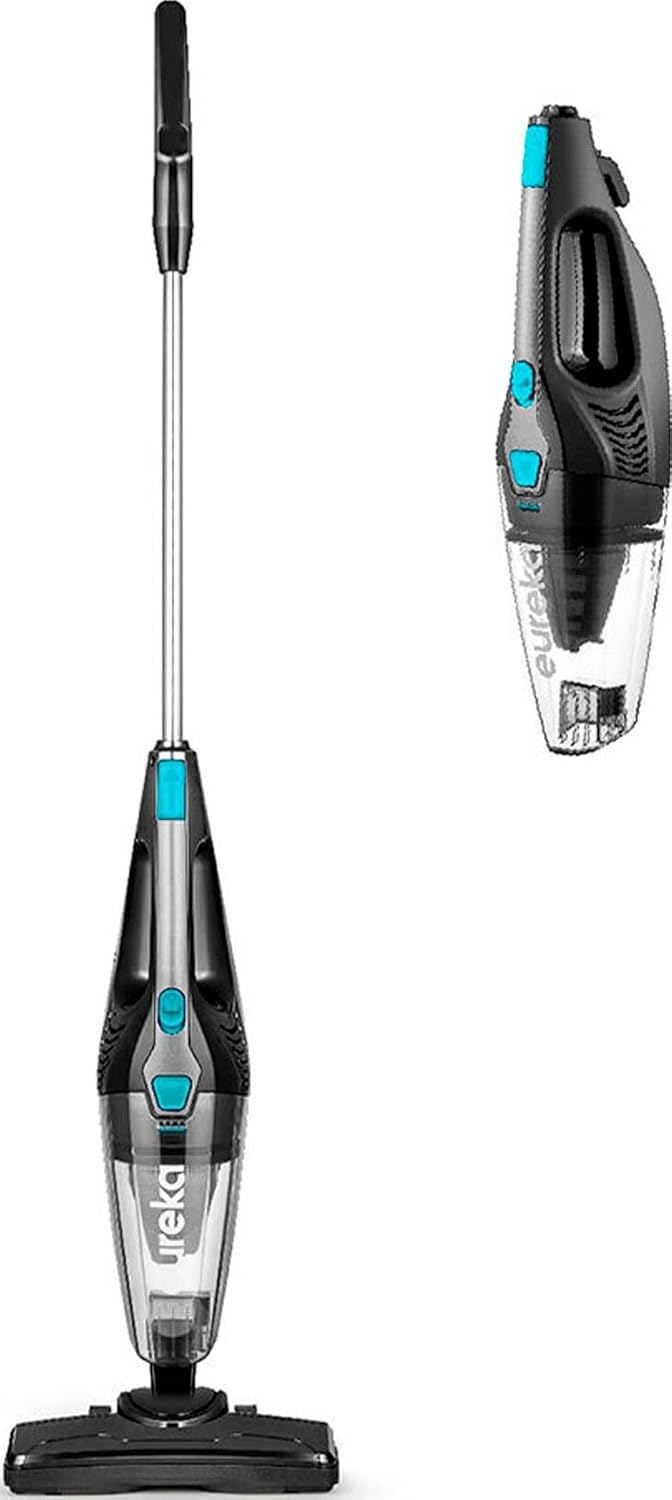
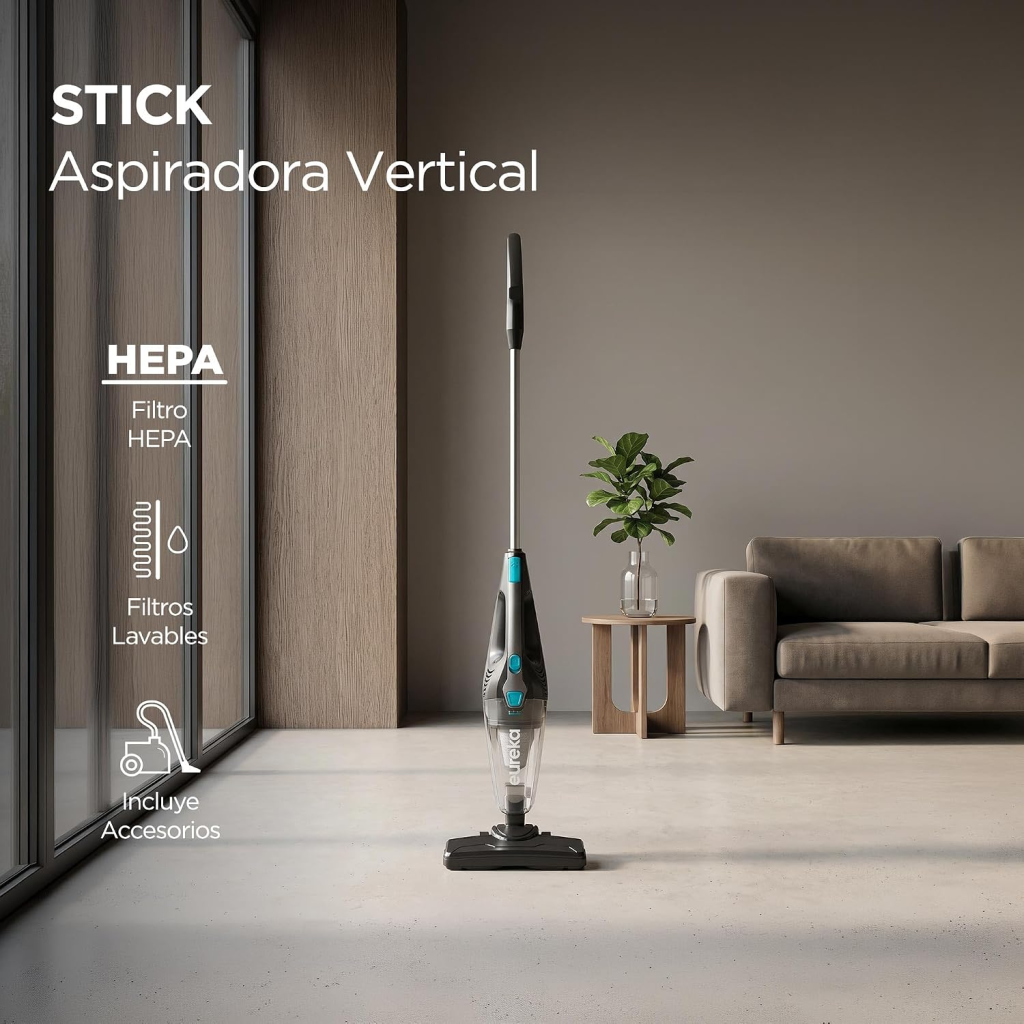
Eureka NES215A Blaze 3-in-1 Swivel Stick Vacuum is a lightweight corded cleaner designed for quick everyday cleaning on hard floors, area rugs, and low-pile carpets. Its main advantages are a 4-pound weight, 3-in-1 configuration, swivel steering, washable filter, and 18-foot power cord, while its main limitations are the lack of cordless operation and the less specialized design for deep carpet cleaning.
Eureka NES215A Blaze 3-in-1 Swivel Stick Vacuum at a Glance
Quick Verdict
The Eureka NES215A takes a deliberately simple approach to floor cleaning. Rather than trying to compete with premium cordless stick vacuums loaded with sensors, multiple power modes, and large battery packs, it focuses on being lightweight, compact, and easy to convert between floor and above-floor cleaning.
Its 3-in-1 design allows the unit to function as a stick vacuum and handheld cleaner, with a crevice tool available for tighter spaces. The manufacturer’s documentation also identifies a floor nozzle, crevice tool, filter, and crevice-tool holder among the components.
The biggest advantage is therefore convenience rather than advanced technology. There is no battery to charge, no charging dock to maintain, and no smart application to configure. Plug it into a suitable outlet and it can continue operating without the runtime limitations associated with a cordless vacuum.
That simplicity also defines its limitations. Buyers looking for deep carpet agitation, advanced HEPA-grade filtration, automated cleaning, or a cordless premium experience should consider a more capable full-size or cordless model.
Bottom Line: The NES215A makes the most sense as a lightweight everyday vacuum for apartments, dorm rooms, small homes, hard floors, and quick cleanup rather than as a replacement for a powerful full-size carpet vacuum.
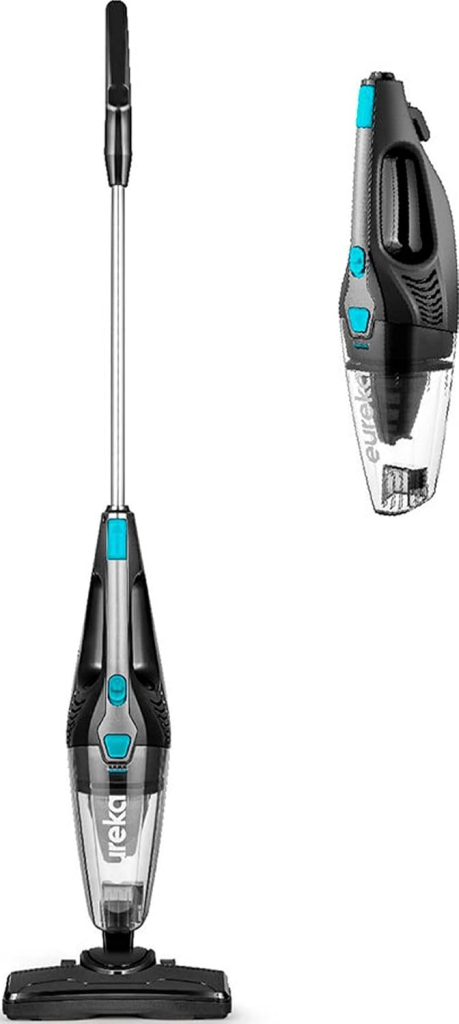
Key Specifications
| Specification | Eureka NES215A |
|---|---|
| Type | Corded stick/handheld vacuum |
| Motor | 2 Amp |
| Rated power | Approximately 240 watts in commonly published specifications |
| Weight | 4 pounds |
| Dust capacity | 0.55 liters in commonly published specifications |
| Filtration | Washable foam filtration |
| Steering | Swivel steering |
| Cleaning configurations | Stick + handheld + crevice-tool configuration |
| Power cord | 18 feet |
| Recommended surfaces | Hard floors, area rugs, low-pile carpets |
| Color | Blaze Blue |
| Noise | 84 dB in one published specification listing |
The available documentation shows some variation in specifications between listings and regional materials. For example, one product/manual source lists 240 watts and 0.55 liters, while other regional documentation can report different electrical or capacity figures. For a commercial page, the exact U.S. configuration should be verified before publishing a definitive specification table.
The 18-foot cord, 4-pound weight, washable filter, and swivel steering are consistently associated with the model in published product documentation.
Bottom Line: The specification sheet describes a deliberately lightweight, corded appliance. Its design priorities are portability and simplicity rather than high-end automation or cordless performance.
Pros and Cons
Pros
- 4-pound lightweight construction.
- 3-in-1 cleaning configuration.
- Swivel steering for easier direction changes.
- Capture nozzle designed for larger debris.
- Washable filtration.
- 18-foot power cord.
- No battery charging or runtime limitation.
- Compact form factor.
- Useful for quick everyday cleaning.
Cons
- Corded rather than cordless.
- Less appropriate for deep-cleaning thick carpet.
- Washable foam filtration is not the same thing as a certified HEPA system.
- No LiDAR navigation, SLAM mapping, AI obstacle avoidance, or autonomous cleaning.
- No battery runtime because it operates from household power.
- Small lightweight construction is better suited to maintenance cleaning than heavy whole-home cleaning.
The replacement-parts catalog also confirms that the model has dedicated components including a dust cup, inlet filter, inner filter block, floor-related parts, power cord, motor assembly, and other serviceable components.
Bottom Line: The strongest reasons to buy are simplicity, low weight, and versatility. The strongest reasons to look elsewhere are deep-carpet requirements, cordless convenience, and advanced filtration or automation.
Who Should Read This Review?
This vacuum deserves the most attention from buyers who value a simple cleaning tool rather than a technology-heavy appliance.
Apartment owners can benefit from the slim design and lightweight handling, particularly where most floors are hardwood, laminate, tile, or other hard surfaces.
Dorm residents may appreciate the combination of compact storage and handheld functionality. A separate full-size upright can be unnecessarily bulky for a small living space.
Small-home owners can use it for regular debris pickup and quick maintenance cleaning, although larger homes with extensive carpet may benefit from a more powerful primary vacuum.
Pet owners can consider it for everyday hair and debris on hard floors. However, households dealing with heavy shedding and thick carpet should look toward a vacuum specifically engineered for pet-hair agitation.
Hard-floor households are among the strongest potential users because the lightweight floorhead and capture-oriented design are well matched to crumbs, dust, and everyday surface debris.
Secondary-vacuum buyers are another strong audience. The NES215A can complement a full-size vacuum by handling quick spills and small messes without requiring a larger machine.
Bottom Line: The ideal owner is someone who wants an inexpensive, lightweight everyday cleaner—not someone looking for a premium all-floor replacement machine.
Field Note — Editorial Observation: The most meaningful characteristic of this design is not a headline suction number; it is the low-complexity architecture. The unit has no battery-management system, navigation computer, app, charging dock, or mapping hardware. That makes the cleaning workflow substantially simpler than a modern robotic vacuum system, where LiDAR navigation, SLAM mapping, AI obstacle avoidance, multi-floor mapping, battery runtime, and smart-home integration become important considerations.
Eureka Brand History and the Blaze Vacuum Line
Eureka’s Position in the Vacuum Market
Eureka is an established floor-care brand with a product portfolio spanning upright, cordless, canister, stick, and handheld vacuum cleaners. The replacement-parts ecosystem identifies Eureka as part of Midea Group and shows ongoing support for multiple categories of vacuum equipment.
That broad product portfolio helps explain where a model such as the NES215A fits. It is not intended to be a flagship technological showcase. Instead, it addresses a simpler part of the market where affordability, portability, and straightforward operation are more important.
The stick-vacuum category itself has changed considerably. Older lightweight corded cleaners competed primarily on convenience and basic suction, while newer premium models increasingly add digital controls, brushroll optimization, sensors, and rechargeable batteries.
The NES215A represents the simpler side of that evolution.
Bottom Line: Eureka’s broad vacuum portfolio places the NES215A in the practical, lightweight end of the market rather than the premium smart-cleaning segment.
How the Blaze Series Fits Into Eureka’s Product Range
The Blaze name is associated with Eureka’s lightweight stick-vacuum products. Eureka’s current accessory pages continue to list Blaze models alongside other stick-vacuum families, including the NES212 and NES312.
The design philosophy is relatively easy to understand: keep the machine small enough for frequent use while adding enough versatility to cover floors and above-floor surfaces.
This is fundamentally different from a large upright. An upright normally emphasizes floor agitation, larger cleaning paths, substantial dust capacity, and whole-home carpet performance.
A lightweight stick model sacrifices some of those characteristics to make quick cleaning easier.
Bottom Line: The Blaze line is best understood as Eureka’s lightweight, convenience-focused stick-vacuum category rather than a direct substitute for every type of full-size vacuum.
Why the NES215A Was Designed
The model’s physical design addresses several common household-cleaning problems.
First, a lighter vacuum is easier to carry from one room to another. Second, the handheld configuration eliminates the need for a completely separate small vacuum. Third, the cord removes the need for a rechargeable battery.
The manual specifically describes assembly around a stick configuration, handheld configuration, floor nozzle, and crevice tool.
This modular approach makes sense for apartments and smaller homes where the same machine may be used on the floor, furniture, stairs, and narrow gaps.
Bottom Line: The NES215A’s design priorities are versatility and accessibility rather than sophisticated automation.
NES215A Versus Modern Cordless Vacuum Trends
The most obvious contrast is the power source.
The NES215A uses household electricity, while cordless stick vacuums rely on rechargeable lithium-ion battery systems. A cordless model provides greater freedom of movement, but its battery introduces charging requirements, runtime limits, and eventual battery aging.
The Eureka avoids those issues. As long as an appropriate electrical outlet is available, cleaning can continue without waiting for a battery to recharge.
This is also why concepts such as battery runtime have little relevance to the NES215A itself. There is no onboard rechargeable battery whose remaining capacity determines how long the vacuum can operate.
The same distinction applies to smart home integration. The NES215A is a manually operated appliance rather than a connected smart vacuum.
Bottom Line: A cordless vacuum wins for freedom of movement; the NES215A wins for continuous corded operation and mechanical simplicity.
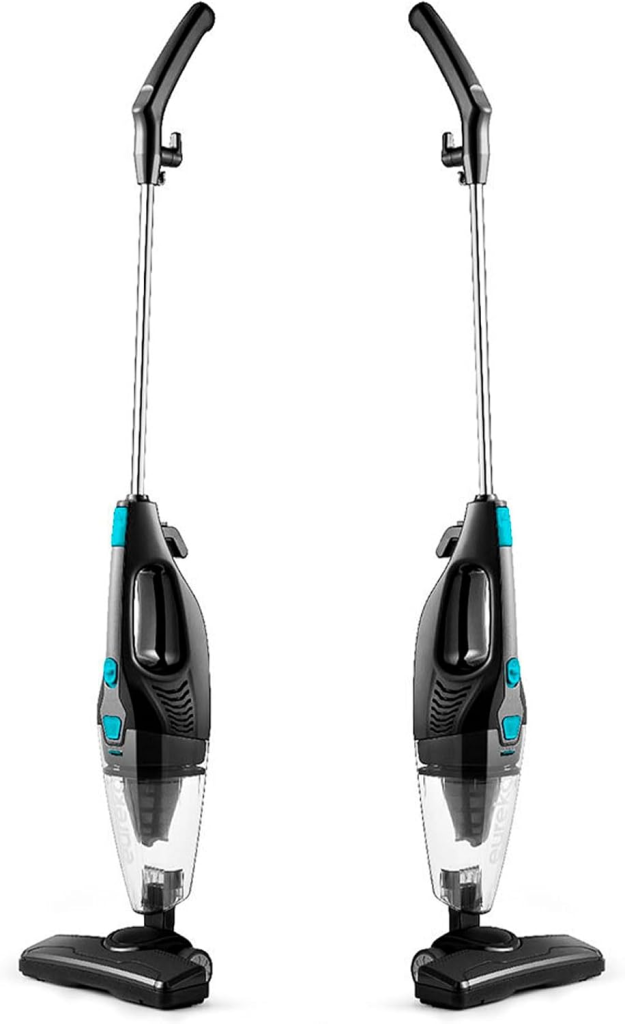
Eureka NES215A Design, Build Quality and Ergonomics
Lightweight Body and Portability
At approximately 4 pounds, the NES215A is significantly more focused on portability than traditional full-size vacuum cleaners.
That matters when cleaning several small areas during the day. Carrying a lightweight machine from a bedroom to a kitchen is less demanding than moving a heavy upright.
The same characteristic helps with stairs. Once converted to the appropriate handheld configuration, the user can carry the cleaner rather than maneuvering a full-size floor machine on every step.
However, low weight should not automatically be interpreted as higher cleaning power. Weight and suction are separate engineering characteristics.
Bottom Line: The 4-pound body is one of the model’s clearest usability advantages, particularly for quick cleaning and above-floor work.
Swivel Steering System
Swivel steering allows the floorhead to change direction relative to the handle instead of requiring the entire vacuum to move along a rigid straight axis.
In practical terms, this can make it easier to move around table legs, chair feet, cabinets, and other obstacles.
This feature is especially useful in smaller rooms where furniture density is high. A vacuum that can change direction without large sweeping movements can feel more agile.
It is important, however, not to confuse swivel steering with automated navigation. The NES215A has no autonomous navigation system.
There is no LiDAR navigation, SLAM mapping, camera-based room mapping, or AI obstacle avoidance. Those technologies belong primarily to robot vacuum systems.
Bottom Line: Swivel steering improves manual maneuverability; it does not turn the appliance into an autonomous cleaner.
Floor Nozzle and Capture Nozzle Design
The model’s capture nozzle is intended to help with larger debris, which is particularly relevant on hard surfaces.
Large crumbs can behave differently from fine dust. A low-profile nozzle has to provide enough clearance for particles to enter instead of simply pushing them forward.
This is one reason a vacuum’s real-world usefulness cannot be judged from motor wattage alone.
A vacuum may have a relatively powerful motor yet perform poorly on particular debris if the floorhead, airflow path, and intake geometry are poorly matched to the task.
Bottom Line: The capture-nozzle concept is particularly useful for everyday hard-floor debris such as crumbs and larger particles.
Storage and Physical Footprint
The slim stick form is convenient for homes where closet space is limited.
Unlike a bulky upright, a lightweight stick cleaner can usually occupy a narrow section of a closet or utility area. The handheld conversion also reduces the need for separate compact cleaning equipment.
Cord storage remains the primary physical consideration. Because this is a corded machine, the user needs to manage the 18-foot power cable rather than simply place the vacuum on a charging dock.
Bottom Line: The compact body helps with storage, but cord management remains part of ownership.
Eureka NES215A 3-in-1 Cleaning Technology Explained
Stick Vacuum Mode
The primary configuration is the stick-vacuum setup.
This is the mode most appropriate for regular floor maintenance. The user can clean hard surfaces, area rugs, and suitable low-pile carpeting without carrying the handheld unit directly across the floor.
The manual documentation describes attaching the handle and floor nozzle to create the standard configuration.
Bottom Line: Stick mode is the most practical configuration for routine floor cleaning.
Handheld Vacuum Mode
Removing the longer handle transforms the appliance into a more compact handheld cleaner.
That opens up applications such as furniture, stairs, shelves, upholstery, and quick spot cleaning.
For apartment owners, this dual-purpose design can be valuable because the same motor unit handles both floor and above-floor jobs.
Bottom Line: Handheld mode increases the value of the lightweight platform because it eliminates the need for a separate small vacuum for many tasks.
Crevice Tool Function
The crevice tool is designed for narrow spaces where the standard floor nozzle cannot reach effectively.
Typical applications include:
- Along baseboards.
- Between furniture cushions.
- Around cabinet edges.
- Inside narrow gaps.
- Around corners.
- Selected vehicle interiors.
The parts documentation identifies the crevice tool as N0103, while the assembly instructions explain how it is attached for extended reach.
Bottom Line: The crevice tool extends the NES215A beyond floor cleaning and makes the handheld configuration more useful.
One Vacuum, Multiple Cleaning Tasks
The central advantage of the 3-in-1 approach is consolidation.
Instead of owning one floor vacuum and a separate small handheld machine, the user can use different configurations of one appliance.
That does not make the NES215A a premium multi-surface system. Rather, it makes the appliance more practical for households that prioritize simplicity.
Bottom Line: The 3-in-1 concept is more about reducing equipment than adding advanced technology.
Eureka NES215A Suction Power and Cleaning Performance
2-Amp Motor and Airflow
The published specification identifies a 2-amp motor.
Motor amperage tells you how much electrical current the motor is designed to draw under its rated conditions. It does not directly equal suction power at the floor.
Similarly, advertised wattage should not be interpreted as an exact measurement of cleaning performance.
Professional vacuum testing can use measurements such as airflow in CFM and sealed suction or Water Lift (inches). These measurements provide more useful engineering information about airflow and pressure than simply quoting motor wattage.
There is no reliable evidence in the reviewed documentation establishing independently measured CFM or Water Lift figures for this specific model, so those numbers should not be invented for the article.
Bottom Line: The 2-amp motor establishes the basic electrical specification, but it should not be presented as a direct suction measurement.
Hard-Floor Cleaning Performance
Hard floors are among the most logical applications for this vacuum.
On hardwood, tile, laminate, and vinyl, the machine does not need to overcome the same carpet-fiber resistance encountered by a deep-cleaning carpet vacuum.
Everyday debris such as dust, crumbs, and surface hair is therefore a more appropriate performance target.
The capture-nozzle design is particularly relevant to larger debris, while regular filter maintenance helps preserve airflow.
Bottom Line: Hard floors represent the strongest use case because the lightweight design can focus on surface debris rather than aggressive carpet agitation.
Area Rugs and Low-Pile Carpet
The manufacturer’s commonly published recommended uses include area rugs and low-pile carpets.
That distinction matters.
Low-pile carpeting generally presents less resistance than dense, high-pile, or shag carpet. A lightweight stick vacuum may therefore move more comfortably across a low-pile surface.
For thick carpet, however, a dedicated upright or powerful cordless vacuum with an engineered brushroll is generally a better choice.
Bottom Line: Treat low-pile carpet as an appropriate secondary surface rather than assuming the NES215A is a deep-carpet specialist.
Large Debris Versus Fine Dust
Large particles and fine particles create different engineering challenges.
Large crumbs need an intake opening capable of accepting the debris without excessive pushing. Fine dust requires appropriate filtration and sufficient airflow.
Pet hair introduces another challenge because long fibers can wrap around moving components or accumulate near airflow restrictions.
The best way to preserve performance is to keep the dust cup and filters maintained and inspect the nozzle whenever pickup deteriorates.
Bottom Line: The NES215A is best viewed as an everyday debris cleaner rather than a specialized high-performance dust-removal machine.
Eureka NES215A Filtration System and Dust Management
Washable Filter System
The NES215A uses washable filtration, and the available manual instructions specifically explain removing and cleaning the pre-motor filter. The instructions state that the filter can be cleaned with warm water and mild detergent when needed and should air-dry for 24 hours before being reinstalled.
This is important because reinstalling a wet filter can restrict airflow and potentially cause operating problems.
Regular inspection is therefore part of normal ownership rather than an optional maintenance task.
Bottom Line: Washable filtration can reduce consumable costs, but it requires proper cleaning and complete drying.
Foam Filtration and Fine-Particle Capture
Published specifications identify the filter type as foam.
Foam filtration should not automatically be described as HEPA filtration.
HEPA efficiency refers to a defined filtration-performance standard. A washable foam filter and a certified HEPA filter are not interchangeable terms.
For readers concerned about allergens, the distinction is important. A premium vacuum with a documented HEPA filter and sealed system filtration may be more appropriate where fine-particle containment is a primary purchasing criterion.
The NES215A can still provide useful filtration for ordinary household cleaning, but the article should avoid implying performance that the manufacturer’s documentation does not establish.
Bottom Line: Describe the filter accurately as washable foam filtration rather than upgrading it to “HEPA” for SEO purposes.
Dust Cup and Debris Management
The commonly published capacity is approximately 0.55 liters.
A dust cup should not be treated as a “fill it completely and forget it” component. As debris accumulates, airflow can become increasingly restricted.
The manual instructs users to switch the vacuum off, unplug it, release the dust cup, remove the filter, empty the collected debris, and correctly reinstall the components.
Bottom Line: Regular dust-cup emptying is a simple but important part of maintaining consistent pickup.
Filtration Versus Premium Sealed Systems
There is a substantial difference between basic washable filtration and the filtration architecture found in premium vacuum cleaners.
A high-end system may combine:
- A pre-motor filter.
- A post-motor filter.
- HEPA filtration.
- Multiple seals.
- Controlled airflow paths.
The NES215A’s simpler construction should therefore be presented honestly.
For an allergy-sensitive buyer, the more important question is not whether the vacuum “has a filter,” but what level of particle capture and system sealing has actually been documented.
Bottom Line: Buyers seeking advanced allergen containment should investigate certified HEPA and sealed-system specifications rather than relying on the word “filter.”
Eureka NES215A Performance for Pet Hair, Dust and Everyday Messes
Pet Hair on Hard Floors
Pet hair on hard flooring is a realistic application for a lightweight stick vacuum.
Hair tends to remain on the surface and can therefore be easier to collect than hair embedded deeply into carpet fibers.
However, long hair can accumulate around brushes or intake areas, so periodic inspection remains important.
The vacuum should not be positioned as a dedicated pet-hair specialist unless comparative testing demonstrates that advantage.
Bottom Line: The NES215A can make sense for everyday pet hair on hard floors, but heavy-shedding homes may need a stronger dedicated pet vacuum.
Crumbs and Food Debris
Kitchen and dining areas are natural use cases.
The capture-nozzle design is intended to help with larger debris, making the vacuum useful for crumbs and other everyday particles that accumulate after meals.
The lightweight form also makes quick cleanup less cumbersome than bringing out a large upright.
Bottom Line: Quick food-debris cleanup is one of the situations where the simple design can be an advantage.
Dust, Pollen and Fine Debris
Fine dust places greater emphasis on filtration and airflow.
A clean filter allows the motor to maintain the intended airflow path, while a loaded filter can contribute to reduced pickup.
However, pollen and other fine particles should not be discussed using unsupported laboratory capture percentages. There is no basis here for assigning a specific HEPA efficiency rating.
Bottom Line: Maintenance is central to fine-dust performance, but this model should not be marketed as a premium allergen-filtration machine.
What It Cannot Replace
The NES215A should not be expected to replace every vacuum category.
It is not a direct substitute for a large upright designed around deep carpet agitation.
It is also not a substitute for a premium cordless stick vacuum when battery-powered mobility is the priority.
And it certainly does not replace a robot vacuum system when the buyer specifically wants autonomous cleaning, room mapping, scheduling, or smart-home control.
Modern robotic cleaners can use technologies such as LiDAR navigation, SLAM mapping, AI obstacle avoidance, multi-floor mapping, battery runtime management, and smart home integration. None of those features should be attributed to this Eureka model.
Bottom Line: The NES215A is a manual lightweight cleaner, not a deep-carpet specialist or autonomous floor-cleaning platform.
Eureka NES215A Noise, Maneuverability and Everyday Usability
Expected Operating Noise
One published specification lists a noise level of 84 dB, but this figure should be presented cautiously unless the measurement conditions are known and independently verified.
Noise can vary depending on measurement distance, room acoustics, floor surface, airflow restriction, and test methodology.
For that reason, vacuuminfo.com should not describe the number as an independent laboratory result unless the site actually performed standardized testing.
Bottom Line: Treat published noise figures as manufacturer/listing data rather than as a substitute for controlled independent measurement.
Maneuverability Around Furniture
The swivel floorhead is one of the more meaningful usability features.
A rigid floorhead can force the user to move the handle through larger arcs when navigating furniture. A swiveling head allows directional changes with less direct alignment.
This becomes especially useful in bedrooms, kitchens, and living rooms where furniture legs create frequent obstacles.
Bottom Line: Swivel steering improves manual maneuverability and is more important to everyday usability than many headline specifications.
Cord Management and Cleaning Radius
The 18-foot power cord provides a useful cleaning radius without requiring battery charging.
For a small apartment, one outlet may cover a meaningful portion of the living space. Larger homes will require more frequent outlet changes.
The tradeoff is obvious: the user gains continuous electrical power but must manage a physical cable.
The manual also warns users not to pull or carry the vacuum by the cord, run the machine over the cord, or use a damaged cord.
Bottom Line: The 18-foot cable reduces outlet changes but cannot provide the unrestricted movement of a cordless cleaner.
Carrying and Stair Cleaning
At 4 pounds, the machine is relatively easy to carry compared with many full-size vacuum cleaners.
The handheld configuration makes stair and above-floor work more practical.
However, corded stair cleaning requires additional attention because the cable can become a trip hazard. The manual specifically advises extra care when cleaning stairs.
Bottom Line: The low weight is an advantage on stairs, but the cord requires deliberate handling.
Eureka NES215A Maintenance and Replacement Costs
How to Clean the Dust Cup
Start by switching the vacuum off and unplugging it.
Hold the vacuum vertically and release the dust cup using the appropriate latch. Remove the filter, empty the collected debris, and reinstall the filter and dust cup securely.
The manual specifically emphasizes turning the machine off and unplugging it before maintenance.
Bottom Line: Emptying the dust cup is a simple maintenance task that should be performed before debris accumulation starts restricting airflow.
How to Wash the Filter
The pre-motor filter should be inspected regularly.
When cleaning is required, the documentation permits cleaning with warm water and mild detergent. The filter should then be allowed to air-dry for 24 hours before being returned to the vacuum.
Never rush this process by reinstalling a wet filter.
A second dry filter can be useful for households that vacuum frequently, although compatibility should always be verified before purchasing replacement components.
Bottom Line: Filter maintenance is inexpensive but essential; complete drying is not optional.
Floor Nozzle and Brush Maintenance
Hair, fibers, and larger debris can accumulate around the cleaning head.
Inspect the nozzle whenever pickup decreases or the machine begins making an unusual sound.
Available documentation also recommends regular attention to the roller brush and belt, with one manual source recommending cleaning them every 2 weeks.
This schedule is a useful maintenance benchmark, although actual frequency depends on household usage and hair/debris levels.
Bottom Line: A few minutes of regular nozzle maintenance can prevent avoidable airflow and pickup problems.
Long-Term Ownership Costs
One advantage of a washable filter is that routine filtration maintenance does not necessarily require constant disposable-filter purchases.
However, washable does not mean maintenance-free.
The official replacement-parts ecosystem lists components such as inlet filters, dust-cup assemblies, motor assemblies, power cords, sealing rings, and other parts for the model.
This is useful from an ownership perspective because buyers can investigate replacement availability rather than assuming the entire vacuum must be discarded after a component fails.
Bottom Line: The simple design can keep routine ownership straightforward, while replacement-part availability provides additional repair flexibility.
Eureka NES215A Troubleshooting Guide
Vacuum Has Weak or Reduced Suction
Reduced pickup should first be treated as an airflow problem rather than an immediate motor failure.
Check the dust cup and empty it if necessary. Then inspect the filter for dirt or moisture and look for blockages around the nozzle and airflow path.
The manual specifically identifies clogged or dirty filters and a full dust cup as causes of ineffective vacuuming.
Bottom Line: Start with the simplest causes—dust cup, filter, and blockage—before assuming the motor has failed.
Vacuum Is Not Picking Up Debris
First inspect the floor nozzle.
Large debris may become trapped near the intake, while hair can accumulate around moving components.
Then check the filter and dust cup. If the vacuum works better after cleaning these components, the issue was likely airflow-related.
Also consider the surface. A lightweight stick vacuum designed for hard floors and low-pile carpet should not be expected to perform like a dedicated deep-carpet machine.
Bottom Line: Poor pickup can be caused by maintenance, obstruction, or using the vacuum outside its intended cleaning range.
Vacuum Is Making Unusual Noise
An unexpected noise can indicate debris in the floorhead, brush area, or airflow path.
Switch the machine off and unplug it before inspection.
If there is a burning smell, damaged electrical cord, or persistent abnormal noise, discontinue use rather than repeatedly restarting the appliance.
The manual includes safety warnings against operating the vacuum with damaged cords and advises service when the machine is not working properly.
Bottom Line: Mechanical debris can sometimes be removed through routine cleaning, but electrical or burning symptoms require a more cautious response.
Vacuum Overheats or Shuts Down
Start by unplugging the vacuum.
Inspect the filter, dust cup, floorhead, and airflow openings for restrictions. A clogged filtration system can make the motor work under less favorable airflow conditions.
Allow the machine to cool before considering another operation cycle.
If overheating continues after maintenance, stop using the machine and consult appropriate service documentation rather than repeatedly operating it.
Bottom Line: Repeated overheating is not normal maintenance behavior; if basic airflow cleaning does not solve it, professional evaluation is the safer choice.
Eureka NES215A Blaze 3-in-1 Swivel Stick Vacuum is best for apartment owners, dorm residents, and hard-floor households needing lightweight everyday cleaning. Its compact 3-in-1 design and corded power suit quick cleanup, while buyers with thick carpet, advanced filtration needs, or cordless preferences should consider a more capable alternative.
Conclusion
The Eureka NES215A Blaze 3-in-1 Swivel Stick Vacuum is a lightweight, affordable option for apartments, dorms, and hard-floor homes. Its 3-in-1 design, swivel steering, washable filter, and corded power make everyday cleaning simple. However, buyers with thick carpets or advanced filtration needs should consider a more powerful alternative.
Frequently Asked Questions
Is the Eureka NES215A a good vacuum?
The NES215A is a good fit for lightweight everyday cleaning, particularly on hardwood, tile, laminate, and other hard surfaces. It also works for suitable low-pile rugs and above-floor cleaning. Its limitations become more important in large homes, thick carpeting, and households requiring premium HEPA filtration or cordless operation.
Is the Eureka NES215A good for pet hair?
It can be useful for pet hair on hard floors, where surface hair is generally easier to collect. User feedback also reports positive experiences with dog and cat hair on laminate and hardwood. However, homes with thick carpeting or heavy shedding may benefit from a vacuum with a powered pet brushroll designed specifically for embedded hair.
Does the Eureka NES215A have a HEPA filter?
The commonly published specifications identify a washable filtration system rather than a certified HEPA filter. Therefore, it should not be marketed as a HEPA vacuum unless the exact unit documentation confirms that certification. Buyers prioritizing HEPA efficiency and sealed system filtration should consider models with those specifications explicitly documented.
Is the Eureka NES215A cordless?
No. The NES215A is a corded electric stick vacuum with an approximately 18-foot power cord. The benefit is continuous operation without battery charging or battery-runtime limitations. The tradeoff is reduced freedom of movement compared with cordless models, particularly when cleaning stairs or moving between distant rooms.
Bottom Line: The model’s strongest ownership advantage is predictable corded operation, while its main convenience limitation is the need to manage the power cable.