
DEWALT 20V MAX cordless wet dry vacuum review: The DCV581H is a compact 2-gallon wet/dry shop vacuum built for portable cleanup, with 20V MAX battery power or AC operation, a washable HEPA filter, and a 5-foot hose. It is best for jobsites, garages, vehicles, workshops, and occasional liquid cleanup rather than high-volume debris collection.
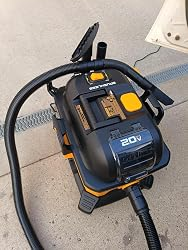
The biggest reason to consider this DEWALT wet/dry vacuum is flexibility. You can use a compatible 20V MAX battery when portability matters or connect the DCV581H to an AC outlet when you want to work without depending on battery runtime. DEWALT confirms that the battery and charger are sold separately.
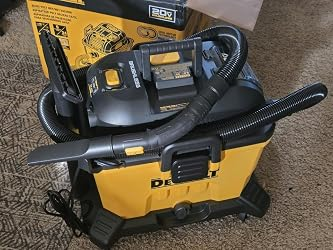
The machine holds up to 2 gallons of wet or dry debris and includes a 5-foot x 1-1/4-inch hose, crevice tool, wide nozzle and washable/reusable HEPA wet/dry filter.
Quick Verdict
The DCV581H makes the most sense for someone who already owns DEWALT 20V MAX batteries and wants a portable shop vacuum that can handle both dry debris and liquids.
Its biggest strengths are the dual-power design, compact footprint, wet/dry versatility, onboard accessory storage and reusable filtration.
Its biggest weaknesses are the relatively small 2-gallon tank, short 5-foot hose, and the additional cost of purchasing a battery and charger if you do not already own them.
Pros
- 20V MAX cordless operation
- AC corded operation
- 2-gallon wet/dry capacity
- 5-foot x 1-1/4-inch hose
- Washable and reusable HEPA filter
- Crevice and wide-nozzle attachments
- Compact portable design
- Onboard accessory storage
- 3-year limited warranty
Cons
- Battery and charger are not included
- 2 gallons is small compared with full-size shop vacs
- 5-foot hose limits reach
- Not designed to replace a large-capacity workshop vacuum
- Battery runtime depends heavily on the battery used and workload
Bottom Line: The DCV581H is a portability-first shop vacuum. If you need a compact wet/dry cleaner that fits naturally into the DEWALT 20V MAX ecosystem, it is much more compelling than it is for someone who needs maximum capacity or extended high-volume extraction.
DEWALT 20V MAX Wet Dry Vacuum Specifications at a Glance
Before discussing performance, it helps to understand exactly what you are buying. The DCV581H is not simply a cordless household vacuum with a wet-pickup feature. It is a compact wet/dry shop vacuum designed around a tank, flexible hose, removable filter and jobsite-oriented portability.
| Specification | DEWALT DCV581H |
|---|---|
| Product type | Wet/Dry Shop Vacuum |
| Battery system | 20V MAX |
| Power source | Battery + AC power |
| Tank capacity | 2 gallons |
| Hose | 5 ft. x 1-1/4 in. |
| Filter | Washable/reusable HEPA wet/dry filter |
| Included attachments | Crevice tool + wide nozzle |
| Battery | Sold separately |
| Charger | Sold separately |
| Warranty | 3-year limited warranty |
DEWALT specifies that the DCV581H can operate from a 20V MAX battery or an AC outlet. The company also identifies it as a tool-only product and lists the 2-gallon capacity, flexible 5-foot hose and washable/reusable filter.
What Comes in the Box?
The package includes the DCV581H wet/dry vacuum, 5-foot flexible hose, crevice tool, wide-nozzle tool, and Gore wet/dry HEPA filter. A compatible battery and charger are not included.
That last point is important when comparing prices. A bare-tool price can look attractive until you calculate the complete setup cost.
If you already have DEWALT 20V MAX batteries, the economics become considerably better because the vacuum can share the battery platform with your existing cordless tools.
DCV581H vs DCV580H Naming Explained
The DCV581H and DCV580H are easy to confuse because both are compact 2-gallon DEWALT cordless wet/dry vacuums.
The key distinction is power flexibility. The DCV581H supports both 20V MAX battery and AC operation, while the DCV580H is cordless-only. DEWALT lists both models as 2-gallon wet/dry vacuums with 5-foot hoses and washable/reusable filtration.
For someone who occasionally works near an outlet, the DCV581H’s dual-power capability is a meaningful advantage.
Bottom Line: The specification sheet tells the story clearly: this is a small, portable wet/dry shop vacuum designed around flexibility rather than maximum capacity.
DEWALT 20V MAX Wet Dry Vacuum Technology Explained
20V MAX Battery Technology
The DCV581H belongs to DEWALT’s extensive 20V MAX cordless platform. This makes the vacuum particularly attractive to users who already own compatible DEWALT power tools and batteries.
One technical detail deserves clarification. DEWALT states that 20V MAX represents the maximum initial battery voltage measured without a workload, while the nominal voltage is 18 volts.
That distinction prevents a common misunderstanding when comparing battery-powered tools.
Battery runtime is not a fixed specification because it depends on battery capacity, battery condition, operating conditions and how continuously the vacuum is used. A larger-capacity battery can provide longer operation, but it also adds weight.
Cordless vs AC Power
This is arguably the DCV581H’s most useful design feature.
When cleaning a vehicle, working outdoors, moving around a construction site or cleaning an area without convenient electrical access, battery operation eliminates the power cord.
When working in a garage or workshop near an outlet, AC operation lets you avoid making battery runtime the limiting factor.
The owner’s manual instructs users to insert the DEWALT battery pack or connect the machine to a 120V wall outlet before operation.
The AC connection should not be interpreted as an integrated battery charger. Plugging the vacuum into an outlet provides operating power; it does not turn the vacuum itself into a battery charger.
Wet/Dry Vacuum Architecture
The DCV581H uses a tank-based wet/dry design. Instead of relying on a conventional household vacuum dust bin, debris and liquids are collected inside the 2-gallon tank.
That makes the machine suitable for applications where ordinary dry vacuums should not be used.
The same basic system handles dry debris and wet pickup, although correct operating procedure still matters. The owner’s manual explains that the vacuum must remain upright and includes an automatic vacuum shutoff designed to help prevent unwanted liquid overflow.
Filtration and HEPA Efficiency
Filtration is one of the DCV581H’s stronger technical features.
DEWALT includes a wet/dry HEPA filter, and the company’s replacement-filter documentation states that the DCV5801H traps 99.99% of dust at 1 micron.
The manual also emphasizes that the filter must be installed correctly and kept in good condition to minimize dust recirculation.
This is where terms such as HEPA efficiency and sealed system filtration need careful interpretation. A filter’s laboratory capture rating does not automatically mean that every particle entering a vacuum is captured under every real-world condition. Filter fit, seals, airflow, damage and maintenance all matter.
Bottom Line: The DCV581H’s technology is deliberately practical: battery flexibility, AC backup, tank-based wet/dry pickup and reusable filtration rather than complicated automation.
DEWALT DCV581H Performance Review: Suction, Airflow & Real-World Cleaning
Dry Debris and Dust Pickup
A portable shop vacuum has a different job from a premium household floor vacuum.
The DCV581H is intended for debris such as dirt, sawdust, wood particles and general workshop mess. Its hose and nozzle arrangement makes it particularly useful for localized cleanup rather than cleaning an entire home floor by floor.
The wide nozzle is better suited to larger surfaces, while the crevice tool helps reach narrow spaces.
For a workshop, the compact design can be useful when the debris is concentrated around a workbench, tool, cabinet or small project.
However, a 2-gallon tank means you should not expect the same collection capacity as a 9-, 12-, 14- or 16-gallon shop vacuum.
Wet Pickup Performance
Wet pickup is where the DCV581H becomes more versatile than a normal dry vacuum.
DEWALT specifically identifies applications such as emptying a toilet or clearing a clogged pipe when describing the 2-gallon tank.
The machine can also be useful for smaller water spills, utility-room cleanup, garage liquids and localized workshop messes.
The limitation is capacity. Two gallons is useful for smaller liquid-recovery tasks, but it is not a substitute for a large-capacity wet vacuum when dealing with substantial amounts of water.
The owner’s manual explains that suction decreases and the motor sound changes when the tank becomes full, at which point the tank should be emptied.
CFM Airflow and Water Lift
Two terms frequently appear in shop-vac discussions: CFM airflow and water lift.
CFM, or cubic feet per minute, describes how much air the vacuum can move. Water lift describes the vacuum’s ability to create suction pressure under a standardized measurement.
Neither number should be considered in isolation.
A vacuum with strong airflow can perform differently depending on hose diameter, nozzle restriction, filter condition and the type of material being collected.
Likewise, higher water lift does not automatically make a machine better at every dry-debris application.
For the DCV581H, the more useful question is whether its complete airflow path and nozzle configuration provide sufficient pickup for the jobs you actually perform.
DEWALT’s current product page does not prominently publish a CFM or water-lift figure for the DCV581H, so we would not assign an unsupported numerical performance rating.
Noise, Heat and Continuous Operation
A wet/dry shop vacuum is inherently more utilitarian than a quiet household floor vacuum.
Motor noise should therefore be expected, particularly during extended cleaning.
Battery operation introduces another consideration: continuous use places a steady load on the battery, meaning runtime can vary substantially according to battery capacity and workload.
AC operation solves the runtime constraint for users who have access to an outlet.
Bottom Line: The DCV581H’s performance profile is best described as compact jobsite utility. It is designed to clean localized dry debris and liquids conveniently, not to compete with large-capacity extraction equipment.
Design, Portability and Everyday Usability
2-Gallon Tank and Compact Footprint
The 2-gallon tank is both an advantage and a limitation.
Its advantage is portability. A smaller tank keeps the machine compact and easier to carry between locations.
The downside is more frequent emptying when collecting substantial debris.
This makes the DCV581H particularly attractive for users who clean small areas repeatedly rather than one large area all at once.
5-Foot Flexible Hose
DEWALT specifies a 5-foot x 1-1/4-inch heavy-duty hose.
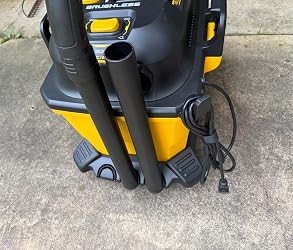
The hose is integrated into the machine’s design and can accept the included crevice and wide-nozzle tools.
Five feet is enough for localized cleanup around a vehicle, workbench or jobsite area, but it is not especially generous when compared with larger shop vacuums.
If you frequently need to reach across a large workshop without moving the vacuum, the hose length becomes a practical limitation.
Accessories and Onboard Storage
The DCV581H includes two basic attachments:
- Crevice tool
- Wide nozzle
The crevice tool is useful for narrow gaps, corners and vehicle interiors.
The wide nozzle is more practical for floors, work surfaces and larger debris fields.
DEWALT also incorporates onboard storage, which reduces the chance of constantly misplacing the attachments.
Carrying and Jobsite Portability
Portability is arguably the central design philosophy of this vacuum.
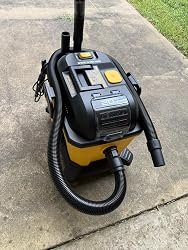
DEWALT provides a mounted handle and onboard accessory storage specifically to make transportation easier.
There is a useful engineering trade-off here: a smaller tank means less debris capacity, but it also means less bulk when the machine needs to be carried.
Field Note: A compact tank becomes a practical advantage when the cleanup location changes frequently. Moving a small vacuum to the debris is often faster than dragging a large shop vacuum, unwinding a long cord and then finding a suitable outlet.
Bottom Line: If portability is your priority, the DCV581H’s compact design makes sense. If you rarely move the vacuum and routinely collect large quantities of debris, the same compactness becomes a disadvantage.
DEWALT 20V MAX Wet Dry Vacuum for Different Cleaning Jobs
Is It Good for Car and Truck Cleaning?
Yes, this is one of the more logical applications.
The cordless design makes it convenient to clean vehicle interiors without running an extension cord from the garage.
The crevice tool can help reach seams, floor edges and narrow areas, while the wide nozzle handles larger floor surfaces.
For vehicle owners who already have DEWALT batteries, the DCV581H offers a practical way to add shop-vac capability without adopting another battery platform.
Is It Good for Garage and Workshop Cleanup?
The DCV581H works well conceptually for small garage and workshop cleanup.
Sawdust, dirt, wood chips and general debris can be collected directly into the tank.
The main question is volume.
A hobbyist working on small projects may appreciate the compact size. A professional woodworker producing large quantities of sawdust throughout the day will probably benefit from a higher-capacity dust-management system.
Is It Good for Construction and Contractor Work?
Contractors can benefit from the vacuum’s portability and battery compatibility.
The ability to work without an outlet can be valuable during installation, repair and finishing work.
However, it is important not to confuse a portable wet/dry vacuum with a dedicated dust extractor.
DEWALT maintains separate dust-management products designed for applications involving fine dust and jobsite dust control.
For tasks where regulatory dust-control requirements apply, choose equipment specifically designed and rated for that application rather than assuming any HEPA-filtered wet/dry vacuum is sufficient.
Is It Good for Household Wet/Dry Cleanup?
It can be useful for localized household cleanup, particularly in garages, basements, utility rooms and during plumbing-related tasks.
It is not necessarily the best primary vacuum for normal household floor cleaning.
A conventional household vacuum is generally better optimized for frequent floor cleaning, while the DEWALT is built around tougher debris and liquid pickup.
Bottom Line: The DCV581H is most useful when you need a portable utility vacuum. Vehicle interiors, workshops, garages, small jobsites and localized liquid cleanup are stronger use cases than whole-home floor cleaning.
DEWALT DCV581H vs Other DEWALT Wet/Dry Vacuums
DCV581H vs DCV580H
| Feature | DCV581H | DCV580H |
|---|---|---|
| Battery operation | Yes | Yes |
| AC operation | Yes | No |
| Tank | 2 gallons | 2 gallons |
| Wet/dry | Yes | Yes |
| Hose | 5 ft. | 5 ft. |
| Filter | Washable/reusable | Washable/reusable HEPA |
| Best fit | Battery + outlet flexibility | Dedicated cordless use |
The fundamental difference is simple: the DCV581H gives you the option of AC operation, while the DCV580H is designed as a cordless model. DEWALT confirms the DCV580H’s 2-gallon capacity, 5-foot hose and washable/reusable filter.
If you already have batteries but never use an outlet, the DCV580H may be sufficient.
If you want maximum power-source flexibility, the DCV581H is the more versatile choice.
DCV581H vs DCV517B
The DCV517B is DEWALT’s smaller 1/2-gallon wet/dry portable vacuum. DEWALT currently lists it alongside the DCV581H and DCV580H in its wet/dry vacuum lineup.
That makes the decision relatively straightforward.
Choose the smaller DCV517B when maximum portability is more important than collection capacity.
Choose the DCV581H when you want the larger 2-gallon tank and the added flexibility of AC operation.
DEWALT Cordless Wet/Dry Vacuum vs Full-Size Shop Vac
DEWALT also sells much larger corded wet/dry vacuums, including 9-, 12-, 14- and 16-gallon configurations.
These larger models are better suited to sustained workshop cleanup and higher debris volumes.
The DCV581H wins when portability matters.
A large shop vacuum wins when tank capacity, longer hoses and continuous workshop use matter more.
Which DEWALT Vacuum Is the Best Value?
There is no universal winner.
Choose DCV581H if: you want battery + AC flexibility.
Choose DCV580H if: you only need cordless operation.
Choose DCV517B if: maximum compactness is the priority.
Choose a larger DEWALT wet/dry vacuum if: you routinely collect substantial quantities of debris.
Bottom Line: The DCV581H occupies a useful middle ground in DEWALT’s lineup: more capable than the smallest portable unit while remaining dramatically more portable than a large workshop vacuum.
DEWALT DCV581H vs Competing Cordless Shop Vacs
DEWALT vs RIDGID Cordless Shop Vac
RIDGID’s cordless wet/dry vacuum options can be attractive to users already invested in the RIDGID battery ecosystem.
The comparison should focus on battery compatibility, tank capacity, hose size, attachments, filtration and total ownership cost rather than simply comparing advertised motor numbers.
DEWALT vs Milwaukee Cordless Wet/Dry Vacuum
Milwaukee’s cordless shop-vac ecosystem provides another strong alternative for professional users.
The most important deciding factor may be the battery platform you already own.
If your workshop already contains multiple DEWALT 20V MAX tools, adding a DEWALT vacuum can eliminate the need for another battery ecosystem.
If your tools are already Milwaukee, the opposite may be true.
DEWALT vs Makita Cordless Vacuum Options
Makita also offers cordless cleaning equipment designed around its battery platform.
Again, the ecosystem question is more important than brand loyalty.
Buying a bare vacuum is particularly attractive when you already own compatible batteries. Starting an entirely new battery platform can increase the actual purchase cost considerably.
Which Ecosystem Makes the Most Sense?
For cordless tools, ecosystem compatibility has genuine economic value.
A user with several DEWALT batteries can purchase a tool-only vacuum and potentially avoid buying another battery and charger.
Someone starting from zero should calculate the complete package before deciding.
Bottom Line: The DCV581H should be evaluated as part of the DEWALT 20V MAX ecosystem, not as an isolated vacuum. Battery ownership can materially change its value proposition.
Maintenance: How to Keep the DEWALT Wet Dry Vacuum Working Properly
How to Clean the Washable Filter
Filter maintenance is essential to maintaining airflow.
DEWALT’s manual instructs users to remove the filter, shake off excess dust, tap it into a waste receptacle and rinse it under running water when appropriate. The manual specifically says not to use a brush to clean the filter.
The filter should be completely dry before returning it to normal dry-vacuum operation.
A clogged filter can restrict airflow and make a vacuum appear weaker than it actually is.
DEWALT states that the filter should never be omitted and should be replaced if it becomes damaged, excessively clogged or otherwise fails to operate correctly.
How to Clean the 2-Gallon Tank
The tank should be emptied regularly.
The manual specifically recommends emptying dry contents before wet pickup because doing so makes tank cleaning easier.
After wet pickup, empty the liquid promptly rather than leaving standing water inside the machine unnecessarily.
Regular cleaning also helps prevent residue and unpleasant odors.
Hose and Accessory Maintenance
Inspect the hose periodically for:
- Blockages
- Cracks
- Kinks
- Loose connections
- Accumulated debris
The same principle applies to the crevice and wide-nozzle attachments.
A blockage can significantly reduce effective airflow even when the motor and filter are working correctly.
Battery and Long-Term Storage
Remove the battery when storing the vacuum for extended periods.
Battery health depends on appropriate charging, storage temperature and usage practices.
The vacuum itself should also be kept clean and dry, with the exhaust area kept unobstructed. DEWALT’s manual specifically instructs users to keep the side exhaust port clean and unblocked.
Bottom Line: Regular filter cleaning and blockage checks are more important to long-term performance than complicated maintenance. Treat the filter and hose as performance components, not disposable afterthoughts.
Troubleshooting Common DEWALT 20V MAX Wet Dry Vacuum Problems
Vacuum Has Weak or Reduced Suction
Start with the simplest possibilities.
Check whether:
- The tank is full.
- The filter is clogged.
- The hose is blocked.
- The nozzle is obstructed.
- The filter is installed correctly.
- The vacuum is positioned correctly.
DEWALT notes that suction decreases when the tank is full and recommends emptying the tank and cleaning or changing the filter.
Vacuum Will Not Turn On
Check the power source first.
For battery operation, confirm that the battery is correctly installed and adequately charged.
For AC operation, verify that the machine is properly connected to the outlet and that the outlet itself is supplying power.
If the machine still does not operate, stop troubleshooting electrical components yourself and consult DEWALT service guidance.
Battery Drains Too Quickly
Battery runtime depends on more than the vacuum itself.
Possible contributors include:
- Battery capacity
- Battery age
- Continuous operation
- Heavy debris
- Restricted airflow
- Dirty filter
- Operating conditions
A larger battery may extend operating time, but it also adds weight.
For long continuous cleaning sessions, the DCV581H’s AC capability is one of its major advantages.
Vacuum Struggles With Wet Pickup
If wet pickup is weaker than expected, inspect the hose, nozzle, filter and tank.
Also confirm that the machine is being operated upright.
The manual specifically states that the vacuum must remain upright to prevent unwanted activation of the automatic vacuum shutoff. If the shutoff activates, the recommended procedure is to turn the motor off, wait for it to stop, and restart it.
Bottom Line: Most apparent suction problems should first be investigated as airflow or maintenance issues before assuming the motor has failed.
Buyer’s Intent: Should You Buy the DEWALT 20V MAX Wet Dry Vacuum?
Who Should Buy It?
The DCV581H is particularly compelling for:
DEWALT 20V MAX owners: Existing batteries make the tool-only purchase much more attractive.
Contractors: The portable form factor is convenient for localized jobsite cleanup.
DIYers: It provides wet and dry functionality without requiring a large workshop vacuum.
Garage owners: The compact tank and cordless capability work well for vehicle and garage cleanup.
Automotive enthusiasts: Cordless operation makes cleaning inside and around vehicles easier.
Homeowners: It can serve as a utility vacuum for occasional wet and dry cleanup.
Who Should Not Buy It?
This is not the right tool for everyone.
You may want a larger shop vacuum if you routinely collect large amounts of sawdust, construction debris or other material.
You may also prefer a dedicated dust extractor if your work involves fine dust management requiring specialized equipment.
And if you do not own any DEWALT 20V MAX batteries, remember to include battery and charger costs in your purchase calculation.
AdSense-Friendly Alternatives
A useful buying guide should not imply that one product is perfect for everyone.
Consider the DCV580H if you want a similar 2-gallon cordless wet/dry vacuum without the DCV581H’s AC capability.
Consider the DCV517B if maximum portability and a smaller footprint are more important than capacity.
Consider a larger DEWALT wet/dry vacuum if your priority is sustained high-volume cleanup.
DEWALT’s current lineup includes multiple capacities and configurations, allowing buyers to match the machine to the workload rather than forcing every application into the same vacuum.
Is the Tool-Only Purchase Actually a Good Value?
This is one of the most important buying questions.
The actual ownership cost can be represented as:
Vacuum + compatible battery + charger + replacement filter + optional accessories
If you already own compatible DEWALT batteries and a charger, the calculation is simple.
If you are starting from zero, compare the complete system price against corded alternatives.
The DCV581H is explicitly sold as a tool-only product.
Bottom Line: The DCV581H is a strong value for existing DEWALT battery owners who prioritize portability. For new buyers without batteries, larger corded shop vacuums may deliver more capacity per dollar.
DEWALT 20V MAX Wet Dry Vacuum Pros, Cons & Final Verdict
What We Like
The best feature is the dual-power design.
Battery operation provides genuine portability, while AC operation removes the battery-runtime limitation when an outlet is nearby.
The 2-gallon capacity is large enough for many small utility jobs without turning the vacuum into a bulky piece of equipment.
The washable/reusable filter also reduces the need for routine disposable filter replacement. DEWALT states that its replacement filter is washable and reusable.
What Could Be Better
The tank is still small compared with full-size shop vacuums.
The 5-foot hose can also feel restrictive when cleaning larger areas.
And the tool-only configuration means new DEWALT users need to budget for a compatible battery and charger.
Final Verdict
So, is the DEWALT 20V MAX wet/dry vacuum worth buying?
Yes—if portability, battery compatibility and wet/dry versatility are your priorities.
Probably not—if you need maximum tank capacity, long continuous operation or high-volume workshop extraction.
The DCV581H is best understood as a compact utility shop vacuum rather than a replacement for every type of vacuum.
Overall Rating Framework
| Category | Assessment |
|---|---|
| Dry debris pickup | Good for localized cleanup |
| Wet pickup | Good for small-to-moderate jobs |
| Portability | Excellent |
| Filtration | Very good |
| Battery flexibility | Excellent for DEWALT owners |
| Hose reach | Average |
| Tank capacity | Limited for large jobs |
| Maintenance | Simple |
| Value | Best for existing DEWALT users |
| Overall | Strong portable utility vacuum |
Bottom Line: The DCV581H succeeds because it does not try to be a giant shop vacuum. It is a compact, flexible cleanup tool that becomes particularly valuable when portability and the DEWALT 20V MAX ecosystem matter more than maximum capacity.
Frequently Asked Questions
Is the DEWALT 20V MAX wet dry vacuum worth it?
Yes, for users who need a compact wet/dry shop vacuum and already own DEWALT 20V MAX batteries. Its dual battery/AC power design gives the DCV581H more flexibility than a cordless-only model. It is less suitable for high-volume workshop cleanup.
Can the DEWALT 20V wet dry vacuum pick up water?
Yes. The DCV581H is designed for wet and dry debris collection and has a 2-gallon tank. DEWALT specifically describes the capacity as suitable for applications such as emptying a toilet or clearing a clogged pipe.
How long does a DEWALT 20V shop vac battery last?
There is no single runtime figure that applies to every 20V MAX battery. Runtime varies according to battery capacity, battery condition, workload and operating conditions. Continuous heavy pickup generally consumes more energy than intermittent localized cleaning.
Does the DEWALT DCV581H come with a battery?
No. The DCV581H is sold as a tool-only product. The compatible battery and charger are sold separately.
Can you use the DEWALT DCV581H with a cord?
Yes. The DCV581H supports both 20V MAX battery operation and AC power. DEWALT’s documentation specifies connection to a 120V wall outlet for corded operation.
What is the difference between DEWALT DCV580 and DCV581H?
The major difference is power-source flexibility. The DCV581H can operate using a 20V MAX battery or AC power, while the DCV580H is a cordless-only model. Both have a 2-gallon wet/dry capacity and 5-foot hose.
Can the DEWALT wet dry vacuum pick up sawdust?
Yes. The DCV581H is designed for dry debris pickup and is suitable for localized workshop and jobsite cleanup. For high-volume fine-dust applications, however, a dedicated dust extractor may be more appropriate.
How do you clean the DEWALT wet dry vacuum filter?
Turn the vacuum off, disconnect the power source and remove the filter. DEWALT recommends shaking off excess dust, tapping it into a waste receptacle and rinsing it under running water when necessary. The manual says not to use a brush on the filter.
Can you use a DEWALT 20V MAX battery in the vacuum?
The DCV581H is designed to use DEWALT 20V MAX batteries. DEWALT identifies battery operation as one of its power options.
Is the DEWALT cordless shop vac good for car detailing?
It can be a good utility option for vehicle interiors, especially for users who already own DEWALT batteries. Its compact design and crevice tool are useful for localized vehicle cleanup.
How much water can a 2-gallon wet dry vacuum hold?
The tank is rated at 2 gallons of wet or dry debris capacity. Actual usable capacity during operation can be affected by the vacuum’s automatic shutoff and operating conditions, so it should not be treated as a recommendation to fill the tank completely.
What should you do if the DEWALT shop vac loses suction?
Check the tank, filter, hose and nozzle first. A full tank, clogged filter or blocked hose can restrict airflow. DEWALT specifically notes that suction decreases when the tank is full and recommends emptying the tank and cleaning or changing the filter.
Bottom Line: For most buyers, the decision comes down to one question: Do you need a portable wet/dry vacuum that fits into the DEWALT 20V MAX ecosystem, or do you need a large shop vacuum designed for maximum debris capacity? If portability wins, the DCV581H is a compelling choice. If capacity wins, step up to a larger wet/dry vacuum.