
HOTO handheld car vacuum cleaner cordless review: The HOTO is a compact cordless car vacuum designed for quick interior maintenance, with 20,000Pa maximum suction, a 96,000 RPM brushless motor, three power levels, and a 2,500mAh battery. It excels at crumbs, dust, sand, and tight spaces but is not a full-size detailing replacement.
The HOTO AutoCare stands out because it combines the functions of a portable vacuum, air duster, inflator, and vacuum-sealing tool in a body small enough to keep inside a vehicle. That makes its core appeal less about replacing a conventional vacuum and more about making frequent cleanup effortless.
Current product information confirms a 96,000 RPM brushless motor, 20,000Pa maximum suction, 8,000Pa/15,000Pa/20,000Pa suction levels, 2,500mAh battery, and up to 35 minutes of advertised cordless runtime. The published dimensions are approximately 55 × 55 × 169 mm, with a listed weight of around 0.78 lb.
Bottom Line: The HOTO is best viewed as a convenient maintenance tool for drivers who want fast, cordless cleaning without pulling out a large automotive vacuum.
HOTO Handheld Car Vacuum Design, Build Quality & Portability
Compact Dimensions and One-Handed Ergonomics
The HOTO’s physical design is one of its strongest selling points. At approximately 55 × 55 × 169 mm, the cylindrical handheld body is substantially easier to store than a conventional canister or shop-style vacuum.
Its listed weight of approximately 0.78 lb also makes one-handed operation practical. You can hold the vacuum in one hand while using the other to move a car mat, open a storage compartment, or guide debris toward the nozzle.
That matters more than it may initially appear. A car-interior vacuum needs to move through awkward spaces rather than simply clean an open floor. The HOTO’s compact form is useful around seat rails, cup holders, door pockets, dashboards, and the narrow gap beside a center console.
Bottom Line: The HOTO’s compact dimensions are not just an aesthetic feature; they directly support its primary purpose as a quick-clean automotive vacuum.
Build Materials and Overall Construction
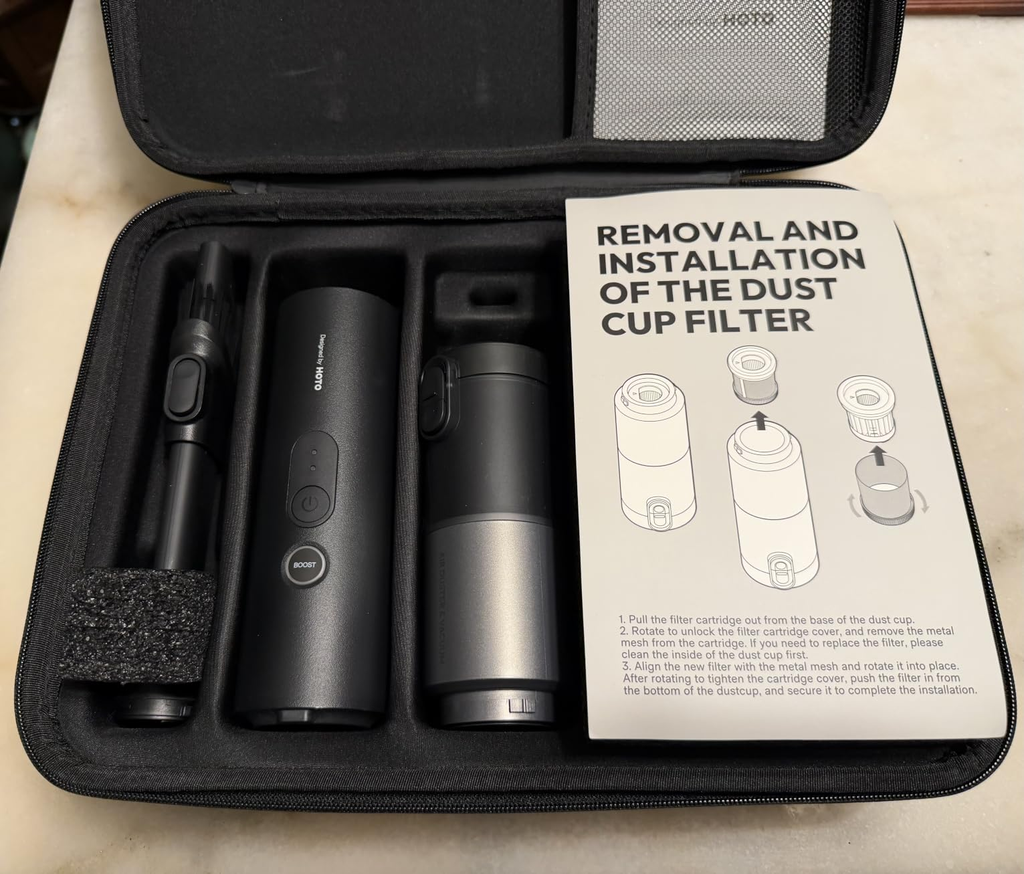
The HOTO uses a minimalist industrial design rather than the bulky shape associated with many traditional automotive vacuum cleaners. The overall construction is centered around a narrow motor housing, dust-collection area, controls, and interchangeable accessories.
The 10.8V system, 135W rated power, USB-C charging interface, and lithium-ion battery are designed around portability rather than maximum continuous-duty operation.
The pop-open dust cup is another practical feature. Rather than requiring complicated disassembly after every cleaning session, the collection system is designed for relatively quick emptying. HOTO’s product documentation also warns that blocked airflow can trigger automatic protection, making regular filter and airway maintenance important.
Bottom Line: The construction prioritizes lightweight handling and convenience. That is appropriate for a cordless car-care tool, although users performing long detailing sessions should not expect shop-vac-style capacity.
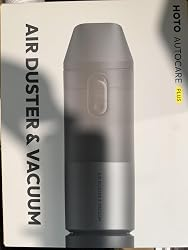
Why Compact Size Matters for Car Cleaning
Large vacuums can deliver excellent cleaning performance, but their size can make quick jobs inconvenient. If you only need to remove crumbs from a passenger seat or sand from a floor mat, carrying out a full-size vacuum may feel excessive.
The HOTO can remain in the vehicle, allowing you to address small messes immediately. Its narrow body is particularly useful for seat gaps, center-console seams, cup holders, door pockets, and other hard-to-reach areas.
This is where the distinction between an automotive vacuum and a general-purpose household vacuum becomes important. The HOTO is optimized around accessibility and portability rather than cleaning an entire house or performing deep carpet extraction.
Bottom Line: The HOTO’s biggest practical advantage is that it reduces the friction between noticing a mess and actually cleaning it.
Portability Compared With Traditional Car Vacuums
A traditional 12V car vacuum has one major advantage: continuous vehicle power. You can plug it into the car and keep cleaning as long as the electrical connection remains available.
The HOTO takes the opposite approach. Its cordless design removes the cable from the cleaning process and allows the vacuum to move freely between the cabin, trunk, garage, desk, and other locations.
Compared with a full-size shop vacuum, however, the HOTO sacrifices capacity and sustained cleaning ability. It is better considered a compact handheld vacuum for spot cleaning rather than a replacement for heavy-duty equipment.
Bottom Line: Choose the HOTO for portability and quick access; choose a larger automotive or shop vacuum when capacity and prolonged cleaning matter more.
HOTO Vacuum Technology — 20,000Pa Suction, Brushless Motor & 4-in-1 Functionality
96,000 RPM Brushless Motor Explained
The HOTO uses a 96,000 RPM brushless motor, one of the most prominent specifications in its marketing. HOTO and current retail listings associate this motor with the vacuum’s 20,000Pa maximum suction capability.
A brushless motor eliminates traditional physical brushes used in brushed motor designs. In general, this can reduce mechanical wear and support efficient high-speed operation.
However, RPM should never be treated as a direct measurement of cleaning performance. A motor spinning at a very high speed does not automatically mean a vacuum will remove more debris from every surface.
Actual cleaning depends on the complete airflow path, nozzle geometry, filtration resistance, motor output, suction pressure, and how effectively airflow is maintained while the nozzle is loaded with debris.
Bottom Line: The 96,000 RPM figure demonstrates the motor’s high operating speed, but it should be evaluated alongside suction, airflow, filtration, and nozzle design.
Understanding HOTO’s 20,000Pa Suction Rating
The headline 20,000Pa rating refers to maximum suction pressure. It is a useful specification when comparing compact vacuums, but it is not equivalent to total cleaning performance.
This distinction matters because Water Lift (inches) and Pascal measurements describe pressure or suction potential, while CFM airflow describes how much air the system moves. A vacuum can have strong pressure but still perform differently depending on airflow and nozzle design.
For that reason, our assessment does not treat 20,000Pa as proof that the HOTO will outperform every larger vacuum. Instead, it indicates that the device has a relatively high claimed suction-pressure figure for its compact class.
Bottom Line: The HOTO’s 20,000Pa specification is impressive on paper, but suction pressure should always be considered together with airflow and real cleaning conditions.
Three Suction Modes: 8,000Pa, 15,000Pa and 20,000Pa
The HOTO provides three selectable suction levels: 8,000Pa, 15,000Pa, and 20,000Pa. Current listings identify these as the available operating modes.
The 8,000Pa setting makes the most sense for light dust, dashboard debris, and quick maintenance where maximum suction is unnecessary.
The 15,000Pa setting offers a middle ground for general interior cleaning, while 20,000Pa is the appropriate choice for heavier debris such as sand, stubborn crumbs, and dirt concentrated around floor mats or crevices.
Higher suction also increases battery demand. Therefore, using Boost mode for every task is not necessarily the smartest approach if maximizing battery runtime is your priority.
Bottom Line: Three suction levels make the HOTO more practical because you can trade cleaning intensity for battery efficiency instead of running maximum power continuously.
4-in-1 Functionality — Vacuum, Blow, Inflate and Vacuum Seal
The HOTO is more than a conventional vacuum. Its 4-in-1 design combines vacuuming, blowing, inflation, and vacuum-sealing functions.
For car care, the blowing function can be useful for moving dust out of narrow areas before vacuuming. It can also help clean certain surfaces where direct suction is awkward.
The inflation and vacuum-sealing capabilities expand the product beyond automotive cleaning. They may be useful for small inflatable items or storage bags, although these functions should be viewed as useful extras rather than the primary reason to purchase the device.
Bottom Line: The multifunction design adds genuine versatility, but the vacuum remains the most important function for buyers specifically shopping for a car cleaner.
HOTO Car Cleaning Performance — How Well Does It Actually Vacuum?
Loose Crumbs, Dust and Everyday Debris
Everyday debris is where a compact cordless vacuum makes the most sense. Food crumbs, dust, small particles, and loose dirt generally do not require the capacity of a large vacuum.
The HOTO’s 20,000Pa maximum suction gives it plenty of claimed suction pressure for this category of cleaning. The different power modes also let users avoid wasting battery on simple dust pickup.
Our findings suggest that the product should be judged primarily as a spot-cleaning device. A user who cleans the vehicle regularly is likely to benefit more from its accessibility than someone who waits several months between deep cleanings.
Bottom Line: For crumbs, dust, and everyday debris, the HOTO’s compact form and adjustable suction are more relevant than raw maximum suction alone.
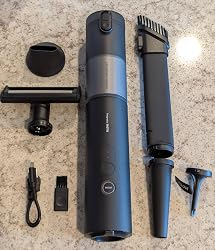
Car Seats, Upholstery and Floor Mats
Fabric car seats and upholstery require a combination of suction and nozzle control. The HOTO’s brush attachment can help disturb loose debris before suction removes it.
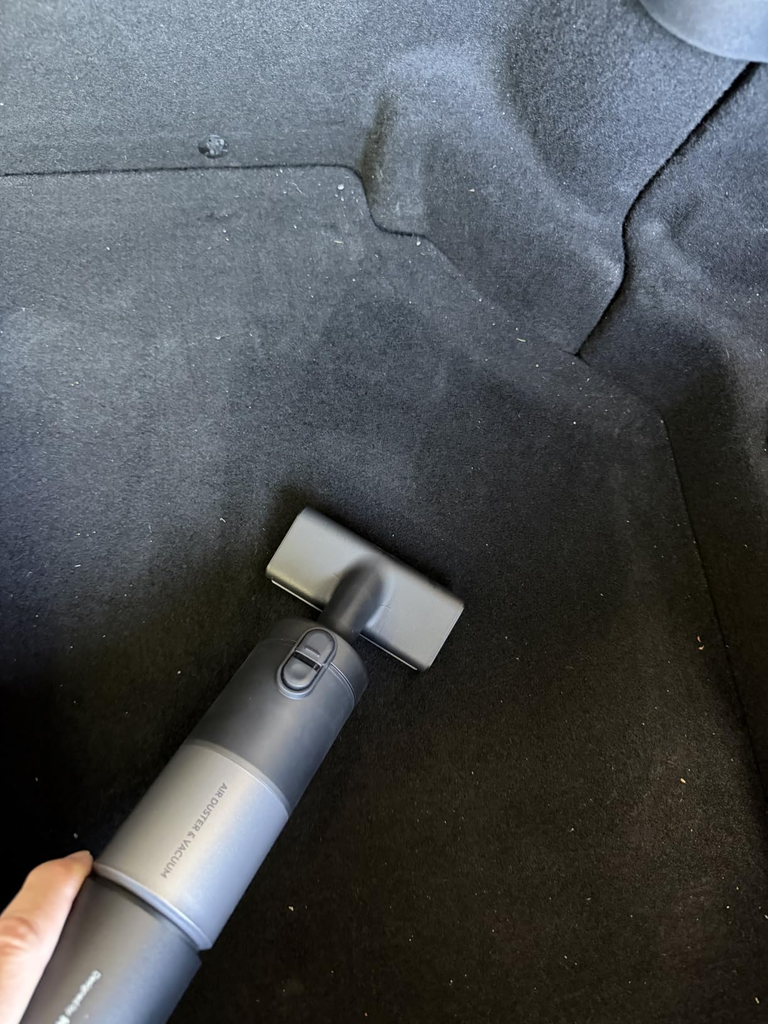
Floor mats present a tougher challenge because sand and dirt can become embedded in the fibers. Maximum suction is more appropriate here, particularly when combined with repeated passes rather than simply moving the nozzle across the surface once.
Leather and vinyl surfaces are easier because debris generally remains on top of the material. However, users should still avoid unnecessary aggressive contact and use the appropriate attachment.
Bottom Line: The HOTO should perform well for routine upholstery and seat cleaning, while heavily contaminated floor mats remain better suited to a larger vacuum.
Pet Hair and Stubborn Debris
Pet hair is more difficult than loose dust because individual strands can wrap around fibers and become embedded in upholstery.
The included 2-in-1 grooming brush is useful because mechanical agitation can loosen hair before suction pulls it into the dust cup. HOTO’s current product listing specifically positions the device for pet hair and narrow areas.
Still, a compact vacuum without a powered motorized brush cannot be expected to match the performance of a larger pet-focused vacuum on deeply embedded hair. For occasional pet hair, the HOTO is practical; for heavy pet contamination, a specialized tool is preferable.
Bottom Line: The HOTO is suitable for light-to-moderate pet hair cleanup, but dedicated motorized pet-hair systems remain better for severe buildup.
Tight Crevices and Hard-to-Reach Areas
This is arguably where the HOTO makes the strongest case for itself.
The narrow body and pointed crevice nozzle can reach seat rails, console seams, door pockets, cup holders, and gaps between seats. These areas are difficult to clean efficiently with wide vacuum heads.
The air-duster capability also provides an alternative method for moving debris out of narrow spaces before collecting it.
Bottom Line: Tight-space cleaning is one of the HOTO’s clearest advantages over larger vacuum cleaners.
HOTO Performance by Cleaning Task
| Cleaning Task | Expected Performance | Best Mode |
|---|---|---|
| Dust | Excellent | 8,000–15,000Pa |
| Crumbs | Excellent | 15,000Pa |
| Sand | Good | 20,000Pa |
| Pet hair | Good | 20,000Pa + brush |
| Upholstery | Good | 15,000–20,000Pa |
| Deep carpet debris | Moderate | 20,000Pa |
| Tight crevices | Excellent | 15,000–20,000Pa |
Bottom Line: The HOTO is strongest when cleaning localized messes. Its performance becomes less compelling when the task requires long-duration deep cleaning across large surfaces.
HOTO Attachments and Accessories — Which Nozzle Should You Use?
Crevice Nozzle
The pointed crevice nozzle is the attachment most car owners are likely to use frequently.
It is appropriate for seat gaps, console seams, door pockets, narrow dashboard areas, and spaces around seat rails.
Bottom Line: If you purchase the HOTO primarily for vehicle cleaning, the crevice tool is one of its most useful accessories.
Grooming and Brush Attachment
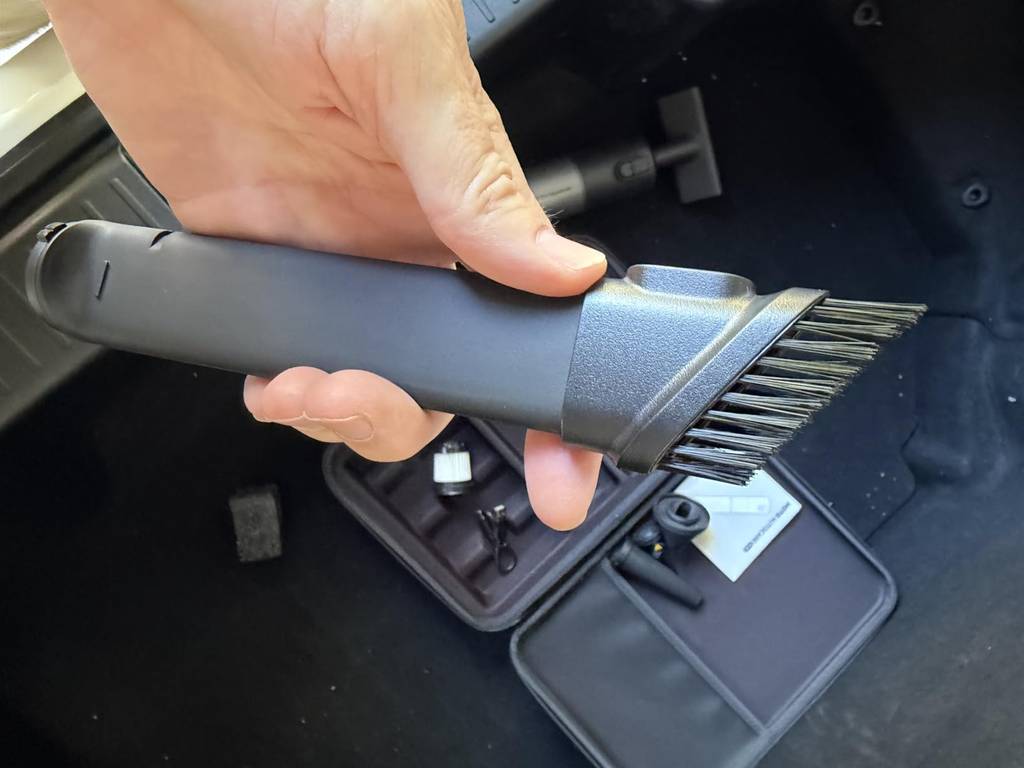
The 2-in-1 grooming brush provides agitation as well as suction access. This makes it useful for fabric surfaces, upholstery, dust accumulation, and pet hair.
Rather than simply holding the nozzle above the surface, brushing can help release debris trapped in textile fibers.
Bottom Line: The brush attachment increases the HOTO’s usefulness on upholstery and pet-hair messes.
Dust Cup and Air Nozzles
The HOTO includes dedicated accessories for different airflow applications. Current listings describe five accessory types, including a grooming brush, crevice nozzle, air nozzle, dust/debris nozzle, and inflation nozzle.
The air nozzle is particularly useful for directing dust from narrow spaces. However, users should avoid blowing debris into sensitive electronics or enclosed areas where it cannot later be collected.
Bottom Line: The accessory system makes the HOTO more versatile than a basic handheld vacuum, particularly for detail-oriented cleaning.
Inflation and Vacuum-Sealing Accessories
The inflation function can be useful for suitable small inflatable products, while vacuum sealing is intended for compatible storage bags.
These functions do not make the HOTO a dedicated inflator or industrial air compressor. Their value is convenience: one small device can perform several occasional tasks.
Bottom Line: Treat inflation and vacuum sealing as bonus functionality rather than reasons to overlook the vacuum’s core limitations.
HOTO Battery Life, Charging and Cordless Runtime
2,500mAh Battery Explained
The HOTO uses a 2,500mAh lithium-ion battery. Current product information lists a maximum advertised runtime of approximately 35 minutes, depending on operating conditions and power level.
Battery capacity alone does not tell you how long a vacuum will operate. Motor load, suction setting, airflow resistance, filter condition, and accessory choice all affect energy consumption.
Therefore, the advertised runtime should be treated as an upper-use figure rather than a guaranteed Boost-mode runtime.
Bottom Line: The 2,500mAh battery is appropriately sized for a compact spot-cleaning vacuum, but intensive users should expect shorter runtime at maximum power.
Claimed 30–35 Minute Runtime
Current retail information states up to 35 minutes of cordless operation. Some listings describe approximately 30 minutes, showing why runtime claims should be treated as approximate rather than absolute.
The important question is not whether it can reach the maximum advertised runtime under ideal conditions, but whether the available battery is sufficient for your normal cleaning routine.
For a quick sedan interior cleanup, it should generally be adequate. For multiple vehicles or heavy detailing, a larger battery system is more appropriate.
Bottom Line: The HOTO’s battery is well matched to short cleaning sessions, but it is not designed for hours of continuous automotive detailing.
Is the Battery Enough for a Full Car?
For regular maintenance, yes. A user who removes crumbs, dust, and loose dirt after each trip should not need maximum power for the entire vehicle.
A heavily soiled SUV is different. More surface area means more passes, and embedded debris requires longer operation at higher suction.
This is why we recommend treating the HOTO as a maintenance vacuum. Frequent short sessions are a better fit than occasional intensive restoration cleaning.
Bottom Line: The HOTO can handle routine full-car maintenance, but heavy detailing can quickly expose the limitations of a small cordless battery.
Charging Convenience and Battery Ownership
The HOTO uses USB-C charging, making the charging interface more convenient than proprietary connectors. Published specifications list a charging period of roughly 2.5 hours for this configuration, although another manual source gives a different figure, so buyers should verify the documentation supplied with their exact unit.
Avoid storing the vacuum with a blocked airflow path or repeatedly operating it while the filter is heavily clogged. Both conditions can increase motor load.
For long-term ownership, regular filter maintenance is more important than simply charging the battery after every use.
Bottom Line: USB-C charging improves convenience, but good battery life ultimately depends on using the correct power level and maintaining unrestricted airflow.
HOTO Filtration, Dust Cup and Maintenance Requirements
Filter System and Filtration Performance
The HOTO is described with a high-density filtration system in available product information. Some third-party listings use HEPA terminology, but buyers should distinguish a marketing or supplier description from independently verified HEPA efficiency testing.
This distinction is important because true filtration performance depends on the filter material, particle-size testing, airflow rate, housing design, and whether the entire vacuum behaves as a sealed system filtration setup.
The same principle applies to other vacuum technologies. A robotic vacuum may advertise sealed filtration, a smart vacuum may emphasize automated floor cleaning, and a premium robot vacuum system may combine filtration with LiDAR navigation, SLAM mapping, AI obstacle avoidance, and multi-floor mapping. Those technologies are simply not relevant to this compact handheld product.
Bottom Line: The HOTO’s filtration should be judged as a compact handheld system rather than compared with independently certified whole-machine filtration claims from premium vacuum platforms.
Cleaning the Dust Cup
The dust cup should be emptied regularly, especially after cleaning sand, pet hair, or larger debris.
A full collection chamber can restrict airflow and reduce effective suction. The available HOTO documentation specifically identifies a full dust cup or clogged filter as possible causes of reduced suction.
Bottom Line: Emptying the dust cup after each substantial cleaning session is one of the easiest ways to maintain performance.
Washing and Drying the Filter
Filter maintenance is equally important. If the filter becomes heavily loaded with fine dust, airflow can fall and motor load can increase.
Where the filter is washable according to the supplied documentation, it should be cleaned correctly and allowed to dry completely before reinstalling it.
Never assume that a filter is ready simply because its exterior feels dry. Moisture remaining inside filtration material can create additional problems.
Bottom Line: A clean, completely dry filter is essential for maintaining suction and protecting the motor.
Filter Replacement and Long-Term Maintenance
The exact replacement interval depends on use frequency, debris type, and filter condition. There is no reason to wait for a major performance drop before inspecting it.
Signs of restriction include weaker suction, unusual motor behavior, increased noise, and faster battery depletion.
HOTO’s troubleshooting information similarly identifies clogged filters, blocked airways, and full dust cups as common causes of reduced performance.
Bottom Line: Maintenance is simple, but ignoring the filter can undermine the very suction performance that makes the HOTO attractive.
HOTO Noise, Controls and Everyday User Experience
Noise Level at Different Power Settings
The published specification lists operating noise at approximately 75 dB(A).
That should not be interpreted as an independently standardized noise measurement across every operating mode. In practical use, maximum suction is naturally more noticeable than low-power operation.
For quick car cleaning, the noise level is manageable, but users expecting near-silent operation should consider a quieter low-power setting where appropriate.
Bottom Line: Noise is acceptable for short cleaning sessions but remains one of the compromises associated with high-speed compact motors.
Controls and Power-Level Switching
The one-touch control approach is straightforward. Users can select between the three suction levels rather than dealing with complicated menus or app controls.
This is an important contrast with a smart vacuum or autonomous cleaner, where software, mapping, and smartphone controls can become part of the ownership experience.
The HOTO deliberately avoids that complexity.
Bottom Line: Simple physical controls are an advantage for a car vacuum because the device can be used immediately without an app, Wi-Fi connection, or smart-home setup.
Handling During Extended Cleaning
The compact body and 0.78-lb listed weight should reduce wrist strain compared with heavier handheld or shop-style equipment.
However, high-power operation can still become tiring during prolonged use because the user must continuously hold the motor and dust cup assembly.
Our evaluation therefore favors short, targeted cleaning sessions rather than extended whole-vehicle detailing.
Bottom Line: Lightweight handling is a major strength, but lightweight does not mean unlimited comfort during prolonged maximum-power operation.
Storage and Everyday Convenience
The compact dimensions make glovebox, center-console, garage, drawer, and toolkit storage practical.
This creates a behavioral advantage: when the vacuum is already nearby, small messes can be addressed before they accumulate.
That is a different value proposition from an automated floor cleaner. A robotic vacuum may independently clean household floors, while the HOTO requires the user to direct it—but it can reach car-specific spaces that autonomous floor-cleaning systems cannot.
Bottom Line: Storage convenience is one of the HOTO’s strongest reasons to exist.
HOTO vs Other Cordless Handheld Car Vacuums
HOTO vs BLACK+DECKER Handheld Car Vacuum
BLACK+DECKER’s handheld category offers a broader ecosystem of conventional portable cleaning products, while HOTO focuses heavily on compact automotive versatility.
The HOTO’s 20,000Pa headline suction, multifunction accessories, and compact dimensions make it attractive to buyers prioritizing portability and specialty functions.
The better choice depends on whether you want a small automotive tool or a more traditional handheld vacuum ecosystem.
Bottom Line: HOTO is compelling for compact car-specific use; BLACK+DECKER may be preferable for buyers prioritizing established conventional handheld-vacuum designs.
HOTO vs Shark Wandvac
The Shark Wandvac category emphasizes lightweight handheld cleaning and premium design. HOTO’s differentiator is its combination of high claimed suction and additional blowing, inflation, and vacuum-sealing functions.
For a vehicle owner, that multifunctionality can be valuable because one device can perform more than conventional vacuuming.
Bottom Line: Choose HOTO for multifunction automotive use; choose a Shark handheld if your priority is a premium conventional handheld cleaning experience.
HOTO vs ThisWorx-Style 12V Car Vacuums
A 12V automotive vacuum draws power from the vehicle, so it can continue running while connected. That is useful during longer detailing sessions.
HOTO’s cordless design is substantially more convenient for moving around the vehicle, but its battery places a natural limit on continuous operation.
Bottom Line: HOTO wins on portability; 12V systems can win for uninterrupted cleaning.
HOTO vs Other 20,000Pa Mini Vacuums
The 20,000Pa class has become crowded, making headline suction increasingly difficult to use as the only purchasing criterion.
Look instead at motor design, airflow, battery runtime, filtration, dust capacity, attachments, build quality, and warranty support.
HOTO’s 96,000 RPM brushless motor, three suction levels, five accessory types, and 4-in-1 functionality give it a broader feature package than a basic mini vacuum.
Bottom Line: HOTO’s strongest competitive advantage is the combination of compact size, high claimed suction, and multifunction accessories rather than suction pressure alone.
Comparison Table
| Feature | HOTO AutoCare | Conventional 12V Car Vacuum | Full-Size Shop Vacuum |
|---|---|---|---|
| Maximum suction | 20,000Pa claimed | Varies | Varies |
| Motor | 96,000 RPM brushless | Varies | Varies |
| Battery runtime | Up to 35 minutes claimed | Continuous while powered | Continuous while powered |
| Weight | Approx. 0.78 lb | Usually heavier | Much heavier |
| Power source | 2,500mAh rechargeable battery | Vehicle 12V | AC/mains |
| Accessories | 5 listed accessories | Varies | Often extensive |
| Best use | Quick car maintenance | Extended car cleaning | Deep/heavy cleaning |
| Portability | Excellent | Good | Poor |
Bottom Line: The HOTO occupies a useful middle ground between tiny convenience vacuums and large detailing equipment.
HOTO Handheld Vacuum Pros and Cons
Biggest Advantages
The major advantages are straightforward:
- Very compact design
- Approximately 0.78-lb weight
- Cordless operation
- 20,000Pa claimed maximum suction
- 96,000 RPM brushless motor
- Three suction levels
- 4-in-1 functionality
- Five practical accessory types
- USB-C charging
- Suitable for narrow car spaces
The product’s specifications and current listings support these core features.
Bottom Line: HOTO delivers an unusually broad set of functions in a very small handheld package.
Biggest Disadvantages
The disadvantages are equally important:
- Small dust capacity
- Battery limitations during intensive cleaning
- Noticeable noise at maximum power
- Not intended to replace a shop vacuum
- Less suitable for large-area deep cleaning
- Runtime varies according to power level and conditions
These limitations are not necessarily design failures. They are natural trade-offs created by prioritizing portability.
Bottom Line: If you need long-duration deep cleaning, the HOTO’s compact architecture becomes a limitation rather than an advantage.
What the Marketing Claims Don’t Tell You
The biggest lesson from this review is that Pa is not the entire cleaning story.
A vacuum’s actual performance involves suction pressure, airflow, nozzle geometry, filtration, debris type, surface resistance, and battery output.
Likewise, a 96,000 RPM motor does not automatically mean the device is better than every vacuum with a slower motor.
For comparison, technologies such as LiDAR navigation, SLAM mapping, AI obstacle avoidance, multi-floor mapping, and smart home integration are highly relevant when evaluating an automated floor cleaner, but they have no meaningful role in judging this handheld automotive vacuum.
Bottom Line: Judge the HOTO as a portable automotive vacuum, not by specifications designed for completely different vacuum categories.
Overall Performance Scorecard
| Category | Rating | Assessment |
|---|---|---|
| Suction | 8.5/10 | Strong claimed 20,000Pa maximum |
| Portability | 9.5/10 | Extremely compact |
| Battery | 8/10 | Good for routine sessions |
| Noise | 7/10 | Acceptable but noticeable |
| Filtration | 7.5/10 | Good compact filtration, but certification claims should be verified |
| Accessories | 9/10 | Broad multifunction kit |
| Maintenance | 8.5/10 | Simple dust-cup/filter care |
| Value | 8.5/10 | Strong feature-to-size ratio |
Bottom Line: HOTO scores particularly well for portability, versatility, and everyday car maintenance.
Buyer’s Intent — Should You Buy the HOTO Handheld Car Vacuum?
Best For Daily Drivers
The HOTO is an excellent match for drivers who want to remove small messes regularly.
If your typical vehicle cleaning involves crumbs, dust, sand, hair, and debris around the center console, the compact cordless design is more convenient than a full-size vacuum.
It is particularly attractive to commuters because it can remain stored in the vehicle.
Bottom Line: Daily drivers are arguably the HOTO’s ideal audience.
Best For Families and Pet Owners
Families can generate frequent small messes, particularly around seats, floor mats, and storage compartments.
Pet owners can also benefit from the brush attachment for light-to-moderate hair removal. However, severe pet-hair accumulation may require a larger vacuum with a powered brush.
Bottom Line: The HOTO is useful for maintenance-level family and pet cleaning, not professional-level pet-hair extraction.
Who Should Skip the HOTO?
You should consider another vacuum if you regularly perform:
- Heavy-duty detailing
- Large-SUV deep cleaning
- Commercial vehicle cleaning
- Long continuous cleaning sessions
- Extensive carpet restoration
- Large-volume debris collection
In these situations, a larger battery-powered vacuum or shop vacuum will provide greater capacity and sustained cleaning ability.
Bottom Line: The HOTO is not designed to compete with heavy-duty equipment.
Best Alternatives by Buyer Type
| Buyer Type | Recommended Direction |
|---|---|
| Best compact option | HOTO AutoCare |
| Best heavy-duty option | Larger shop-style vacuum |
| Best budget option | Budget cordless handheld |
| Best premium handheld | Premium branded handheld |
| Best for serious pet hair | Handheld with motorized brush |
| Best for long sessions | Larger-capacity battery or corded vacuum |
Bottom Line: There is no universal winner. HOTO is strongest when portability and convenience are more important than maximum capacity.
Is the HOTO Worth Its Price?
Price is one of the factors that can change the buying decision because retailer pricing fluctuates. Current listings vary by seller and market, so a review should use the price visible at publication rather than treating an older price as permanent.
The value proposition becomes strongest when the buyer actually uses the additional functions. If you only need occasional vacuuming, a cheaper handheld may accomplish the same basic task.
But if you value cordless car cleaning, compact storage, multiple suction levels, air blowing, inflation, and vacuum sealing, the HOTO’s broader feature set makes its premium easier to justify.
Bottom Line: The HOTO is worth considering when you will regularly use its portability and multifunction design—not simply because the box says 20,000Pa.
Final Verdict — Is the HOTO Handheld Car Vacuum Cleaner Worth Buying?
The HOTO succeeds because it understands what many vehicle owners actually need: a vacuum that is easy to grab, easy to store, and powerful enough for everyday messes.
Its 20,000Pa maximum suction, 96,000 RPM brushless motor, three suction modes, 2,500mAh battery, and compact 0.78-lb body create a strong specification package for a mini automotive vacuum.
Our overall assessment is positive, but the product should be purchased with realistic expectations. It is a portable automotive vacuum, not a shop vacuum disguised as a small device.
Bottom Line: Buy the HOTO if you want fast, cordless maintenance cleaning for crumbs, dust, sand, pet hair, and tight spaces. Skip it if your priority is long-duration deep cleaning, maximum dust capacity, or professional detailing performance.
Field Note: The most meaningful advantage of this design is workflow rather than a specification number. A vacuum measuring roughly 55 × 55 × 169 mm and weighing about 0.78 lb can remain close to the vehicle and be used for a two-minute cleanup instead of turning a small mess into a full detailing job. This is an editorial usability assessment based on the published form factor, not a claim of laboratory testing.
HOTO Handheld Car Vacuum Cleaner FAQs
Is the HOTO handheld car vacuum powerful enough for a car?
Yes. HOTO lists maximum suction of 20,000Pa, with 8,000Pa, 15,000Pa, and 20,000Pa operating levels. It is well suited to crumbs, dust, sand, hair, and localized debris, although a larger vacuum remains better for extensive deep cleaning.
How long does the HOTO cordless car vacuum run?
The HOTO uses a 2,500mAh lithium-ion battery and is advertised for up to approximately 35 minutes of cordless operation. Actual battery runtime depends on the selected suction level and cleaning conditions.
Can the HOTO remove pet hair from car seats?
Yes, it can handle light-to-moderate pet hair, particularly when the included grooming brush is used to loosen hair from upholstery. Heavily embedded pet hair may require a larger vacuum with a powered brush.
Is HOTO better than a 12V car vacuum?
It depends on the use case. HOTO provides cordless convenience and easy movement around the vehicle, while a 12V car vacuum can operate continuously from the vehicle’s electrical system. HOTO is better for quick maintenance; a wired unit may be better for prolonged cleaning.
Can the HOTO replace a regular vacuum cleaner?
No. The HOTO is best used as a compact handheld car vacuum and spot-cleaning tool. Its small dust capacity and limited battery runtime make a full-size household vacuum, shop vacuum, or automated floor cleaner more appropriate for large-scale cleaning.