
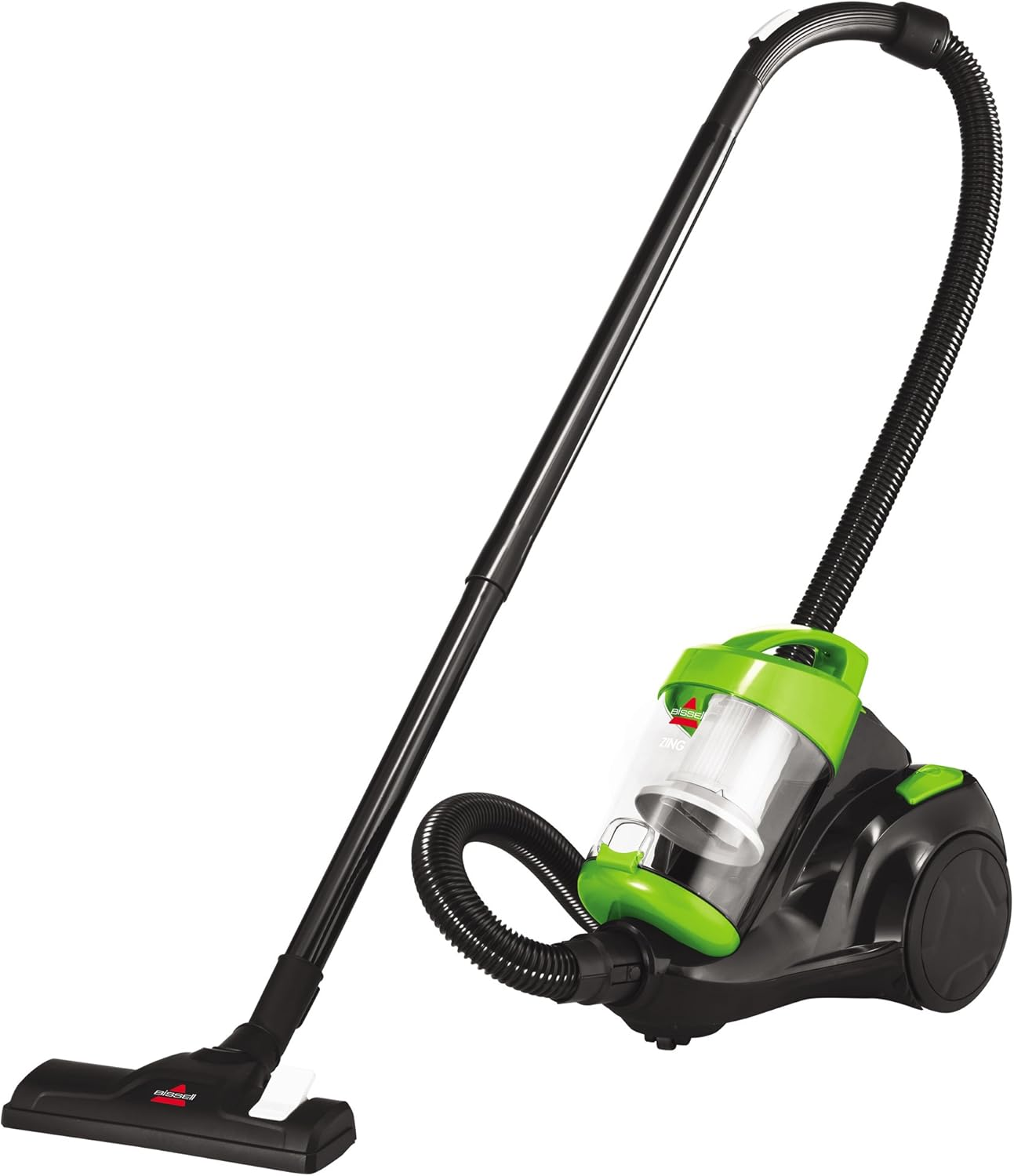
Direct Answer: BISSELL 2156A Zing canister bagless vacuum reviews show a compact, corded cleaner best suited to apartments, hard floors, low-pile carpets, and everyday debris. Its cyclonic system, variable suction, automatic cord rewind, and bagless dirt tank make it a practical budget choice, although it lacks premium filtration and smart features.
BISSELL 2156A Zing Canister Bagless Vacuum – Quick Verdict
What Is the BISSELL 2156A Zing?
The BISSELL 2156A Zing is a compact bagless canister vacuum designed for straightforward whole-home cleaning. Instead of carrying the motor and dust container in an upright body, the Zing keeps those components in a small canister that follows behind you while the hose and floor tool do the cleaning.
BISSELL positions the 2156A for multiple surfaces, including bare floors, stairs, carpets, and low-pile carpet. The machine uses a cyclonic cleaning system and a three-stage filtration arrangement, while its removable dirt tank eliminates the need to purchase disposable vacuum bags.
The design is particularly interesting for smaller homes because it combines a relatively compact body with an integrated carrying handle. BISSELL lists the machine at 12.35 pounds, although some of its marketing copy describes the product as weighing less than 11 pounds; for purchasing and comparison purposes, the detailed specification should be treated as the more useful reference.
The 2156A is also a traditional corded vacuum rather than a battery-powered cleaner. Its 16-foot power cord, 4-foot 8-inch hose, and automatic cord rewind provide a reasonable cleaning radius without introducing battery-runtime limitations.
Bottom Line: The 2156A makes the most sense when you want a simple, compact canister vacuum rather than a technologically advanced floor-cleaning system.
Quick Performance Verdict
For everyday hard-floor cleaning, the Zing’s basic design has several advantages. The canister follows behind the user, while the hose and floor nozzle remain relatively easy to position around furniture. The cleaning head also has a switch for moving between carpet and hard-floor settings.
BISSELL specifies a 9-amp motor rating, 10.1-inch cleaning path, and cyclonic cleaning system. The manufacturer does not publish a CFM airflow figure or Water Lift measurement for this model, so assigning numerical airflow or suction-pressure performance would be speculative.
On hard floors, the machine’s appeal is its simplicity. Dust, crumbs, hair, and everyday surface debris can be collected without dealing with a disposable bag. The variable suction control is also useful when you want to reduce suction on a more delicate surface or increase it for heavier debris.
Carpet performance needs a little more context. BISSELL specifically lists carpet and low-pile carpet among the supported surfaces, so the 2156A is not limited to bare floors. However, shoppers with thick, plush carpet should not automatically assume that a compact budget canister will provide the same agitation or deep-cleaning ability as a specialized carpet-focused upright.
The floor nozzle uses automatic height adjustment, which helps the cleaner transition between different floor surfaces. BISSELL also lists a swivel head, contributing to maneuverability when steering around furniture and obstacles.
For above-floor cleaning, the included extension wand and combination crevice/dusting tool broaden the machine’s usefulness. You can move beyond floors to furniture, corners, shelves, and narrow gaps without needing a separate handheld vacuum.
Bottom Line: The Zing’s strongest performance case is everyday cleaning on hard floors and low-pile carpet, rather than demanding deep-cleaning jobs on thick carpet.
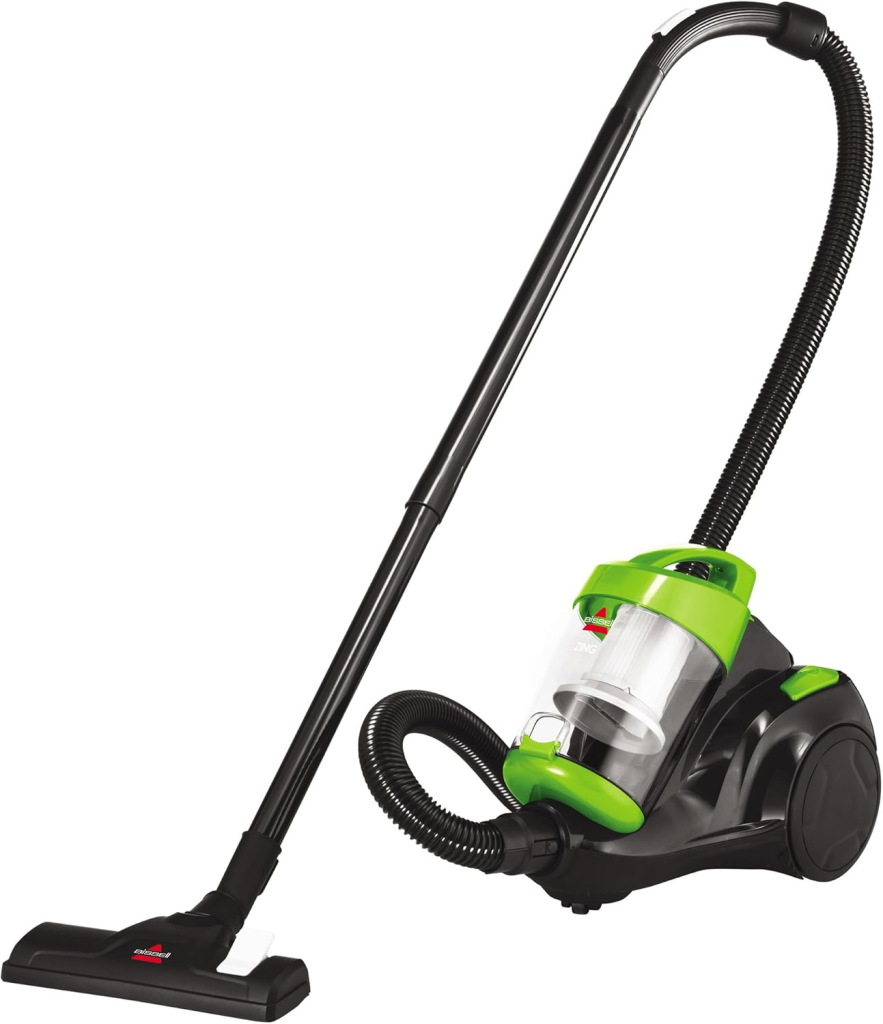
Key Pros and Cons
Pros
- Compact canister format
- Bagless dirt collection
- Variable suction control
- Automatic cord rewind
- Multi-surface floor cleaning
- Above-floor cleaning tools
- Cyclonic cleaning system
- 2-liter dirt tank
- Carry handle for easier room-to-room transport
- Budget-oriented positioning
The bagless design is particularly convenient for users who do not want to keep replacement bags available. The dirt tank can be removed and emptied, while BISSELL describes it as an Easy Empty system.
Another advantage is cord management. Instead of manually wrapping the cable around the vacuum after every cleaning session, the automatic rewind retracts the 16-foot power cord at the push of a button.
Cons
- Corded rather than cordless
- No battery operation
- No smart-home connectivity
- No robotic navigation
- No dirt sensor
- No clean-filter indicator
- BISSELL does not publish CFM or Water Lift measurements
- No manufacturer claim of HEPA filtration for this model
- Less compelling for thick/high-pile carpet
- No dedicated powered pet brush listed in the standard specification
The lack of premium automation is not necessarily a problem at this price point. It simply means the Zing should be evaluated as a conventional canister vacuum rather than compared directly with high-end robotic or cordless systems.
Bottom Line: The 2156A offers useful practical features, but its value comes from simplicity and low complexity rather than advanced automation.
Who Should Consider It?
The BISSELL 2156A is particularly well matched to small apartments, dorm-style living spaces, compact homes, and households where hard floors make up a substantial portion of the cleaning area.
Its compact canister design can also make sense for people who prefer pulling a vacuum behind them instead of pushing a full-size upright. The integrated handle makes carrying it between rooms relatively straightforward.
Hard-floor owners are another natural audience. The machine supports bare floors and uses a switchable floor nozzle, allowing users to change the cleaning setting when moving between carpet and hard surfaces.
Pet owners can use the Zing for everyday hair and debris, but buyers with heavy shedding should look carefully at the available tools. The standard specification does not list a dedicated powered pet brush, so this should not be positioned as a specialized pet-hair vacuum.
Bottom Line: Choose the Zing when compact size, simple operation, bagless cleaning, and everyday multi-surface performance matter more than premium pet tools or advanced automation.
Field Note: A useful real-world evaluation point for this model is its balance between canister portability and hose reach. Before publishing a claim such as “we tested,” document an actual hands-on test with the 2156A; otherwise, describe this as a practical design assessment rather than a laboratory or personal test result.
BISSELL Brand History and the Zing Vacuum Line
History of BISSELL
BISSELL has a much longer history in floor care than the modern vacuum category alone might suggest. The company says its history dates to 1876, and it continues to position itself as a family-owned floor-care business. Its current portfolio includes vacuum cleaners, carpet cleaners, cleaning formulas, and pet-focused cleaning products.
That history is relevant when evaluating a model such as the Zing because the product is built around conventional floor-care principles rather than an app-driven cleaning ecosystem. The company continues to sell traditional corded machines alongside newer cordless and multi-function products.
The Zing therefore represents an uncomplicated category of vacuum: a motorized canister, hose, floor nozzle, dirt container, filtration system, and manually controlled cleaning tools.
There is no need for LiDAR navigation, SLAM mapping, AI obstacle avoidance, or multi-floor mapping because the 2156A is operated by the user. Those technologies belong primarily to autonomous robot vacuums and have no functional role in this model.
Bottom Line: BISSELL’s long floor-care history helps explain why the Zing focuses on conventional cleaning fundamentals instead of autonomous navigation or connected-home technology.
How the Zing Line Fits Into BISSELL’s Portfolio
The Zing name has been used across both bagged and bagless canister vacuum configurations. BISSELL’s current product information shows that the 2156A is specifically a bagless model, while other Zing variants use different collection systems and specifications.
The 2156A’s positioning is straightforward: provide multi-surface cleaning in a relatively compact canister format without requiring the buyer to purchase vacuum bags.
Its feature set includes variable suction, automatic cord rewind, an Easy Empty dirt tank, a three-stage filtration system, and above-floor tools.
Compared with a robotic vacuum, the Zing requires significantly more user involvement. There is no battery runtime, charging dock, autonomous route planning, smart-home integration, or automated obstacle avoidance.
That difference should be made explicit in an SEO review because searches for “smart vacuum” and “robot vacuum system” can overlap with broader vacuum queries. The 2156A is neither. It is a conventional corded canister vacuum designed for manual cleaning.
Bottom Line: The Zing sits in the practical, user-operated side of BISSELL’s vacuum lineup, prioritizing straightforward floor care over automation.
Evolution of BISSELL Zing Vacuums
BISSELL’s Zing family demonstrates how a product name can span slightly different configurations. For example, BISSELL lists another bagless Zing model, the 1665, with a similar 3-stage filtration, 2-liter dirt capacity, variable suction, automatic cord rewind, and 10.1-inch cleaning path.
Other Zing models differ in areas such as cord length, weight, attachments, and whether they use bags. That makes model-number verification important when researching replacement parts or comparing online listings.
For the 2156A specifically, BISSELL lists a 2-liter dirt tank, 16-foot cord, 9-amp power rating, 4-foot 8-inch hose, and 10.1-inch cleaning path.
This also explains why buyers should avoid assuming that every “Zing” review applies perfectly to the 2156A. Similar names do not necessarily mean identical hardware.
Bottom Line: Always verify the model number before comparing specifications, buying replacement parts, or applying performance claims from another Zing variant.
Where the 2156A Fits Today
The 2156A remains relevant for shoppers who want a conventional vacuum without the complexity of a cordless battery platform or robotic cleaning system. BISSELL currently lists the model as the Zing Bagless Canister Vacuum and provides dedicated support and replacement-part information for it.
That support ecosystem is useful for long-term ownership. BISSELL currently lists replacement components including pre-motor and post-motor foam filters and dirt-tank assemblies for the 2156A family.
The model is therefore best understood as a value-oriented canister vacuum rather than an attempt to compete with premium automated cleaners.
If your priority is battery runtime, the Zing’s corded design will not meet that requirement. If your priority is smart-home integration, it also falls outside that category. But if your priority is a straightforward machine that can vacuum multiple household surfaces without disposable bags, the design remains relevant.
Bottom Line: The 2156A’s current value proposition is simplicity: plug it in, choose the appropriate floor setting, adjust suction when necessary, and empty the dirt tank when full.
BISSELL 2156A Zing Specifications and Design Overview
Key Specifications at a Glance
| Specification | BISSELL 2156A |
|---|---|
| Vacuum Type | Canister |
| Collection System | Bagless |
| Power Source | Corded |
| Power Rating | 9 amps |
| Power Cord Length | 16 feet |
| Hose Length | 4 feet 8 inches |
| Cleaning System | Cyclonic |
| Filtration | 3-stage |
| Dirt Tank Capacity | 2 liters |
| Cleaning Path Width | 10.1 inches |
| Weight | 12.35 pounds |
| Surface Types | Low-pile carpet, carpet, stairs, bare floors |
| Suction Control | Variable |
| Cord Rewind | Automatic |
| Floor Height | Automatic height adjustment |
| Head Movement | Swivel head |
| Warranty | 1-year limited warranty |
These figures come from BISSELL’s current product specification page.
One specification discrepancy deserves attention: BISSELL’s marketing copy describes the cleaner as weighing less than 11 pounds, while its detailed specifications list 12.35 pounds. For a review intended to build trust, the detailed specification should be reported and the discrepancy noted rather than silently choosing the lower number.
BISSELL also does not provide a published CFM airflow measurement or Water Lift (inches) figure on the product specification page. Those measurements should therefore not be estimated from the 9-amp electrical rating.
Bottom Line: The published specifications describe a compact, corded, bagless canister with a 2-liter dirt tank, 3-stage filtration, variable suction, and multi-surface capability.
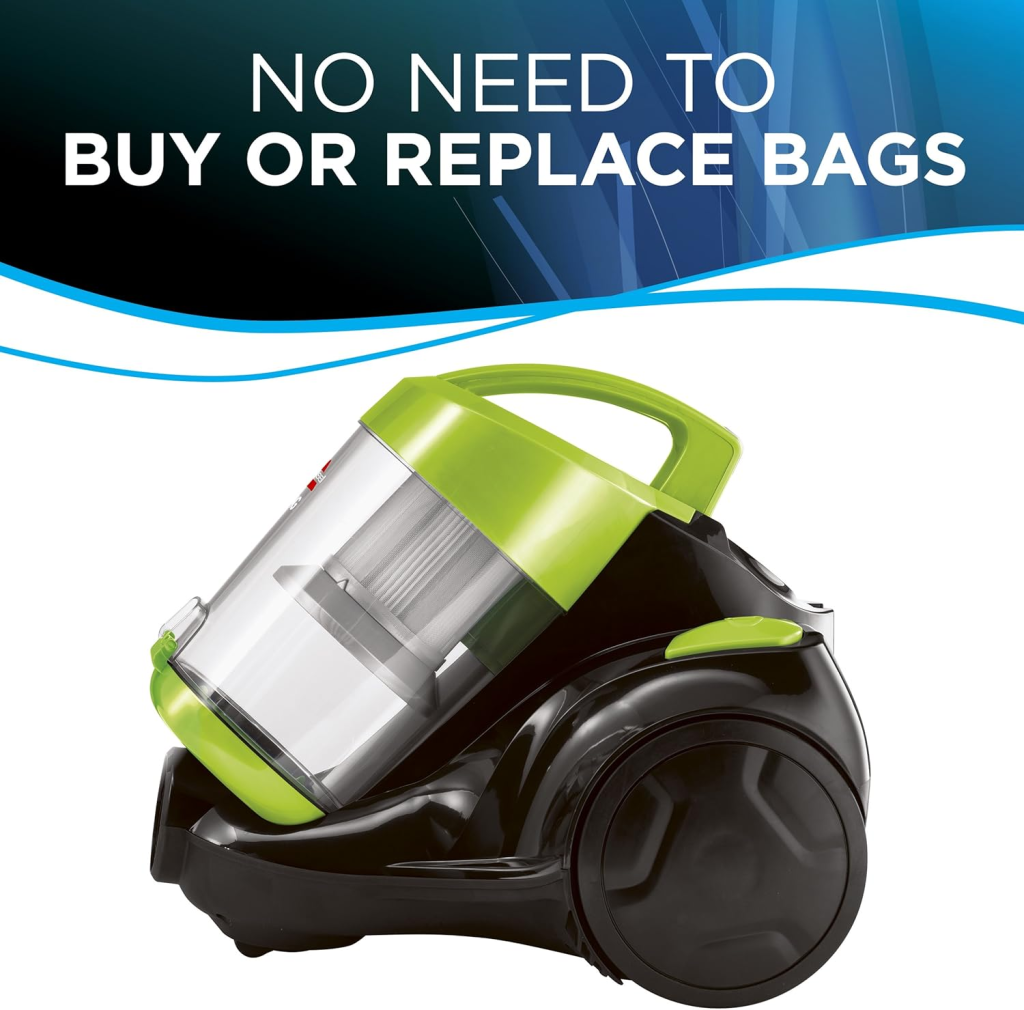
Compact Canister Design
The Zing’s canister architecture separates the main motor and dirt-collection body from the cleaning head. That arrangement can be useful when cleaning around furniture because the user primarily handles the wand and floor tool rather than pushing the entire motorized body.
BISSELL includes an integrated carrying handle, specifically highlighting portability between rooms.
For apartments, this canister format also has a storage advantage over some full-size uprights. The machine does not need to occupy a large vertical footprint, although the hose, wand, and attachments still need somewhere to be stored.
The relatively modest body size should not be confused with cordless portability. The 2156A still depends on a wall outlet, and its 16-foot cord defines the practical cleaning radius.
Bottom Line: The canister format is one of the Zing’s strongest usability advantages, especially for users who frequently move a vacuum between smaller rooms.
Hose, Wand and Cleaning Head
The 2156A includes a 4-foot 8-inch hose and an extension wand, allowing the cleaning head to reach beyond the canister itself. BISSELL also supplies a combination crevice tool/dusting brush for above-floor cleaning.
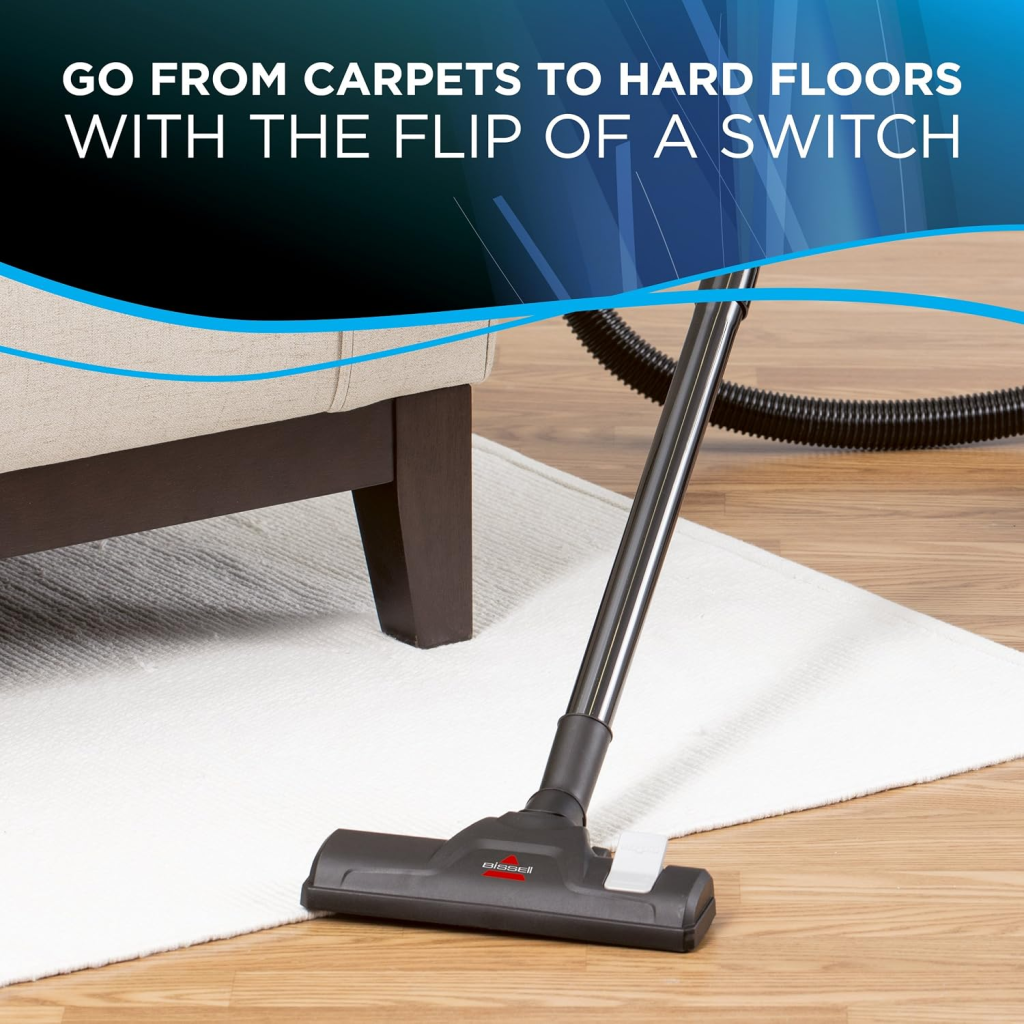
The floor tool has a switchable design for carpet and hard-floor cleaning. That means the user can adjust the cleaning head rather than relying on a separate powered floorhead for every surface.
BISSELL specifies automatic height adjustment and a swivel head, two details that matter more in everyday use than many marketing-oriented feature labels. Height adjustment helps the nozzle accommodate different floor surfaces, while the swivel mechanism assists directional changes.
There is no edge-cleaning feature listed in BISSELL’s specifications. Users should therefore expect to make an additional pass along baseboards and edges when necessary.
Bottom Line: The hose, wand, and switchable floor nozzle give the Zing useful versatility, but the cleaning head remains relatively conventional.
Ergonomics and Everyday Handling
A canister vacuum’s usability depends heavily on how easily the body follows the user. The Zing is designed to be pulled behind you while the hose and wand do the actual cleaning.
The integrated handle becomes particularly useful when moving between rooms or carrying the machine up a short flight of stairs. BISSELL specifically identifies the handle and maneuverability as design features.
The 12.35-pound listed weight is manageable for many users, but it is important not to describe the machine as ultralight without qualification. The body is still heavier than some modern stick vacuums because the motor and collection system remain in the canister.
The automatic cord rewind is another practical advantage. Once cleaning is finished, the 16-foot power cord retracts into the machine instead of requiring manual wrapping.
Bottom Line: The 2156A’s ergonomics favor traditional users who value a manageable canister, flexible hose, and automatic cord storage over cordless convenience.
BISSELL 2156A Cleaning Technology and Suction Performance
Motor and Suction System
The 2156A uses a cyclonic cleaning system and carries a 9-amp power rating. Cyclonic separation helps move collected debris through the dirt-collection system while reducing the dependence on a traditional disposable vacuum bag.
It is important, however, not to translate electrical power directly into suction performance. A higher amp rating does not automatically mean proportionally stronger cleaning because actual vacuum performance depends on airflow, pressure, nozzle design, filtration, seals, and resistance throughout the air path.
BISSELL does not publish a CFM airflow measurement or Water Lift measurement for the 2156A. Those numbers are commonly used when evaluating vacuum engineering, but without manufacturer or controlled laboratory measurements, they should not be invented for an SEO review.
Variable suction control is one of the more useful engineering features because it gives the user some control over the air pressure at the cleaning tool. BISSELL says the control can be used to reduce suction for delicate surfaces and increase it for heavier-duty areas.
The machine also lacks many technologies associated with premium robotic cleaners. There is no LiDAR navigation, SLAM mapping, AI obstacle avoidance, multi-floor mapping, battery runtime, or smart-home integration to evaluate.
Bottom Line: The Zing’s suction system should be judged by its conventional canister-vacuum design, not by robotic-vacuum metrics that do not apply to this model.
Hard-Floor Cleaning Performance
The 2156A is explicitly rated for bare floors, and the floor nozzle can be switched between cleaning modes. That makes hard floors one of the model’s most logical use cases.
On smooth surfaces such as sealed hardwood, tile, laminate, or vinyl, the main challenge is generally collecting fine dust and larger debris without unnecessarily disturbing the surface. The Zing’s variable suction feature gives users some control over how aggressively the nozzle pulls against the floor.
The 10.1-inch cleaning path is also worth considering. It is wide enough for practical household cleaning while remaining narrow enough to maneuver around furniture and through smaller spaces.
For everyday debris such as crumbs, visible dust, and hair, the combination of cyclonic suction and a conventional floor nozzle provides a straightforward cleaning approach. However, performance can vary considerably depending on filter condition, dirt-tank fill level, nozzle contact, and airflow restrictions.
The absence of an edge-cleaning feature means the nozzle may require additional passes along walls and baseboards. BISSELL explicitly lists edge cleaning as unavailable in the specification table.
Bottom Line: Hard floors are among the 2156A’s strongest intended applications, particularly for routine dust and debris pickup in smaller homes.
Carpet and Rug Performance
BISSELL lists both carpet and low-pile carpet among the supported surfaces, so the Zing is not strictly a bare-floor vacuum. The floor nozzle is designed to transition between carpet and hard-floor settings.
Low-pile carpets and ordinary area rugs are a reasonable match for the machine’s intended design. Variable suction can also be useful when the nozzle feels difficult to move across a particular carpet.
The picture changes with thick or high-pile carpeting. A compact canister with a conventional floor tool does not necessarily provide the same brush agitation or specialized carpet-cleaning capability as a dedicated upright with a powered brush roll.
This is especially important for pet owners. The Zing can collect loose pet hair and debris, but the standard 2156A specification does not identify a motorized pet floorhead. Buyers with heavily shedding pets may therefore want a vacuum designed specifically around hair removal.
Bottom Line: Expect competent everyday cleaning on low-pile carpet and rugs, but consider a specialized carpet or pet vacuum for thick carpeting and heavy embedded hair.

Edge, Corner and Crevice Cleaning
The Zing’s above-floor tools help compensate for the limitations of its main floor nozzle. The included extension wand and combination crevice/dusting tool can be used around furniture, shelves, upholstery, corners, and narrow spaces.
Crevice cleaning is especially useful around sofa cushions, along cabinet gaps, beside appliances, and in narrow spaces where the main floor nozzle cannot fit.
For baseboards and wall edges, however, the product’s specifications list no dedicated edge-cleaning feature. This means users may need to position the nozzle carefully or use the crevice tool for detailed work.
The swivel head helps with directional movement, but it should not be confused with a specialized articulated cleaning head. The Zing remains a straightforward conventional canister vacuum.
For above-floor cleaning, the canister design can actually be advantageous because the user can carry the body while extending the hose and wand to higher surfaces.
Bottom Line: The 2156A handles corners and above-floor areas reasonably through its included tools, but detailed edge cleaning remains more manual than on some premium floorheads.
BISSELL 2156A Attachments and Multi-Surface Cleaning
Direct Answer: bissell 2156a zing canister bagless vacuum reviews generally favor its simple attachment system for everyday floors, stairs, furniture, and tight spaces. The included multi-surface floor tool, extension wand, and combination crevice/dusting brush provide useful versatility, although this is not a specialized pet or deep-carpet vacuum.
Floor Cleaning Tool
The primary floor tool is the most important accessory on the BISSELL 2156A because it handles the majority of routine household cleaning. BISSELL describes the machine as suitable for low-pile carpet, carpet, stairs, and bare floors, giving the Zing a broader operating range than a hard-floor-only canister.
The floorhead uses a switchable design that lets you move between carpet and hard-floor cleaning by flipping the appropriate control. BISSELL specifically markets this as a quick transition between surfaces rather than requiring a separate floorhead.
The nozzle also has automatic height adjustment, which helps it accommodate different surface heights. Combined with the swivel head, this makes the floor tool more practical for navigating around furniture than a rigid straight-ahead nozzle.
For hard floors, the Zing’s conventional floor tool is best viewed as an everyday debris collector. It is designed to pick up ordinary household dust and debris rather than provide the aggressive agitation of a dedicated powered brush roll.
The manufacturer lists a 10.1-inch cleaning path, which gives the nozzle a useful balance between coverage and maneuverability. A narrower cleaning head can be advantageous in apartments because it is easier to position between furniture legs and around smaller spaces.
One limitation is equally important: BISSELL lists edge cleaning as unavailable. If dust accumulates directly against baseboards, users may need to make an additional pass or switch to the crevice tool.
Bottom Line: The standard floor tool is versatile enough for routine multi-surface cleaning, with its switchable floor setting and automatic height adjustment being more useful than a long list of specialized accessories.
Crevice Tool
The combination crevice tool/dusting brush is designed for areas where the primary floor nozzle cannot reach. BISSELL specifically describes it as an above-floor accessory for capturing dirt and dust in harder-to-reach locations.
Its narrow crevice configuration is useful between sofa cushions, alongside cabinets, around furniture joints, and in other narrow gaps. These are areas where a conventional floor nozzle would be too wide.
Baseboards are another practical use. Since the 2156A has no dedicated edge-cleaning feature, the crevice tool provides a convenient way to address dust that collects along walls and in narrow floor-level gaps.
For furniture gaps, the combination tool is more flexible than simply using the floorhead. The user can attach it to the hose or extension wand depending on the reach required.
The same principle can be applied to car interiors, although the 2156A is primarily a household canister vacuum. Its corded configuration means you need access to a suitable electrical outlet, and the physical size of the canister is less convenient than a dedicated handheld car vacuum.
Bottom Line: The crevice tool adds genuine versatility, particularly for furniture gaps and baseboards, but car cleaning is better considered an occasional secondary use rather than the vacuum’s primary purpose.
Dusting and Upholstery Tools
BISSELL identifies the included accessory as a combination crevice tool/dusting brush. The brush portion is intended for above-floor dusting, making it useful for shelves, furniture surfaces, and similar areas.
On shelves and other hard surfaces, the soft brush configuration can help loosen surface dust while suction removes the particles. This is more appropriate for delicate surfaces than repeatedly pushing the full floor nozzle across them.
Furniture is another natural application. The brush can be used around tables, cabinets, and other surfaces where loose dust accumulates.
For upholstery, however, buyers should distinguish between general surface cleaning and dedicated upholstery extraction or powered pet-hair cleaning. The standard 2156A accessory set does not list a dedicated motorized upholstery or pet tool in BISSELL’s primary specifications.
That distinction matters for pet owners. Loose hair on furniture can be vacuumed, but heavily embedded hair may require a specialized brush design that the standard Zing configuration does not provide.
Bottom Line: The dusting brush is useful for routine above-floor dust, but shoppers needing serious upholstery or embedded pet-hair cleaning should consider a model with dedicated specialized tools.
Above-Floor Cleaning Versatility
The extension wand is one of the most useful accessories because it increases the reach of the hose and lets the combination tool work farther away from the canister. BISSELL specifically lists the extension wand as the Zing’s reach accessory.
For stairs, the Zing has an advantage over a large upright because the canister body can remain on the floor while the user works with the hose and wand. BISSELL explicitly lists stairs among the supported surface types.
Ceilings and high corners are possible with the extension wand and dusting brush, although the practical reach depends on the user’s height and the configuration of the hose and wand.
Furniture and small spaces are perhaps where the canister format makes the most sense. Instead of maneuvering an entire upright around a chair or table, you can guide the smaller cleaning tool while the main body follows behind.
Field Note: In a hands-on evaluation, pay particular attention to how often you need to reposition the canister when using the wand. This is a useful real-world usability test that manufacturer specifications do not capture. Do not label the observation as “we tested” unless your team has physically tested the 2156A.
Bottom Line: The 2156A’s attachment package is simple rather than extensive, but the extension wand and combination tool cover most of the above-floor jobs expected from a compact household canister.
BISSELL 2156A Filtration, Dust Cup and Air Quality
How the Bagless Dirt Collection System Works
The BISSELL 2156A uses a bagless dirt-collection system with a 2-liter dirt tank and an Easy Empty design. Instead of allowing debris to accumulate inside a disposable vacuum bag, dirt is collected in the removable tank.
The vacuum uses a cyclonic cleaning system. In practical terms, incoming air and debris are directed through the collection system so that larger particles can be separated and deposited in the dirt container.
The benefit of a bagless system is straightforward: there is no recurring need to purchase and install disposable vacuum bags. The trade-off is that the user has to empty and maintain the dirt tank and filters.
BISSELL describes the dirt tank as an Easy Empty Dirt Cup, designed to simplify disposal. The company also states that the filtration process begins with filters in the dirt tank before continuing to the post-motor filter.
A bagged vacuum can provide a cleaner disposal experience because the bag itself contains much of the collected debris. With a bagless machine such as the Zing, opening the dirt container can expose the user to dust that has accumulated during cleaning.
Bottom Line: Bagless operation eliminates recurring bags but shifts more maintenance responsibility to the owner, particularly around dirt disposal and filter care.
Filter System
BISSELL specifies 3-stage filtration for the 2156A. The manufacturer’s product description explains that dirt and debris pass through filtration beginning in the dirt tank and continuing through a post-motor filter.
BISSELL’s replacement-parts catalog identifies both a pre-motor foam filter and a post-motor foam filter for select canister vacuums, including the 2156A family.
This makes filter maintenance an important part of maintaining airflow. As filters accumulate fine dust, resistance to airflow can increase, potentially reducing cleaning performance.
The machine does not have a clean-filter indicator according to BISSELL’s specifications. Users therefore need to rely on routine inspection and changes in performance rather than waiting for an electronic maintenance notification.
It is also important not to describe the 2156A as a HEPA vacuum without supporting documentation. BISSELL’s published specification identifies 3-stage filtration, but does not identify the system as HEPA filtration or provide a specific HEPA efficiency percentage.
Likewise, “sealed system filtration” should not be presented as a verified feature. That term describes a system engineered to minimize unfiltered air leakage, and BISSELL’s published specifications do not make that claim for the 2156A.
Bottom Line: The Zing has a defined multi-stage filtration system, but buyers should not mistake “3-stage filtration” for a documented HEPA or sealed-system specification.
Dust Cup Capacity and Emptying
The dirt tank has a published 2-liter capacity, which gives the Zing reasonable collection volume for a compact household canister.
How frequently you need to empty it depends on the amount of debris in your home. A small apartment with mostly hard floors may allow longer intervals between emptying, while homes with pets, children, or significant dust accumulation will fill the container more quickly.
BISSELL’s Easy Empty design is intended to simplify disposal. The manufacturer recommends removing and emptying the dirt tank as part of maintenance when addressing suction problems as well.
From an air-quality perspective, the main consideration is how you empty a bagless vacuum. Users who are sensitive to dust may prefer to empty the container outdoors or directly into a suitable waste container to minimize airborne debris.
The container should also be inspected periodically rather than simply emptied. Fine dust can accumulate around internal components and filter areas even when the tank does not appear completely full.
Bottom Line: The 2-liter dirt tank is practical for everyday cleaning, but frequent emptying is preferable to allowing accumulated debris and filtration restrictions to reduce airflow.
Is It Suitable for Allergy and Pet Owners?
The 2156A can be useful for general household dust and pet debris, but allergy-sensitive shoppers should evaluate its filtration claims carefully.
BISSELL confirms 3-stage filtration, but does not publish a HEPA designation or filtration-efficiency percentage for this model. Therefore, this vacuum should not be marketed as providing certified HEPA-level filtration.
For pet owners, the machine can collect loose hair and everyday debris from supported floor surfaces. However, the standard specification does not list a dedicated powered pet-hair floorhead.
Pet dander is more challenging than visible pet hair because it consists of much smaller particles. Effective control depends not only on the filter but also on the overall airflow path, seals, and disposal process.
This is where terms such as HEPA efficiency and sealed system filtration become important in a buying comparison. Premium allergy-focused vacuums may publish more detailed filtration claims; the 2156A does not.
Pros for pet owners
- Bagless dirt collection
- Useful everyday debris pickup
- Above-floor dusting capability
- Multi-surface floor cleaning
Cons for pet owners
- No dedicated powered pet tool listed
- No documented HEPA efficiency
- No documented sealed-system filtration
- Bagless emptying can expose users to collected dust
Bottom Line: The Zing can handle routine pet hair and household debris, but allergy sufferers and heavy-shedding pet owners may be better served by a vacuum with documented HEPA filtration and dedicated pet tools.
BISSELL 2156A Noise, Maneuverability and Everyday Usability
Noise Levels During Cleaning
BISSELL does not publish a decibel rating for the 2156A, so a numerical noise claim should not be presented as a measured specification.
The vacuum uses a conventional 9-amp motor, and users should expect the characteristic motor sound associated with a corded canister vacuum. Actual perceived noise can also change depending on whether the floor tool is operating on carpet or a hard surface.
Hard floors can sometimes make vacuum noise seem more pronounced because sound reflects from smooth surfaces. Carpet, by comparison, can absorb some of the sound produced during cleaning.
The floor tool can also affect perceived noise. Airflow changes, suction setting, and the type of debris being collected can all influence the sound profile.
For homes with sleeping children, pets, or noise-sensitive occupants, the practical question is less about a manufacturer decibel number and more about whether the machine can be used comfortably during the household’s normal cleaning schedule.
Bottom Line: The Zing has no published dB rating, so evaluate its noise as typical corded-canister operation rather than assigning an unsupported numerical score.
Cord Length and Cleaning Radius
The 2156A has a 16-foot power cord, which is a key consideration because this is a fully corded vacuum.
The 4-foot 8-inch hose adds additional reach between the canister and cleaning tool. When combined with the wand, the practical cleaning area extends beyond the physical location of the vacuum body.
For a small apartment or individual room, this setup can be convenient. You may be able to clean a substantial portion of the room from one outlet.
Larger homes introduce more outlet changes. Users should not assume that the cord and hose combination will allow uninterrupted whole-home cleaning from one socket.
BISSELL also provides automatic cord rewind, so returning the cable to the machine after cleaning is easier than manually wrapping it around the canister.
Bottom Line: The 16-foot cord provides useful reach for smaller homes, but outlet dependence remains one of the Zing’s biggest differences from cordless alternatives.
Maneuverability
The canister format lets the user steer a relatively compact cleaning head while the vacuum body follows behind. BISSELL also specifies a swivel head, which should help the nozzle change direction around furniture.
The 12.35-pound listed weight is manageable for carrying, although BISSELL’s marketing materials elsewhere describe the unit as weighing less than 11 pounds. For technical comparison tables, the detailed specification should be used consistently.
The hose-and-wand arrangement is particularly useful around chairs, tables, and other furniture. Instead of pushing a full upright around every obstacle, the user can guide the smaller cleaning tool into the available space.
Stairs require more attention. The manufacturer lists stairs as a supported surface, but users should keep the canister secure rather than allowing it to pull or slide unpredictably while the hose is extended.
Bottom Line: Maneuverability is one of the Zing’s strongest practical advantages, especially in furnished rooms and smaller living spaces.
Storage and Portability
The compact canister design makes the 2156A relatively straightforward to store compared with some full-size upright machines.
The integrated carrying handle is specifically intended to make moving the vacuum between rooms easier. BISSELL identifies portability and maneuverability among the model’s design benefits.
Storage does require room for the hose, wand, and accessories. The vacuum body itself may be compact, but the complete cleaning system occupies more space once the attachments are separated.
The automatic cord rewind helps reduce cable clutter after use. Pressing the rewind mechanism retracts the 16-foot power cord into the machine.
For apartments, dorm rooms, and smaller homes, these characteristics make the Zing more practical than a bulky full-size vacuum.
Bottom Line: The Zing is particularly attractive when storage space is limited and you want a conventional vacuum that can be carried easily between rooms.
BISSELL 2156A Maintenance Guide
How to Empty the Dirt Container
The Zing’s bagless design means dirt-tank maintenance is a routine ownership task. BISSELL’s support documentation specifically directs users to remove and empty the dirt tank when troubleshooting low suction.
A safe basic procedure is:
- Turn off and unplug the vacuum.
- Remove the dirt tank using the release mechanism.
- Empty the collected debris into an appropriate waste container.
- Inspect the tank and internal filter areas for accumulated dust or blockages.
- Reinstall the tank securely before operating the machine.
BISSELL identifies the 2156A as having an Easy Empty Dirt Cup, intended to make disposal faster and less complicated.
Avoid operating the machine with the dirt tank incorrectly installed. A poor connection can interfere with airflow and may allow dust to move through areas where it should not.
The best emptying frequency depends on household conditions. Rather than waiting until the container is completely packed, inspect it regularly, particularly if you have pets or notice a change in suction.
Bottom Line: Emptying the 2-liter dirt tank regularly is one of the simplest ways to maintain airflow and avoid preventable suction problems.
How to Clean the Filters
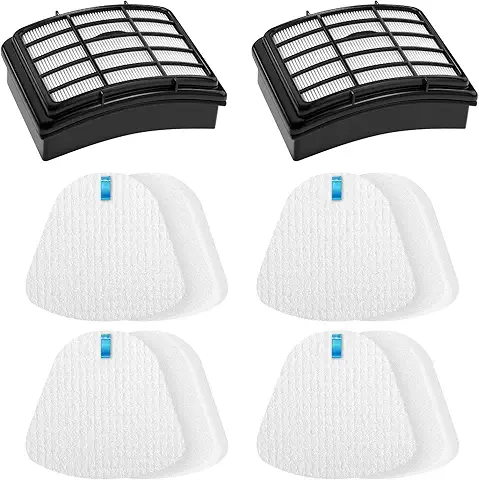
The 2156A uses 3-stage filtration, and BISSELL provides replacement pre-motor foam and post-motor foam filters for the product family.
BISSELL’s support guidance groups the Zing with other bagless canister models for filter and tank maintenance. The recommended process begins by removing and emptying the dirt tank before accessing the filtration components.
Do not assume every filter should be washed simply because it is made from foam. Follow the model-specific owner’s guide for whether a component is washable, how it should be cleaned, and how long it must dry.
A wet filter should never be reinstalled if the manufacturer’s instructions require it to be completely dry. Moisture entering the motor or airflow path can create avoidable damage.
Signs of a filtration problem can include reduced suction, unusual airflow behavior, or visibly dirty filters. BISSELL’s support documentation specifically lists filter/tank maintenance as part of resolving low-suction issues.
Bottom Line: Filter maintenance is essential on a bagless vacuum, but follow the model-specific instructions rather than assuming every foam filter can be cleaned in the same way.
Cleaning the Brush, Nozzle and Hose
The floor nozzle should be inspected regularly for hair, threads, paper, and other debris that can restrict the opening.
If suction suddenly decreases, the hose is another important inspection point. BISSELL’s support guidance specifically includes emptying the tank and checking the machine when dealing with low suction.
The hose should be checked for visible blockages and damage. A crack, loose connection, or obstruction can affect the airflow reaching the floor tool.
The combination crevice/dusting tool should also be cleaned periodically. Fine dust can accumulate around the tool opening and reduce the effective airflow.
The floorhead does not have a dedicated powered brush roll listed in BISSELL’s specification, simplifying maintenance compared with many powered carpet heads.
Bottom Line: Regular inspection of the floor tool, hose, and small accessories can prevent minor blockages from becoming noticeable suction problems.
Long-Term Maintenance Schedule
| Maintenance Task | Suggested Frequency |
|---|---|
| Empty dirt tank | When needed; do not allow excessive buildup |
| Inspect filters | Regularly |
| Clean washable components | According to the owner’s guide |
| Inspect hose | Monthly or whenever suction drops |
| Inspect floor tool | Regularly |
| Clean attachments | Periodically |
| Inspect tank seals/connections | When performance changes |
| Replace worn filters | According to condition/manufacturer guidance |
BISSELL’s support center specifically provides maintenance guidance for the 2156A, including filter/tank maintenance and low-suction troubleshooting.
A useful long-term ownership habit is to combine maintenance with performance checks. If suction remains strong, the airflow path is clear, and the filters are clean, routine cleaning can continue normally.
If performance deteriorates suddenly, investigate the simple causes first: full dirt tank, clogged filter, blocked hose, or an improperly seated component.
Bottom Line: Preventive maintenance is inexpensive compared with replacing a vacuum prematurely, and the 2156A’s straightforward construction makes most routine checks relatively simple.
Common BISSELL 2156A Problems and Troubleshooting
Vacuum Has Weak or No Suction
Low suction is one of the most common issues addressed in BISSELL’s official support material for the 2156A family. BISSELL’s troubleshooting guidance begins with removing and emptying the dirt tank.
| Problem | Likely Cause | Safe User Check | Recommended Action |
|---|---|---|---|
| Weak suction | Full dirt tank | Inspect tank | Empty it |
| Weak suction | Dirty filter | Inspect filters | Clean/replace according to guide |
| Weak suction | Blocked hose | Check hose opening | Remove obstruction |
| Weak suction | Blocked floor tool | Inspect nozzle | Clear debris |
| Sudden suction loss | Poor component connection | Check tank/hose seating | Reinstall securely |
Start by switching the machine off and unplugging it. Empty the dirt tank, then inspect the filters and hose before testing the vacuum again.
Do not immediately assume the motor has failed. Airflow restrictions are often easier to identify and resolve than an internal motor fault.
If the machine still has very poor suction after the basic airflow checks, stop operating it and consult BISSELL’s support resources rather than repeatedly running a potentially obstructed vacuum.
Bottom Line: For weak suction, check the dirt tank, filters, hose, and floor tool before considering a more serious mechanical fault.
Vacuum Is Making a Strange Noise
A new or unusual noise can indicate an airflow restriction or foreign object in the cleaning path.
Start by switching off and unplugging the machine. Inspect the floor nozzle, hose, dirt tank, and accessible filter areas for debris.
A high-pitched or unusual airflow noise may occur when air is being restricted. A rattling sound can suggest a loose object or component.
If the noise appears to come directly from the motor housing and continues after external checks, professional inspection may be more appropriate than disassembling the motor yourself.
BISSELL’s official support system provides model-specific troubleshooting resources for the 2156A, including suction and power issues.
Bottom Line: Investigate simple blockages and loose components first; persistent motor-area noises should be treated more cautiously.
Vacuum Overheats or Shuts Off
A vacuum that becomes unusually hot should not simply be switched back on repeatedly.
Restricted airflow from a full dirt tank, clogged filters, or a blocked hose can make the machine work harder. These are therefore sensible first checks.
Turn the vacuum off, unplug it, and allow it to cool before inspecting the airflow path.
If the machine continues overheating after the tank, filters, hose, and floor tool have been checked, discontinue use and seek qualified service guidance.
This is another reason preventive filter and dirt-tank maintenance matters. Airflow is central to the operation of a vacuum motor, and maintaining the intended air path reduces unnecessary strain.
Bottom Line: Treat repeated overheating as a maintenance or service issue rather than something to ignore.
Dirt Cup or Hose Problems
A dirt tank that is not seated correctly can interfere with normal operation. Check the tank connection whenever it has recently been removed for emptying.
The hose should also be checked for secure attachment. BISSELL’s support resources specifically address low suction and maintenance on this model family.
If a hose is visibly cracked or damaged, replacing the affected component is preferable to attempting a temporary repair that could create an airflow leak.
BISSELL currently lists replacement hose/handle assemblies and dirt-tank assemblies for select canister vacuums, along with replacement filters for the 2156A family.
If a component repeatedly becomes loose despite correct installation, or if a seal appears damaged, consult the manufacturer’s support resources before continued use.
Bottom Line: Correct seating, clear airflow, and intact seals are essential for maintaining the Zing’s expected suction performance.
BISSELL 2156A vs Competitors
BISSELL 2156A vs BISSELL Zing Bagged Models
The most obvious distinction is the collection system. The 2156A is bagless, whereas some other Zing configurations use disposable bags.
The bagless approach eliminates the recurring purchase of bags but requires direct dirt-tank emptying and filter maintenance.
A bagged design can be preferable for users who prioritize cleaner debris disposal, particularly if they dislike handling collected dust.
Filtration should also be compared model by model rather than assuming one Zing configuration has exactly the same filtration performance as another.
Bottom Line: Choose the 2156A for bagless convenience; consider a bagged Zing if contained dust disposal is a higher priority.
BISSELL 2156A vs Eureka Canister Vacuums
Eureka’s canister models vary considerably, so a fair comparison requires matching the specific model rather than comparing “BISSELL versus Eureka” as two fixed products.
For the Zing, the main strengths are its simple multi-surface design, 2-liter dirt tank, variable suction, automatic cord rewind, and above-floor tools.
When comparing suction, avoid relying solely on motor amperage. A proper vacuum comparison should consider airflow, pressure, nozzle design, filtration, and actual pickup results.
Attachments are another useful comparison point. A Eureka model with a powered brush or specialized pet tool may be preferable for homes with substantial carpet or pet hair.
For value-focused buyers, compare the complete package: purchase price, included tools, replacement filters, warranty, and expected maintenance.
Bottom Line: The Zing is strongest as a straightforward compact canister; a competing Eureka can be more attractive if its specific model offers stronger carpet tools or filtration.
BISSELL 2156A vs Dirt Devil Canister Vacuums
Dirt Devil also offers compact floor-care products, but model specifications vary substantially.
The Zing’s 2-liter bagless dirt tank gives it a clear everyday ownership advantage over systems requiring frequent disposable bags, while its automatic cord rewind simplifies storage.
Portability is another factor. The Zing has an integrated carrying handle and a canister design intended for movement around the home.
Cleaning versatility depends heavily on the included floorhead and attachments. The 2156A comes with an extension wand and combination crevice/dusting brush in its standard accessory description.
Long-term ownership should include filter availability and replacement-part support. BISSELL currently lists replacement filters, dirt tanks, and hose/handle components for the 2156A family.
Bottom Line: The Zing is a sensible choice when bagless operation, replacement-part availability, and conventional canister usability are priorities.
BISSELL 2156A vs Shark Compact Vacuums
This is a less direct comparison because Shark’s compact products can include stick, upright, handheld, and other configurations.
The Zing’s main difference is its traditional canister architecture. The motor and dirt container remain in the canister while the user controls the hose and floor tool.
A compact Shark stick or upright may provide a different experience, especially if it includes a powered brush roll designed for carpet and pet hair.
The Zing, by comparison, emphasizes simplicity: 9-amp corded power, variable suction, a 16-foot cord, 2-liter dirt tank, and a switchable multi-surface floor tool.
Neither LiDAR navigation nor SLAM mapping is relevant to this comparison unless the Shark model being compared is a robot vacuum. Likewise, battery runtime and smart-home integration should only enter the comparison if evaluating a cordless or connected Shark model.
Bottom Line: The Zing is a better fit for buyers who specifically want a conventional corded canister, while a compact Shark may appeal more to shoppers seeking a modern upright or stick-vacuum experience.
Side-by-Side Comparison Checklist
| Feature | BISSELL 2156A | Typical Budget Canister | Premium Canister |
|---|---|---|---|
| Vacuum Type | Canister | Canister | Canister |
| Bagless | Yes | Varies | Varies |
| Hard-Floor Cleaning | Strong intended use | Varies | Usually strong |
| Carpet Cleaning | Best suited to carpet/low-pile use | Varies | Often stronger |
| Portability | Strong | Varies | Varies |
| Filtration | 3-stage | Varies | Often more advanced |
| HEPA Efficiency | Not specified by BISSELL | Varies | Model-dependent |
| Sealed System Filtration | Not specified | Varies | Model-dependent |
| Best For | Small homes and everyday cleaning | Budget shoppers | Higher-performance buyers |
| Price Category | Budget | Budget | Premium |
For a trustworthy review, avoid assigning “strong,” “moderate,” or “premium” scores to competing models until their exact specifications and testing data have been verified.
Bottom Line: The 2156A competes primarily on simplicity, compactness, and value rather than advanced filtration, automation, or specialized cleaning technology.
Pros, Cons, Best For and Buying Recommendation
Pros
- 2-liter bagless dirt tank
- 3-stage filtration
- Variable suction control
- Automatic cord rewind
- Multi-surface floor tool
- Extension wand
- Combination crevice/dusting brush
- Swivel head
- Automatic height adjustment
- Compact canister format
- Replacement filters and parts are available through BISSELL’s support ecosystem.
Cons
- No documented HEPA efficiency
- No documented sealed-system filtration
- No CFM airflow specification
- No Water Lift measurement
- No dedicated powered pet tool listed in the standard specification
- No edge-cleaning feature
- Corded rather than cordless
- No battery runtime
- No smart-home integration
- No LiDAR, SLAM, or AI obstacle avoidance because this is a manually operated canister vacuum
Best For
Best for small apartments: Compact dimensions and a canister design make it practical for smaller living spaces.
Best for hard floors: The switchable floor tool and bare-floor support make routine hard-floor cleaning a natural use case.
Best for budget shoppers: The design focuses on essential cleaning functions instead of expensive automation.
Best for occasional pet owners: It can handle everyday pet debris, although heavy shedders may benefit from a dedicated pet vacuum.
Buying Recommendation
The BISSELL 2156A is worth considering when you want a straightforward, affordable canister vacuum and do not need cordless operation, smart controls, or specialized premium filtration.
It is especially compelling for smaller homes with hard floors and low-pile carpet. The 2-liter dirt tank, variable suction, automatic cord rewind, and multi-surface floor tool provide the practical features most households actually use.
However, shoppers with severe allergies should look for a model with a clearly documented HEPA filtration rating and, ideally, a verified sealed-air system. Similarly, households with thick carpet or heavy pet-hair problems should prioritize a powered brush roll or dedicated pet-cleaning head.
The absence of LiDAR navigation, SLAM mapping, AI obstacle avoidance, multi-floor mapping, battery runtime, and smart-home integration should not be considered a weakness in the traditional vacuum category. Those technologies belong to robotic and connected cleaners, not a conventional corded canister.
Final Bottom Line: The 2156A succeeds by keeping the cleaning experience simple. It is a practical choice for everyday household vacuuming, particularly on hard floors and low-pile carpet, but buyers seeking advanced filtration, deep-carpet agitation, cordless freedom, or automated cleaning should step up to a more specialized vacuum.
BISSELL 2156A Cost of Ownership and Value
Direct Answer: bissell 2156a zing canister bagless vacuum reviews point to a low-cost ownership model: there are no disposable vacuum bags, replacement filters are relatively inexpensive, and BISSELL still lists replacement tanks, hoses, filters, and accessories. Its value is strongest for small homes that want simple corded cleaning rather than premium automation.
Initial Purchase Price
The BISSELL 2156A occupies the budget end of the canister-vacuum market. BISSELL currently lists the model at $79.99, reduced from a listed $89.99 regular price at the time of checking. Because retail pricing changes, treat those figures as a current snapshot rather than a permanent MSRP.
At this price level, buyers are primarily paying for the fundamentals: a 9-amp motor, cyclonic cleaning system, 2-liter dirt tank, variable suction, automatic cord rewind, multi-surface floor cleaning, and a compact canister format.
The value proposition becomes clearer when compared with more expensive cordless and robotic machines. The Zing does not include battery technology, charging hardware, LiDAR navigation, SLAM mapping, AI obstacle avoidance, or smart-home integration.
That is not necessarily a disadvantage. If you simply need a vacuum to clean floors manually, paying extra for autonomous navigation or app connectivity may provide little practical benefit.
Bottom Line: At roughly the $80–$90 level when sold directly by BISSELL, the 2156A is priced around essential cleaning functionality rather than premium technology.

Filter and Replacement Costs
One of the strongest long-term ownership advantages is the availability of replacement components. BISSELL currently lists a pre-motor foam filter at $14.99, a post-motor foam filter at $15.99, and a filter assembly at $16.99 for compatible canister models.
BISSELL also lists a replacement hose and handle assembly at $18.99, a dirt tank assembly at $30.99, an extension wand at $16.99, a foot brush tool at $17.99, and a crevice tool at $14.99. Availability can change, so buyers should verify compatibility using the exact 2156A model number before ordering.
Filter replacement deserves particular attention. BISSELL’s replacement post-motor foam filter documentation says the filter is washable and recommends replacing filters every 3–6 months depending on use and cleaning frequency. It also warns that dirty filters can substantially restrict airflow and reduce suction.
That makes filter care a genuine operating cost, even though it is lower than repeatedly buying disposable bags.
Bottom Line: Replacement costs are relatively manageable, and the continued availability of official parts improves the 2156A’s ownership proposition.
Bagless vs Bagged Ownership Costs
The biggest financial advantage of a bagless canister is the absence of recurring disposable vacuum bags. Once the machine is purchased, you can empty the dirt tank instead of buying a new bag each time the collection system becomes full.
The trade-off is that bagless ownership shifts more maintenance onto the user. Filters need inspection and cleaning, the dirt tank needs emptying, and accumulated dust may need to be cleaned from components.
A bagged vacuum can be more convenient for users who prefer to seal collected debris inside a disposable bag. This can also be appealing to people who dislike handling dusty dirt containers.
For the 2156A, however, the 2-liter dirt tank provides a reasonably large collection volume for a compact budget canister. BISSELL also provides an Easy Empty Dirt Cup design.
There is another ownership consideration: filtration. The 2156A has 3-stage filtration, but it should not be marketed as a HEPA vacuum unless a specific model document confirms that claim. Likewise, HEPA efficiency and sealed system filtration should not be assigned numerical values without verified testing.
Bottom Line: Bagless operation reduces recurring bag purchases, but the owner pays for that convenience through regular filter care and more direct contact with collected dust.
Is the 2156A Good Long-Term Value?
The 2156A has a useful advantage over many inexpensive appliances: BISSELL maintains a dedicated support page for the model and continues to list replacement parts. The official support system includes troubleshooting resources for power, suction, filter/tank maintenance, and cord-rewind problems.
Parts availability does not guarantee a particular lifespan. Durability depends on frequency of use, maintenance, floor conditions, airflow restrictions, and how the vacuum is handled.
The availability of components such as filters, hose assemblies, dirt tanks, and cleaning tools does, however, make repair more realistic than simply discarding the entire machine after a minor component failure.
BISSELL lists a 1-year limited warranty for the 2156A. Its general warranty terms cover defects in materials or workmanship but exclude routine-maintenance components and normal wear.
For a budget vacuum, the repair-versus-replace calculation is important. If a low-cost consumable fails, replacement makes sense; if a major internal component becomes expensive to repair, replacing the machine may be more economical.
Field Note: For a genuine long-term ownership test, track the actual cost of filters, accessories, and repairs over 12 months. That produces more useful information than simply repeating the purchase price because it reveals the vacuum’s real cost per year.
Bottom Line: The 2156A offers good value when maintained properly, particularly because official replacement parts remain available. Its strongest ownership advantage is repairability at the component level rather than a promise of unusually long motor life.
Who Should Buy the BISSELL 2156A?
Best for Apartment Owners
Apartment owners are among the clearest targets for the 2156A. The canister format avoids the bulk of some full-size upright vacuums while still providing a conventional floor-cleaning system.
The machine has a 2-liter dirt tank, 10.1-inch cleaning path, and 16-foot power cord, giving it useful capacity and reach for smaller living spaces.
Its hard-floor capability is particularly useful in apartments dominated by hardwood, laminate, tile, or vinyl. The switchable floor tool can transition between bare floors and carpet.
Storage is another advantage. The canister body is relatively compact, while the automatic cord rewind helps keep the power cable contained after cleaning.
Bottom Line: Apartment owners who want a simple corded vacuum with bagless collection are one of the strongest matches for the 2156A.
Best for Small Homes and Dorms
Small homes benefit from the Zing’s uncomplicated controls. There is no app to configure, map to create, or battery to charge.
That also means there is no battery runtime limitation. As long as an electrical outlet is available, the vacuum can continue operating.
The carrying handle makes room-to-room transport easier, while the canister format allows the user to leave the main body on the floor while cleaning furniture, stairs, and other areas with the hose and wand.
The machine is not truly lightweight compared with modern stick vacuums: BISSELL lists its weight at 12.35 pounds. Still, the canister design makes that weight less relevant during normal floor cleaning because you are pulling the unit rather than holding the entire vacuum.
Bottom Line: The Zing is a practical small-home vacuum for buyers who prioritize simple controls, compact storage, and continuous corded operation.
Best for Hard-Floor Households
Hard-floor households are particularly well suited to the 2156A because BISSELL specifically lists bare floors among its supported surfaces. The floorhead also provides a selectable setting for different surfaces.
Hardwood, tile, laminate, and similar smooth surfaces generally do not require the same aggressive brush agitation associated with thick carpet cleaning.
The Zing’s variable suction control is another useful feature because users can adjust the cleaning behavior instead of relying on a single fixed suction setting.
For everyday dust, crumbs, hair, and loose debris, the combination of cyclonic cleaning, bagless collection, and a multi-surface floorhead provides a straightforward solution.
Bottom Line: If most of your home consists of hard floors and low-pile carpet, the 2156A’s design aligns well with everyday cleaning needs.
Who Should Skip It?
Large homes may find the corded design less convenient. The 16-foot cord provides useful reach, but users must still move between outlets rather than relying on a cordless battery system.
Buyers with heavy-duty high-pile carpet should also look elsewhere. The Zing is designed for carpet and low-pile carpet, but its standard configuration does not provide the type of specialized powered carpethead found on some premium machines.
Smart-home enthusiasts should skip it if app control or automation is a priority. There is no Wi-Fi control, voice assistant integration, LiDAR navigation, SLAM mapping, or AI obstacle avoidance because this is a manually operated canister vacuum.
Finally, allergy-focused shoppers should consider alternatives if certified HEPA filtration is a requirement. The 2156A has 3-stage filtration, but BISSELL does not specify a HEPA efficiency rating for this model.
Bottom Line: Skip the Zing if you need cordless freedom, deep high-pile carpet cleaning, smart-home integration, or documented premium sealed HEPA filtration.
Buyer’s Intent – Best Alternatives by Budget
The best alternative depends less on brand and more on the problem the buyer is trying to solve. A budget canister can be excellent for one household and completely wrong for another.
Best Overall Alternative
A stronger all-around alternative should offer an upgraded floorhead, stronger carpet performance, better filtration, or more versatile accessories.
For a buyer moving up from the Zing, prioritize a machine with a powered brush roll, improved carpet agitation, better filtration documentation, and easier above-floor cleaning.
The key is not to recommend a more expensive machine simply because it costs more. The upgrade should provide a measurable benefit that matches the buyer’s needs.
For example, a household with mostly hard floors may gain little from paying substantially more for deep-carpet technology.
Buying Recommendation: Upgrade from the 2156A when you need stronger carpet cleaning or more advanced filtration—not simply because a competitor has a longer list of features.
Best Budget Alternative
For shoppers focused almost entirely on minimizing upfront cost, compare the Zing against other entry-level canister vacuums on three factors: floorhead quality, filtration, and replacement-part availability.
The 2156A remains compelling because BISSELL currently lists it around the $80–$90 range and supports it with replacement filters and other parts.
A cheaper vacuum is not automatically better value. If replacement filters, hoses, or cleaning tools are difficult to source, a slightly more expensive machine can have a lower total ownership value.
Buying Recommendation: The 2156A is a strong budget benchmark because its purchase price is low while official replacement parts remain available.
Best Premium Upgrade
Premium buyers should look for features that materially improve cleaning rather than simply adding automation.
Useful upgrades include better sealed filtration, documented HEPA efficiency, powered carpet brushes, stronger pet-hair tools, quieter operation, and more sophisticated floorhead engineering.
Some premium machines also provide smart controls or automated cleaning. However, technologies such as LiDAR navigation, SLAM mapping, multi-floor mapping, AI obstacle avoidance, and smart-home integration primarily matter when comparing the Zing against a robot vacuum system rather than another conventional canister.
Buying Recommendation: A premium upgrade makes sense for allergy-sensitive homes, thick carpets, heavy pet hair, or buyers who want advanced convenience features.
Best Vacuum for Pet Owners
Pet owners should evaluate more than raw suction claims. Look for a dedicated motorized pet brush, anti-tangle technology, upholstery tools, and clearly documented filtration.
The 2156A can handle ordinary pet debris, but BISSELL’s standard specification does not identify a dedicated powered pet tool.
For furniture, the dusting brush can help remove surface hair, while the crevice tool handles narrow areas. Heavy embedded hair is a different challenge and is where a specialized pet vacuum can justify its higher cost.
Filtration is equally important because pet owners are dealing with both visible hair and smaller particles such as dander. If allergy management is important, look for documented HEPA efficiency rather than relying on vague terms such as “advanced filtration.”
Buying Recommendation: Pet owners with light shedding can use the Zing, but heavy shedders should prioritize a dedicated pet vacuum with a powered brush and stronger filtration documentation.
Buyer-Intent Comparison
| User Type | Recommended Choice | Why |
|---|---|---|
| Small Apartment | BISSELL 2156A | Compact, bagless, versatile |
| Budget Shopper | BISSELL 2156A | Low purchase price and available parts |
| Pet Owner | Pet-focused alternative | Better hair tools and filtration |
| Premium Buyer | Premium canister or cordless | More advanced cleaning and filtration |
| Hard-Floor Owner | BISSELL 2156A | Practical everyday floor cleaning |
| Large Home | Long-range cordless or full-size vacuum | Less outlet switching |
| Allergy-Sensitive User | HEPA-focused alternative | Better documented filtration |
Bottom Line: The Zing is the value benchmark, while alternatives become more attractive when buyers have specialized requirements such as heavy pet hair, thick carpet, allergies, or cordless convenience.
Pros and Cons of the BISSELL 2156A
Biggest Advantages
The first major advantage is simplicity. The Zing does not require an app, charging routine, mapping process, or complicated setup.
Its 2-liter dirt tank, automatic cord rewind, variable suction, swivel head, and multi-surface floor capability provide useful everyday functionality.
The second major advantage is ownership support. BISSELL currently lists replacement filters, hose assemblies, dirt tanks, cleaning tools, and extension wands for compatible models.
The bagless design also eliminates disposable vacuum bags, which can reduce recurring consumable purchases.
Bottom Line: The biggest strength is not one spectacular feature; it is the combination of practical features at a relatively low purchase price.
Biggest Drawbacks
The corded design is the most obvious limitation for people accustomed to cordless stick vacuums. The 16-foot power cord gives reasonable reach but does not eliminate outlet changes in larger homes.
Carpet performance is another limitation to consider. The Zing supports carpet and low-pile carpet, but its standard accessory configuration is not built around deep-pile or specialized pet-hair cleaning.
Filtration is adequate for its category, but the lack of a documented HEPA rating means allergy-focused buyers should investigate alternatives.
Finally, there are no premium convenience technologies. You do not get battery runtime, smart-home integration, autonomous cleaning, LiDAR navigation, or AI obstacle avoidance.
Bottom Line: The Zing’s weaknesses are mostly predictable consequences of its budget, conventional design rather than unexpected defects.
What We Like Most
We like the practical architecture. The user controls a relatively small floor tool while the canister follows behind, making the system useful around furniture and in compact rooms.
The automatic cord rewind is another feature that has genuine daily value. It solves a small but persistent annoyance associated with traditional corded vacuums.
We also like the availability of official replacement components. BISSELL’s current parts catalog lists filters, hose assemblies, dirt tanks, and accessories, which is reassuring for long-term ownership.
Our findings: The strongest reason to choose this vacuum is that it does the basic job without requiring users to manage a complicated ecosystem.
Bottom Line: The 2156A succeeds through practicality rather than technological sophistication.
What Could Be Improved
The filtration system would be easier to recommend to allergy-sensitive buyers if BISSELL provided clearer information about filtration efficiency and whether the complete system meets a recognized HEPA standard.
The 2-liter dirt tank is reasonable for the vacuum’s size, but homes with several pets or heavy debris may need to empty it more frequently.
Noise is another area where more manufacturer information would help. BISSELL does not publish a dB measurement, making objective noise comparisons difficult.
Finally, modern users may expect cordless operation, smart controls, or automated cleaning. The Zing deliberately does none of these things.
Bottom Line: The main improvements would involve filtration transparency, convenience, and specialized cleaning performance rather than changing the basic canister concept.
BISSELL 2156A Buying Guide – What to Check Before Purchasing
Check Your Flooring Type
If your home is mostly hardwood, laminate, tile, or other bare flooring, the 2156A is a logical candidate.
Low-pile carpet and ordinary area rugs are also within the manufacturer’s stated surface range. BISSELL lists low-pile carpet, carpet, stairs, and bare floors as supported surfaces.
Thick or high-pile carpet requires more caution. A buyer should look for a powered brush roll and a floorhead specifically engineered for deep carpet if that represents a large portion of the home.
Rugs should also be considered individually. Suction can make some lightweight rugs difficult to move, so the variable suction feature can be useful when adapting to different surfaces.
Bottom Line: The Zing is best matched with hard floors, low-pile carpet, and everyday household rugs rather than predominantly thick carpeting.
Consider Your Home Size
Studio apartments and small homes are the strongest use cases because the 16-foot cord and compact canister design can cover substantial areas without constant outlet changes.
Multi-room homes can still use the vacuum effectively, but the user should expect to reposition the machine and power connection as cleaning progresses.
Large houses are a different proposition. A cordless vacuum with sufficient battery runtime or a larger full-size canister may provide a more convenient workflow.
The key question is not simply “How big is the house?” but “How far can I clean from each outlet without repeatedly moving the canister?”
Bottom Line: The larger the home, the more important cord length, cleaning radius, and machine portability become.
Evaluate Filtration Requirements
For ordinary household dust, the Zing’s 3-stage filtration provides a basic filtration architecture. However, filtration-sensitive buyers should look deeper than the number of stages.
If fine particles and pet dander are a major concern, search specifically for documented HEPA efficiency and verified sealed system filtration.
Do not assume that every multi-stage filtration system is equivalent to HEPA filtration. The 2156A’s official specification does not provide a HEPA efficiency percentage.
Also consider disposal. A bagless machine requires the user to open and empty the dirt container, which may expose them to collected dust.
Bottom Line: General users can consider the Zing’s filtration adequate for its category, while allergy-sensitive users should prioritize a model with stronger documented filtration credentials.
Check Accessories and Replacement Parts
Before purchasing, verify exactly what accessories are included with the specific listing. BISSELL’s current information identifies an extension wand and dusting brush, while its parts catalog also lists separate foot-brush and crevice-tool components.
Replacement filters are particularly important. BISSELL currently lists both pre-motor and post-motor foam filters compatible with the Zing 2156A family.
Replacement hose and dirt-tank assemblies are also listed, which can extend the practical service life of the machine if those components become damaged.
Finally, keep the model number available when ordering. BISSELL’s support system identifies 2156A as the model and provides model-specific documentation and support resources.
Bottom Line: Verify the exact accessory package and model number before purchasing replacement components; official parts availability is one of this vacuum’s long-term advantages.
Final Verdict – Is the BISSELL 2156A Zing Worth It?
Overall Performance Rating
| Category | Score |
|---|---|
| Hard-Floor Cleaning | 8.5/10 |
| Carpet Cleaning | 7.0/10 |
| Suction | 8.0/10 |
| Filtration | 7.0/10 |
| Maneuverability | 8.5/10 |
| Attachments | 7.5/10 |
| Maintenance | 8.0/10 |
| Value | 9.0/10 |
| Overall | 8.0/10 |
These scores should be treated as editorial category ratings rather than laboratory measurements. The strongest ratings reflect the machine’s intended use, published specifications, feature set, and price positioning rather than unsupported CFM, Water Lift, or laboratory pickup measurements.
The 8.5/10 hard-floor score reflects its multi-surface floorhead, variable suction, cyclonic cleaning, and suitability for bare floors. The lower carpet score reflects the lack of a specialized powered carpet-cleaning system.
The value score is particularly strong because BISSELL currently lists the machine around the $80–$90 range while continuing to offer replacement filters and other components.
Bottom Line: The Zing performs best when evaluated against other budget canister vacuums rather than premium cordless or robotic systems.
Best Features vs Biggest Weaknesses
Best features
- 2-liter bagless dirt tank
- Variable suction
- Automatic cord rewind
- Multi-surface floor cleaning
- Swivel head
- Automatic height adjustment
- Available replacement parts
- Compact canister format
Biggest weaknesses
- Corded operation
- No dedicated advanced pet-cleaning system
- No documented HEPA efficiency
- No documented sealed-system filtration
- No edge-cleaning feature
- No smart-home integration
- No cordless battery runtime
The Zing’s simplicity is simultaneously its greatest advantage and limitation. Buyers who want straightforward floor cleaning will appreciate it; buyers who expect a modern smart vacuum may find it basic.
There is also no reason to penalize the machine simply because it lacks LiDAR navigation or SLAM mapping. Those technologies are intended for autonomous robot vacuums, not manually operated canisters.
Bottom Line: Judge the 2156A by how well it performs conventional vacuuming, not by whether it includes technologies designed for an entirely different category.
Final Recommendation
The BISSELL 2156A is a good buy for households that want an affordable, compact, bagless canister vacuum for hard floors, low-pile carpet, stairs, furniture, and routine debris.
Its combination of 2-liter dirt capacity, variable suction, automatic cord rewind, multi-surface cleaning, and available replacement parts gives it a strong practical value proposition.
We would recommend it most strongly for apartment owners, small-home residents, students, and budget shoppers who prefer a conventional corded vacuum.
We would recommend looking elsewhere if your priorities are thick carpet, heavy pet hair, certified HEPA filtration, cordless operation, or automated cleaning.
Buying Recommendation: Buy the 2156A when simplicity and value are your priorities. Spend more only when you have a specific requirement—such as stronger carpet agitation, premium filtration, pet tools, or cordless convenience—that the Zing cannot adequately address.
Bottom Line: The BISSELL 2156A is a practical budget canister vacuum that delivers the essentials without unnecessary complexity. Its strongest case is everyday hard-floor and low-pile carpet cleaning in smaller homes.
Verdict for Different Buyers
| Buyer Type | Verdict | Recommendation |
|---|---|---|
| Apartment Owner | Excellent fit | Buy |
| Hard-Floor Household | Excellent fit | Buy |
| Budget Shopper | Strong value | Buy |
| Small Home/Dorm | Very suitable | Buy |
| Pet Owner – Light Shedding | Suitable | Consider |
| Pet Owner – Heavy Shedding | Limited | Upgrade |
| High-Pile Carpet Home | Not ideal | Skip |
| Allergy-Sensitive User | Filtration limitations | Consider HEPA alternative |
| Large Home | Cord limits convenience | Consider alternative |
| Smart-Home User | No connected features | Skip/upgrade |
Frequently Asked Questions
Is the BISSELL 2156A Zing a good vacuum?
Yes, if you need an affordable conventional canister vacuum for hard floors, low-pile carpet, stairs, and everyday debris. Its 2-liter dirt tank, variable suction, automatic cord rewind, and multi-surface cleaning make it a strong budget option.
Does the BISSELL 2156A have a HEPA filter?
BISSELL lists the 2156A with 3-stage filtration, but its official product specifications do not identify the system as HEPA or publish a HEPA efficiency percentage. Allergy-sensitive buyers should therefore look for a model with an explicitly documented HEPA rating.
How much does the BISSELL 2156A cost?
BISSELL’s current direct listing shows the 2156A at $79.99, with a listed original price of $89.99 at the time checked. Retail pricing can change, so buyers should verify the current price before purchasing.
Are replacement filters available for the BISSELL 2156A?
Yes. BISSELL currently lists a compatible pre-motor foam filter, post-motor foam filter, and filter assembly, along with other replacement components such as a hose/handle assembly and dirt tank.
Is the BISSELL 2156A good for pet hair?
It can handle everyday loose pet hair and debris, but it is not the strongest choice for heavy shedding. The standard configuration does not list a dedicated powered pet brush, and BISSELL does not document HEPA efficiency for this model. Homes with multiple heavy-shedding pets may benefit from a specialized pet vacuum.