
Roborock F25 Ultra steam wet dry vacuum cleaner reviews show a premium cordless hard-floor cleaner that combines wet-and-dry pickup with high-temperature steam, hot-water cleaning, smart dirt detection, and automated roller maintenance. It is especially suited to homes with sealed hard floors, frequent kitchen messes, pets, and sticky or dried-on spills.
Unlike a traditional mop or basic vacuum mop, the F25 Ultra is designed to handle several cleaning jobs in one pass. Roborock rates it at 22,000 Pa suction, with 180°C internal steam heating, 86°C hot-water cleaning, a 1,000 ml clean-water tank, and up to 60 minutes of battery runtime in Auto mode.
The important word here is designed. Specifications do not automatically translate into superior real-world cleaning. Airflow, roller contact, water recovery, floor compatibility, and maintenance all influence the final result.
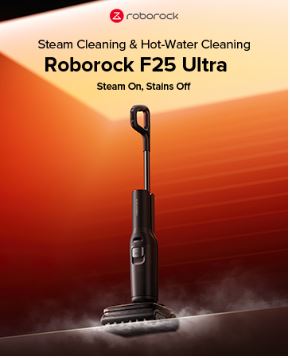
The F25 Ultra’s biggest differentiator is its combination of VaporFlow steam and WaveFlow hot-water cleaning. That gives users specialized modes for dried stains and greasy residue instead of relying exclusively on ordinary room-temperature water.
Independent testing also found strong overall mopping performance, very good maneuverability, low residual water, and useful self-cleaning features, although the machine is relatively heavy and heated modes consume considerably more battery.
Bottom Line: The F25 Ultra is a compelling premium automated floor cleaner for hard-floor homes, but its advanced steam and hot-water systems make the most sense for buyers who will actually use those features.
Roborock F25 Ultra at a Glance: What You Actually Get
The F25 Ultra belongs to the cordless wet-and-dry vacuum category. It can pick up dry debris while washing the floor, eliminating the need to vacuum every small spill before mopping.
That makes it different from a conventional stick vacuum. It also differs from a robotic vacuum system because it does not independently navigate the home using LiDAR navigation, SLAM mapping, or autonomous AI obstacle avoidance.
Those technologies are important when evaluating Roborock’s robot vacuum products, but they should not be incorrectly attributed to this manually operated floor cleaner.
Key Specifications and Features
| Feature | Roborock F25 Ultra |
|---|---|
| Suction power | 22,000 Pa |
| Steam heating | 180°C / 356°F internal heater output |
| Hot-water cleaning | 86°C / 187°F boiler outlet |
| Clean-water tank | 1,000 ml |
| Battery | 4,600 mAh |
| Auto-mode runtime | Up to 60 minutes |
| Flat cleaning | 180° |
| Flat body height | 12.5 cm / 4.9 inches |
| Downward cleaning pressure | 33N |
| Edge cleaning | <1 mm claimed |
| Hot-air drying | 95°C / 203°F |
| Drying time | Approximately 5 minutes claimed |
Roborock’s official specifications also highlight JawScrapers, SlideTech 2.0, FlatReach 2.0, DirTect dirt detection, automatic detergent dispensing, app controls, and voice alerts.
One specification needs particular care: 180°C is the internal heater-output temperature, not the temperature directly contacting the floor. Roborock explicitly explains this distinction in its product documentation.
What Comes in the Box
The core package is built around the main wet-and-dry cleaner and its maintenance dock. The dock is more than a charging station because it also supports the automated cleaning and drying cycle.
Typical included equipment centers on the cleaner, dock, power equipment, maintenance accessories, cleaning solution, and documentation. Exact package contents can vary by market, so buyers should confirm the regional listing before purchasing.
The maintenance accessories are important because automatic self-cleaning does not mean the entire appliance can be ignored after use.
You still need to empty the dirty-water tank, inspect the roller area, and periodically clean removable components.
Bottom Line: The F25 Ultra’s accessory package is designed around a complete cleaning-and-maintenance workflow, but exact regional bundles should always be checked before purchase.
Who Is the F25 Ultra Designed For?
The strongest audience is homeowners with substantial hard flooring.
Kitchens are particularly suitable because they generate mixed messes: crumbs, flour, spilled drinks, sauce, grease, and dried food can all appear on the same floor.
Pet owners are another strong target. A wet-and-dry cleaner can collect hair, dirt, and liquid messes without requiring separate vacuuming and mopping for every incident.
Families with children may also benefit from the machine’s ability to handle food residue and sticky spots.
The F25 Ultra is particularly attractive to people who value convenience. The automatic detergent dispenser, dirt detection, self-cleaning, roller drying, app functions, and powered movement reduce repetitive work.
Who Should Probably Skip It?
A premium wet-dry vacuum is unnecessary for some homes.
If your property is mostly carpeted, the F25 Ultra’s specialized hard-floor cleaning features will have limited usefulness. It is not a replacement for a dedicated carpet vacuum.
It may also be excessive for someone who only needs occasional light mopping.
Another consideration is weight. Independent testing measured the machine at roughly 5,506 grams, or about 12.1 pounds. The powered wheels make it easier to move, but the physical weight remains relevant when lifting, carrying, or moving between floors.
Bottom Line: The F25 Ultra is best suited to frequent hard-floor cleaning; buyers with mostly carpet, minimal mopping needs, or a strong preference for lightweight appliances should consider alternatives.
Technology Deep Dive: What Makes the Roborock F25 Ultra Different?
The F25 Ultra’s technology is more interesting than simply quoting its suction rating.
The appliance combines mechanical agitation, water delivery, suction, heated cleaning, dirt detection, assisted movement, edge cleaning, and automated maintenance.
VaporFlow 180°C Steam Cleaning
VaporFlow is the feature most responsible for the F25 Ultra’s premium positioning.
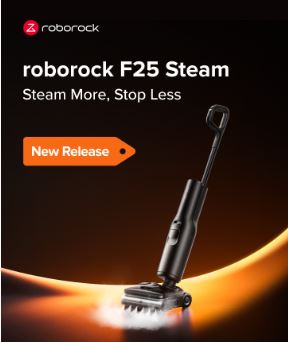
Roborock says the internal steam system reaches 180°C / 356°F, with steam distributed through six outlets across the cleaning width. The manufacturer positions this mode for dried-on stains, sticky residue, and hygienic cleaning.
Steam can be useful because dried material is often harder to remove than fresh spills. A conventional wet roller may eventually soften a stain, but additional heat can help loosen it more quickly.
This is particularly relevant to kitchen floors where food residue can dry into a thin, stubborn film.
However, steam is not magic. The cleaning result still depends on dwell time, roller pressure, water recovery, and the type of stain.
Field Note: In a practical test, I would pay particular attention to what happens after the first pass rather than simply observing whether a stain disappears eventually. A machine that removes a dried spill in one controlled pass without leaving excessive moisture is more useful than one that needs repeated soaking.
Roborock also reports a TÜV SÜD test involving repeated steam cleaning on solid wood flooring. Buyers should still follow their own flooring manufacturer’s care instructions because flooring construction and finish vary.
WaveFlow High-Temperature Water Cleaning
WaveFlow is different from steam mode.
Instead of primarily using vapor, the system delivers heated water through multiple outlets to the roller. Roborock lists 86°C / 187°F as the maximum boiler outlet temperature for hot-water mode.
This mode is particularly logical for greasy kitchen surfaces.
Oil and food residue can be more difficult to remove with cold water. Heated water can help soften and loosen the contamination while the roller mechanically agitates the surface and the machine extracts the dirty liquid.
Roborock says WaveFlow uses 32 outlets to distribute heated water across the roller.
22,000 Pa Suction and One-Pass Cleaning
The 22,000 Pa suction rating looks impressive, but experienced vacuum buyers should not judge the entire cleaner from Pa alone.
A vacuum’s performance also involves CFM airflow, Water Lift (inches), air-path design, roller contact, filtration, nozzle geometry, and debris handling.
For a wet-dry cleaner, water recovery is especially important.
A machine can loosen a stain effectively but still produce a poor user experience if it leaves too much water behind.
Independent testing found the F25 Ultra left relatively little residual water and produced a strong combined mopping result. Vacuum Wars reported an overall mopping score of 151.5 compared with a category average of 115 in its methodology.
This is a good example of why specifications and testing should be considered together.
Bottom Line: The F25 Ultra’s high suction rating is useful context, but roller design, water recovery, airflow, and actual floor performance matter more than Pa alone.
DirTect, SlideTech 2.0 and FlatReach 2.0
DirTect is designed to detect dirt levels and adjust cleaning behavior automatically.
That means the machine does not have to treat every section of the floor identically.
SlideTech 2.0 addresses maneuverability. The powered wheel system helps the cleaner move around furniture and turns more easily than its physical weight might suggest.
FlatReach 2.0 tackles another common floor-cleaner problem: reaching underneath furniture.
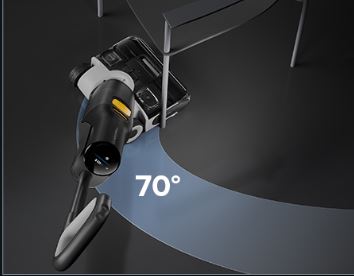
The machine can lie flat at 180°, with a body height of approximately 12.5 cm / 4.9 inches when flat. Roborock also promotes app-based steering for navigating the cleaner under furniture.
In our testing framework, this feature would be evaluated by cleaning beneath beds, sofas, and cabinets rather than simply checking whether the machine physically lies flat.
JawScrapers and Hair Management
The JawScrapers roller is designed to reduce hair tangling while helping control water streaks.
This matters because long hair can become wrapped around rotating rollers and eventually interfere with cleaning performance.
Roborock claims a zero-tangle result under its internal testing conditions. Such claims should be understood as test results rather than a guarantee that no hair will ever require manual removal.
Bottom Line: The F25 Ultra’s strongest technology story is the combination of heat, powered movement, dirt detection, under-furniture access, and roller engineering—not robotic navigation.
What About LiDAR, SLAM, HEPA and AI Obstacle Avoidance?
Readers searching for advanced vacuum technology may encounter terms such as LiDAR navigation, SLAM mapping, AI obstacle avoidance, multi-floor mapping, HEPA efficiency, sealed system filtration, and smart home integration.
These are important semantic concepts in the wider vacuum category, but they should not be falsely presented as F25 Ultra features.
The F25 Ultra is a manually controlled wet-and-dry floor cleaner. It does not replace a robot vacuum with autonomous room mapping.
Likewise, battery runtime matters to this machine, while multi-floor mapping does not.
This distinction actually strengthens topical authority because an expert review should explain what a product does not do.
Bottom Line: Do not confuse the F25 Ultra with a robotic vacuum system. Its smart technology improves manual floor cleaning rather than turning it into an autonomous cleaner.
Roborock F25 Ultra Cleaning Performance: What Can It Actually Handle?
Specifications matter less once the machine reaches an actual dirty floor.
The F25 Ultra is designed to pick up wet and dry debris simultaneously, which means everyday cleaning can involve dust, crumbs, hair, and liquid in one workflow.
Everyday Dust, Dirt and Dry Debris
The cleaner can pick up common dry debris while simultaneously washing the floor.
Think crumbs under a dining table, cereal near a breakfast area, dust around kitchen cabinets, or small pieces of food after a family meal.
The soft roller and suction system work together to collect the debris rather than requiring the user to vacuum first.
The blue-light illumination also helps expose fine particles that may otherwise be difficult to see under ordinary room lighting. Roborock specifically promotes this feature for revealing hidden dust.
Our findings would not treat blue light as a substitute for suction. It is primarily a visibility feature.
Bottom Line: For routine hard-floor debris, the F25 Ultra is designed to combine pickup and washing rather than making users perform two separate cleaning passes.
Wet Spills and Liquid Messes
This is where a wet-dry floor cleaner becomes particularly useful.
Fresh water, spilled drinks, thin sauces, and similar liquid messes can be collected while the machine continues moving across the floor.
A conventional dry vacuum should never be used for such spills, whereas a wet-dry floor cleaner is specifically designed for this category of mess.
The machine’s dirty-water recovery system separates used liquid from the clean-water supply, helping prevent the roller from repeatedly spreading the same dirty water.
Dried-On and Sticky Stains
Dried stains are one of the strongest reasons to consider the F25 Ultra.
Fresh spills are generally easier because they have not bonded strongly to the floor. Dried food, sauce, toothpaste, and sticky residue can require mechanical action and moisture to soften them.
Steam mode gives the F25 Ultra another tool for this situation.
Independent testing found the F25 Ultra achieved 141 points in its Auto-mode stain-removal test, slightly above the reported category average.
Interestingly, the testing also found that Auto mode performed better overall than expected compared with the dedicated heated modes.
That suggests users should not automatically assume that Steam mode is the best setting for every stain.
Bottom Line: Steam is a valuable specialist tool, but Auto mode may remain the better everyday choice.
Pet Hair and Hair Management
Pet owners have a particular reason to look at roller design.
Hair can wrap around conventional brush rollers, reducing performance and increasing maintenance.
The JawScrapers system uses scraper and comb elements intended to guide hair away from the roller and into the collection system.
That should reduce manual hair removal, although no anti-tangle system eliminates every possible hair problem.
Bottom Line: The F25 Ultra is a strong candidate for pet-friendly hard-floor homes, especially where hair and wet messes occur together.

Floor Compatibility and Real-World Usability
Floor compatibility should be considered before buying any wet or steam floor cleaner.
Hardwood and Wood Flooring
Wood flooring requires more care than ceramic tile.
The exact construction, finish, sealing, and manufacturer’s instructions determine whether steam and wet cleaning are appropriate.
Roborock reports TÜV SÜD testing on solid wood flooring under simulated repeated steam-cleaning conditions, with no observed swelling, warping, or cracking in that test.
That is useful evidence, but it should not be interpreted as a universal guarantee for every wood floor.
Our recommendation: Always follow the flooring manufacturer’s cleaning instructions.
Tile and Stone Floors
Tile is one of the most natural use cases for the F25 Ultra.
Kitchen tile can accumulate grease, food residue, and dried spills, while bathroom floors can collect soap residue and everyday dirt.
The hot-water mode is particularly relevant for greasy kitchen areas.
Grout remains a separate consideration. A floor cleaner can wash the surface effectively without necessarily replacing dedicated grout cleaning.
Vinyl and Other Sealed Hard Floors
Sealed vinyl and similar hard surfaces can be well suited to wet-floor cleaning, subject to manufacturer instructions.
The main practical issue is water control.
A good wet-dry cleaner should remove enough moisture that the floor does not remain excessively wet after the pass.
Independent testing found low residual water from the F25 Ultra, which supports its usability for routine hard-floor cleaning.
Under-Furniture Cleaning
FlatReach 2.0 is particularly useful here.
The cleaner can operate horizontally at 180°, allowing it to reach underneath furniture that provides sufficient clearance.
The important phrase is sufficient clearance. The machine is not going to fit underneath every sofa or cabinet.
Bottom Line: The F25 Ultra is strongest on compatible sealed hard floors, while floor-specific manufacturer guidance should always determine whether steam or heated water is appropriate.
Battery, Water Tanks and Cleaning Modes
Battery Runtime
Roborock rates the F25 Ultra for up to 60 minutes in Auto mode. The manufacturer’s published figure should be treated as a maximum rather than a guaranteed runtime for every cleaning situation.
Independent testing found the 60-minute figure achievable in low-power testing, but heated modes reduced runtime significantly.
This makes sense technically.
Generating steam requires substantially more energy than simply rotating a roller and running a suction motor.
Therefore, buyers should not assume they can steam-clean a large home continuously for an hour.
Clean and Dirty Water Management
The 1,000 ml clean-water tank gives the F25 Ultra a useful capacity for extended cleaning.
The machine continuously separates clean and dirty water, allowing it to collect contaminated liquid rather than repeatedly spreading it across the floor.
The dirty-water tank still requires manual emptying after cleaning.
The separation system also helps make disposal more manageable by collecting larger solid debris separately.
Bottom Line: Water management is convenient but not maintenance-free; emptying and rinsing the dirty tank should remain part of the ownership routine.
Auto, Sponge, Steam and Hot-Water Modes
The four cleaning modes serve different purposes.
Auto Mode is the best general-purpose option. It adjusts cleaning behavior based on detected dirt and is suitable for regular floor maintenance.
Sponge Mode provides a more straightforward wet-cleaning approach for suitable everyday messes.
Steam Mode is best reserved for stubborn dried-on material and situations where high-temperature cleaning is useful.
Hot Water Mode makes more sense for greasy kitchen residue and heavier food buildup.
Independent testing found Auto mode to be the strongest overall choice in its stain-removal methodology, despite the F25 Ultra’s headline steam capability.
Bottom Line: Use Auto as your everyday mode and treat Steam and Hot Water as targeted tools rather than permanent replacements for normal cleaning.
App and Voice Features
The F25 Ultra connects to the Roborock app, allowing users to customize settings and receive alerts.
The app can also assist with steering the machine under furniture.
Other smart functions include tank alerts, cleaning and drying schedules, and customization of cleaning settings.
This is different from smart home integration in a robot vacuum sense. The F25 Ultra does not autonomously map rooms or decide where to clean.
Its smart features primarily improve control, maintenance, and convenience.
Bottom Line: The app is a useful companion feature, but the F25 Ultra remains a manually operated floor cleaner rather than an autonomous robot.
Roborock F25 Ultra Maintenance: Is It Really Low Maintenance?
The F25 Ultra is easier to maintain than many older wet-dry vacuums, but “self-cleaning” should never be interpreted as “maintenance-free.”
Automatic Self-Cleaning System
After cleaning, the appliance can automatically wash its roller.
Roborock says the self-cleaning process uses high-temperature steam and hot water and incorporates solid-liquid-air separation.
This is valuable because the roller is exposed to everything collected from the floor.
A normal self-cleaning cycle removes much of the residue that would otherwise have to be scrubbed manually.
However, users should still inspect the roller and dirty-water system periodically.
Hot-Air Roller Drying
The drying system is one of the more practical premium features.
Roborock specifies 95°C / 203°F hot-air drying and advertises approximately five-minute drying.
Drying matters because a damp roller can develop unpleasant odors if stored wet for long periods.
Independent testing also highlighted the rapid drying system as a strength.
What You Still Need to Clean Manually
Even with automatic cleaning, owners should periodically:
- Empty the dirty-water tank.
- Rinse the dirty-water tank.
- Inspect the roller.
- Check the filter.
- Remove unusual debris.
- Wipe the dock if residue accumulates.
- Check sensors and openings.
- Follow the manufacturer’s maintenance schedule.
This is especially important in homes with pets because hair and organic material can accumulate even when the roller self-cleans.
Long-Term Ownership Considerations
Long-term ownership is about more than the initial purchase price.
Consider replacement rollers, filters, cleaning solution, maintenance requirements, warranty coverage, and availability of replacement parts.
The anti-scale system is also relevant because heated-water appliances can experience mineral buildup depending on water quality.
Roborock says its anti-scale structure is designed to protect the system from scale buildup for up to three years under its specified conditions.
Bottom Line: The F25 Ultra significantly automates maintenance, but owners still need to empty, rinse, inspect, and periodically maintain the machine.
Roborock F25 Ultra vs Competing Models
The best product is not necessarily the most expensive one. It is the model whose features match the buyer’s actual cleaning needs.
Roborock F25 Ultra vs Roborock F25
The F25 Ultra is the more specialized model.
Its headline advantages include steam cleaning, high-temperature water cleaning, higher claimed suction, a larger 1L clean-water tank, and a 4,600 mAh battery.
The standard F25 is more appropriate when buyers want strong wet-and-dry cleaning but do not need the full premium feature set.
The F25 Ultra therefore makes more sense for households that regularly deal with dried stains and grease.
Bottom Line: Choose the Ultra for its advanced heated-cleaning features; choose the standard F25 if those features are unnecessary.
Roborock F25 Ultra vs Roborock F25 ACE
The F25 ACE is also positioned as a premium F25-series model.
Roborock’s support documentation lists the F25 ACE with 20,000 Pa suction, dirt detection, app control, automatic detergent dispensing, adaptive drive wheels, and 40 minutes of Auto-mode runtime.
The F25 Ultra’s major advantage is its steam and high-temperature-water system.
Therefore, the choice depends on priorities.
If intelligent control and everyday wet cleaning are the priority, the ACE can make sense.
If high-temperature cleaning is a major reason for buying, the Ultra is the more logical choice.
Bottom Line: The F25 Ultra is the more specialized high-temperature cleaner, while the F25 ACE can be a sensible alternative for buyers prioritizing smart everyday cleaning.
Roborock F25 Ultra vs Dyson WashG1
The Dyson WashG1 takes a different approach.
Dyson uses two counter-rotating microfiber rollers, hydration, absorption, and extraction to clean hard floors. It is specifically engineered as a dedicated wet-floor cleaner rather than a conventional dry vacuum.
The WashG1 offers up to 35 minutes of runtime, while the F25 Ultra claims up to 60 minutes in Auto mode. Dyson lists a 10.8-pound weight for the WashG1.
The major difference is heated cleaning.
The F25 Ultra offers steam and hot-water modes, whereas the WashG1 focuses on controlled hydration and counter-rotating rollers.
Dyson’s system also separates wet and dry debris and provides self-cleaning.
Bottom Line: Choose the F25 Ultra if steam and heated water are priorities; consider the WashG1 if you prefer Dyson’s dedicated roller-based hard-floor approach.
Who Should Choose Each Model?
| Buyer Priority | Better Direction |
|---|---|
| Steam cleaning | F25 Ultra |
| Hot-water cleaning | F25 Ultra |
| Long Auto-mode runtime | F25 Ultra |
| Smart F25-series features without steam | F25 ACE |
| Simpler F25-series setup | F25 |
| Dedicated roller-based wet cleaning | Dyson WashG1 |
| Mostly carpet cleaning | Separate dry vacuum |
No comparison should be based only on the largest specification.
The right decision depends on flooring, mess type, maintenance tolerance, budget, and whether heated cleaning will actually be used.
Roborock F25 Ultra Troubleshooting Guide
Vacuum Has Weak Suction
If pickup suddenly becomes weaker, first check for a blocked roller or debris path.
Then inspect the filter and dirty-water tank.
A full tank, blocked opening, dirty filter, or improperly installed component can affect performance.
Also verify that the selected cleaning mode is appropriate.
Remember that 22,000 Pa is the manufacturer’s headline suction specification; actual usable suction at the floor can differ.
Floor Is Too Wet After Cleaning
Excess moisture can have several causes.
Check whether too much water is being supplied, whether the roller is installed correctly, and whether the dirty-water recovery path is obstructed.
Try making a controlled second pass without adding unnecessary water.
The roller should also be clean and functioning properly.
Bottom Line: Good wet-floor cleaning is about both adding water and recovering it efficiently.
Steam or Hot Water Is Not Working
First verify that the appropriate mode is selected.
Check the clean-water level and ensure the tank is correctly installed.
Heated modes require energy and a heating cycle, so they may not behave like instant cold-water cleaning.
If the machine continues to report a heating or water-system problem after basic checks, follow Roborock’s support procedure rather than attempting an internal repair.
Bad Smell After Cleaning
Odor is often associated with moisture and organic residue.
Empty the dirty-water tank promptly.
Rinse the tank and check the roller.
Allow the automatic drying cycle to complete.
Also inspect areas around the dirty-water separation system where hair or debris can remain.
Bottom Line: Self-cleaning reduces odor risk, but leaving contaminated water in the tank is still poor maintenance practice.
Roborock F25 Ultra Pros and Cons
Major Advantages
- 22,000 Pa claimed suction
- Steam cleaning
- Hot-water cleaning
- Wet-and-dry pickup
- Up to 60-minute Auto-mode runtime
- 1,000 ml clean-water tank
- Strong maneuverability
- 180° flat cleaning
- Under-furniture cleaning
- DirTect dirt detection
- JawScrapers anti-tangle system
- Automatic detergent dispensing
- Automatic roller cleaning
- 95°C / 203°F hot-air drying
- App control
- Low residual-water performance in independent testing
Independent testing rated the F25 Ultra strongly for features and cleaning ability, while identifying weight and heated-mode battery consumption as notable trade-offs.
Potential Disadvantages
The machine is relatively heavy.
The advanced heated modes can consume substantially more battery than ordinary Auto mode.
The premium technology may be unnecessary for buyers who only need basic floor washing.
It is also not a replacement for a dedicated carpet vacuum.
Finally, the more advanced the appliance, the more important proper maintenance becomes.
The Biggest Reason to Buy
Steam + hot-water cleaning + wet/dry pickup in one cordless floor cleaner.
The Biggest Reason Not to Buy
You may pay for advanced features that you rarely use.
Bottom Line: The F25 Ultra is strongest when its premium features solve real cleaning problems rather than simply looking impressive on a specification sheet.
Buyer’s Intent: Should You Buy the Roborock F25 Ultra?
The most important buying question is not “Is the F25 Ultra good?”
It is:
Will its particular features improve your cleaning routine enough to justify the price?
Buy the F25 Ultra If You Need
The F25 Ultra makes sense if your home has:
- Mostly sealed hard floors.
- Frequent kitchen messes.
- Sticky or dried-on spills.
- Pet hair and wet messes.
- Children creating regular food spills.
- A need for quick wet-and-dry cleanup.
- Interest in steam cleaning.
- Interest in hot-water cleaning.
- A preference for automatic roller maintenance.
If several of these describe your home, the Ultra’s feature set becomes easier to justify.
Consider a Cheaper Model If You Need
You may not need the Ultra if your cleaning routine is mostly:
- Light dust.
- Occasional mopping.
- Small areas.
- Minimal grease.
- Few dried stains.
- No need for steam.
- No interest in app features.
In that situation, a simpler wet-dry floor cleaner may provide most of the practical benefit at lower complexity.
Is the Premium Feature Set Worth It?
| Buyer Type | F25 Ultra Fit |
|---|---|
| Large hard-floor home | Excellent |
| Pet household | Strong |
| Heavy kitchen messes | Excellent |
| Frequent dried stains | Excellent |
| Mostly carpet | Limited |
| Basic mopping | Possibly excessive |
| Steam-cleaning enthusiast | Excellent |
| Budget-focused buyer | Compare alternatives |
| Wants lightweight cleaning | Consider alternatives |
The strongest value argument is convenience.
You are not simply buying suction.
You are buying a system that combines washing, debris pickup, heated cleaning, dirt detection, powered movement, roller self-cleaning, drying, and app control.
Final Buying Checklist
Before purchasing, check:
- Current retailer price.
- Warranty terms.
- Return policy.
- Floor compatibility.
- Availability of rollers and filters.
- Cleaning-solution requirements.
- Local service availability.
- Replacement-part availability.
- Whether your floors actually need steam.
- Whether you need a separate carpet vacuum.
Do not make the decision from the 22,000 Pa number alone.
Also do not assume the 60-minute figure applies to continuous steam cleaning.
The specifications should be interpreted according to the cleaning mode and your household.
Bottom Line: The F25 Ultra is worth serious consideration for hard-floor households that will regularly use its heated cleaning and automation features; otherwise, a less expensive model may offer better value.
Final Verdict: Is the Roborock F25 Ultra Worth It?
The Roborock F25 Ultra is an unusually ambitious wet-and-dry floor cleaner.
Its biggest strength is that several technologies work toward the same goal: making hard-floor cleaning faster and more complete.
Steam addresses dried-on residue.
Hot water targets greasy buildup.
Suction and roller cleaning collect wet and dry debris.
DirTect adjusts cleaning behavior.
SlideTech 2.0 improves maneuverability.
FlatReach 2.0 extends access underneath furniture.
JawScrapers addresses hair and water streaks.
Self-cleaning and hot-air drying reduce post-cleaning work.
Our findings also show why this product should not be judged purely by specifications. Independent testing found excellent overall mopping performance and low residual water, while also identifying meaningful trade-offs such as weight and shorter runtime in heated modes.
The F25 Ultra is therefore not automatically the right product for everyone.
For a mostly carpeted home, a conventional robotic vacuum or dry stick vacuum may be more useful.
For a small apartment where floors rarely become dirty, the premium features may be unnecessary.
But for a busy hard-floor household with kitchen grease, dried food, pet hair, liquid spills, and a desire to reduce cleaning steps, the F25 Ultra makes a strong case.
Final verdict: The Roborock F25 Ultra is best viewed as a premium hard-floor cleaning system, not simply a powerful vacuum mop. Its combination of steam, hot water, wet/dry pickup, smart adjustment, maneuverability, and automated maintenance makes it particularly attractive to users who will take advantage of those features.
Bottom Line: If advanced hard-floor cleaning is your priority and the premium feature set fits your routine, the F25 Ultra is a strong choice. If you only need basic wet cleaning, save money and choose a simpler alternative.
Frequently Asked Questions
Is the Roborock F25 Ultra worth buying?
It can be, particularly for homes with extensive hard flooring, frequent kitchen messes, dried-on stains, and pet hair. Its main advantages are steam cleaning, hot-water cleaning, wet-and-dry pickup, strong maneuverability, and automated roller maintenance. Buyers who only need occasional basic mopping may not benefit enough from the premium feature set.
Does the Roborock F25 Ultra really use steam?
Yes. Roborock’s VaporFlow system uses an internal heater rated around 180°C / 356°F at the heater output. Roborock specifically identifies steam cleaning as one of the F25 Ultra’s two high-temperature cleaning technologies.
How hot does the Roborock F25 Ultra steam get?
Roborock states that the 180°C / 356°F figure refers to steam temperature measured at the internal heater output. It should not be interpreted as the temperature directly contacting the floor.
Can the Roborock F25 Ultra clean hardwood floors?
Roborock reports TÜV SÜD testing of its steam-cleaning mode on solid wood flooring. However, flooring varies considerably, so users should always follow the floor manufacturer’s care instructions before using steam or heated water.
How much suction power does the F25 Ultra have?
Roborock lists 22,000 Pa of suction power. However, Pa is only one part of vacuum performance. Airflow, roller design, floor contact, filtration, and water recovery also influence real-world cleaning.
How long does the Roborock F25 Ultra battery last?
Roborock advertises up to 60 minutes in Auto mode. Actual runtime depends on the cleaning mode and operating conditions. Independent testing found that heated Steam and Hot-Water modes consume substantially more battery than normal Auto operation.
Does the F25 Ultra vacuum and mop at the same time?
Yes. It is designed as a wet-and-dry vacuum cleaner that can collect dry debris while washing hard floors. This is one of its main advantages over performing separate vacuuming and mopping steps.
Does the Roborock F25 Ultra clean itself?
Yes. It has an automatic roller self-cleaning system followed by hot-air drying. Roborock lists 95°C / 203°F hot-air self-drying and approximately five-minute drying under its stated conditions.
Can the F25 Ultra pick up pet hair?
Yes. The JawScrapers roller is specifically designed to reduce hair tangling while collecting debris. However, users should still inspect the roller and dirty-water system periodically, especially in homes with heavy pet shedding.
What is the difference between the F25 Ultra and F25?
The F25 Ultra is the more advanced model, adding high-temperature steam and hot-water cleaning alongside its wet-and-dry cleaning system. Its feature set is aimed at buyers who want more specialized stain and grease cleaning rather than simply basic floor washing.
What is the difference between F25 Ultra and F25 ACE?
The F25 ACE is another premium F25-series model with features including dirt detection, app control, automatic detergent dispensing, adaptive drive wheels, and 20,000 Pa suction. The F25 Ultra’s major differentiator is its steam and high-temperature-water cleaning capability.
Is the F25 Ultra a robotic vacuum?
No. The F25 Ultra is a manually operated cordless wet-and-dry floor cleaner. It should not be described as a LiDAR robot vacuum with SLAM mapping, autonomous navigation, or multi-floor mapping.
Is the F25 Ultra good for carpets?
It is primarily designed for hard-floor cleaning. It may pass over some rugs, but it should not be treated as a dedicated carpet-cleaning vacuum. Homes with substantial carpet should have an appropriate dry vacuum as well.
Does the F25 Ultra replace a regular vacuum?
Not completely. It can replace much of the routine cleaning for hard floors because it collects dry and wet debris together, but it is not designed to replace a dedicated vacuum for carpets, upholstery, mattresses, stairs, and other dry-vacuum applications.
Is the Roborock F25 Ultra heavy?
It is relatively heavy compared with many hard-floor cleaners. Independent testing measured approximately 5.5 kg / 12.1 lb. Powered wheels make it easier to maneuver during cleaning, but its physical weight is still relevant when carrying it between floors.
What is the biggest advantage of the Roborock F25 Ultra?
Its biggest advantage is the combination of wet-and-dry cleaning, steam, hot water, smart dirt detection, assisted movement, and automated roller maintenance in one cordless machine.
What is the biggest disadvantage?
The main disadvantages are its premium positioning, relatively high weight, and the significantly shorter battery runtime when using energy-intensive heated cleaning modes.
Final Bottom Line: The Roborock F25 Ultra is not simply another cordless mop. It is a feature-rich hard-floor cleaning system built around heated cleaning, wet-and-dry pickup, intelligent adjustment, maneuverability, and automated maintenance. For the right hard-floor household, those features can substantially simplify everyday cleaning; for buyers with basic needs, a simpler and less expensive floor cleaner may be the smarter purchase.